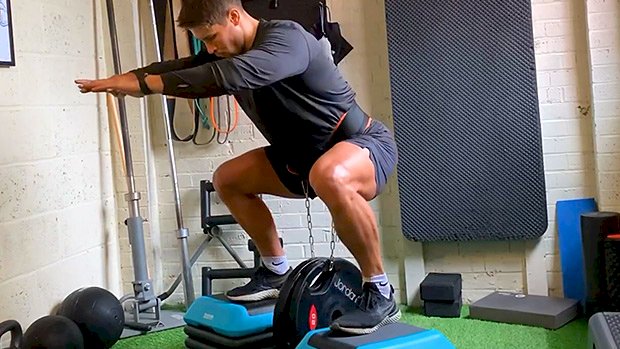
 Training legs with heavy barbells and plate-loaded machines can take a toll. Those who suffer with back pain can struggle with repeated compression and shear forces through the spine. And those who lack upper-body mobility can struggle with a bar on their back. That’s usually where hip belt squats come in, but they feel awkward for a lot of lifters. Don’t worry though, the right variation can help you build bigger and stronger legs while unloading your spine. I’ve worked with pro rugby teams that have solely used hip belt squats as their main lower-body lift. The purpose was to manage unnecessary back stress outside their daily spine-crunching tackles. The traditional way to perform hip belt squats is with a purpose-built machine or a low cable. No access to that equipment? No problem. Here are six unconventional ways to hip belt squat: 1. The Olympic Plate Variation Let’s start with some more obvious alternatives. You’ll need a couple benches or boxes and a standard dip belt. The key is to have the box as low as possible so it’s not too awkward to get on. It’s also useful to have the belt chain as long as you can get it. This will keep the weight as far from your fun parts as possible, while allowing the weight to stay close to the floor as you hit full depth. That way if you bail out in the bottom of your squat, it’ll please the gym safety police. Because of how the plates are hanging, you can afford to use a narrower stance. However, these are arguably the hardest to get in and out of because the plates can’t rest on the floor like the other options. 2. The Kettlebell Variation Kettlebells are easy to sit upright on the floor, so just link your chain through and get going. The downside will be the amount of kettlebell weight available to you. For beginners though, kettlebells are a great place to starting. There’s also a nice feel to them. They allow good depth, making them a valuable booty-building exercise. 3. The T-Bell Variation A loadable kettlebell, also known as a T-bell, can be a good solution if you need to stack the weight up. It will often allow you to use 225 pounds or more. A higher step will be needed to compensate for the height of the handle, and you’ll also want to use a longer chain so the plates don’t hit your inner thighs. However, if you like belt squatting with more of a sumo stance and need to go heavy, these are a great option. This variation and the previous ones all cause a little swinging to occur. For some, it can be hard to manage. On the upside though, the potential swing forces you to control the eccentric or negative even more. The following variations are a little more stable (less swinging) since there’s some form of attachment to the floor. 4. The Banded Variation These are possibly the easiest to get in and out of, and for a higher-rep quad burner they’re hard to beat. In the video I start with the standard band version. Once fatigue sets in I grab a dowel and keep going. It becomes a drop-set since the dowel gives me a little help on the way up, allowing me to do some extra reps. A banded hip belt squat can also be useful as a power complex. You’d do some heavy-ish squats (say, 85% of your 1RM for 3-5 reps), wait a few minutes, then do 5-7 banded belt squats as fast as you can. You should feel a slight potentiation effect from the heavy pre-load. The band will also teach you to speed through it, while accelerating you on the way down. This has a powerful effect on the neuromuscular system that most sports strength coaches will appreciate. The advantage with bands is that you don’t need much of a setup. You can use either a dipping belt or loop through a lifting belt. This is something Westside Barbell has done for years, so I can’t claim to have come up with the banded method. Albeit the drop-set is an extra nasty take on it. 5. The Landmine Back-Facing (Without Deficit) Variation If you have a landmine-style attachment, this should be on the top of your list of must-try exercises. Now, here’s the deal: It’s not actually essential that you stand on some boxes. Boxes simply raise you up and allow you to hit depth. If having a shorter chain is comfortable enough, then give it a try. You can also use smaller Olympic plates and stack more of them on the bar. That way you’ll be closer to the floor, and might find you won’t need the elevation. Using a landmine in the back-facing position will cause you to feel it more in your quads in the bottom position. Because of the leverage factors, the landmine is loading you more at the bottom, while also driving your knees forward away from the device. If you have cranky knees, you might want to skip this. If you don’t, this one will blast your quads into oblivion. 6. The Landmine Back-Facing (With Deficit) Variation If you need to use larger plates, or feel you’ll benefit from the extra range of motion, then use a deficit. The feel of this is exactly the same as the previous version, in that the
Origin: 7 Variations of the Hip Belt Squat
7 Variations of the Hip Belt Squat

Published
 All about sport xlsport.club