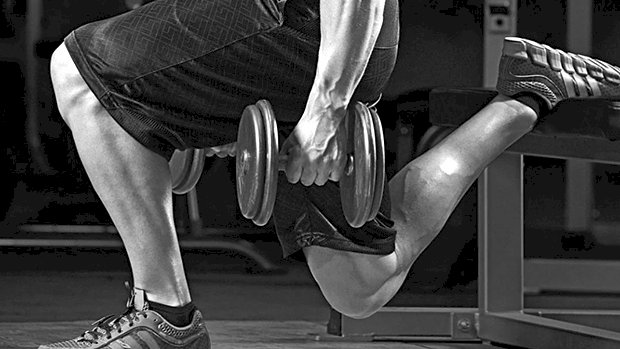
 The Cause for the Pause Why train one leg at a time? Because a lack of single leg stability, strength, and power is linked to lower back pain and knee injuries. Plus, single-leg training is a powerful orthopedic health indicator. But it’s not always easy to get unilateral lifts right. That’s where pauses come in. They force you to perfect your technique. Better technique, better training results. Explosive Paused Dumbbell Bulgarian Split Squat The traditional Bulgarian split squat can help you identify functional weak links in single leg stance. Improving it takes motor control to create internal stability in the bottom position, which tends to be the most unstable. And the best way to improve your stability there is by adding an isometric pause at the bottom of each rep, then exploding out of the hole from that dead-stop position. You’re going to have to use less weight, but don’t worry. By increasing total time under tension to around 25-40 seconds per set, you can train yourself to repeatedly produce power in a more metabolically stressful environment while keeping movement patterns and muscular targeting on point. Do 6-10 reps per leg for 2-5 sets. If you can’t move explosively under control, then lighten the load until you can. Gradually add weight over time if you’re planning to go heavy. Paused Non-Alternating Dumbbell Walking Lunge Lunges are often left out of strength and hypertrophy programs because they’ve gotten a reputation for being lower back and knee killers. The non-alternating walking lunge with pauses at the bottom usually results in more pain-free training, less pissed off joints, and more size gains. While the forward lunge theoretically places more of an emphasis on the quads (due to the more vertical torso angle), this isn’t necessarily a good thing when it comes to longevity. More quad emphasis usually leads to more external loading and more front-sided knee pain, especially with harsh changes of directions in and out of the bottom position. Why? Because it leads to momentum and compensation. You can limit this by using a non-alternating step pattern. It places constant muscular tension on the lead leg. The goal here is to train unilaterally and get a metabolic stress-based pump in the lower body while sparing the knees. So another method we can use is adding short pauses at the bottom of each rep. Don’t rest your back knee on the floor, but rather hover over the floor with full tension for a half second before driving up with the front leg, lead by the glutes and hamstrings. While this movement can absolutely be loaded heavy, be careful not to lose the feel of it as the dumbbells get heavy. Stay strict on your tempo and technique for sets of 8-12 reps with pauses, and don’t forget to train both sides equally. Lead with your weaker leg first, then finish off each set with your more dominant side. Dynamic 90-90 Paused Reverse Lunge I hear it all the time from new athletes: “Single leg work hurts my lower back.” Most lower back pain can be attributed to two factors: a lack of stability through the lumbo-pelvic complex and/or a lack of hip mobility. So why not bring up both of these common deficits with this one movement? It’s important if you have motor control or balance issues. Test your hip and core stability with only one foot on the ground, and the raised knee and hip bent to 90-degrees. If you can’t hold this position for 30 seconds without losing balance and having to touch down, start doing single leg movements like this one. It’ll help you get strong and coordinated in single leg stance, and train you to stabilize and brace properly through the lower body and core. This will greatly transfer to your big lifts and keep you healthy in the long run. Start this movement by getting into that 90-90 position with one leg. You’ll notice that the heavier you load this exercise with dumbbells, the more challenging it’ll be to maintain stability. Pause for a full second at the top to tap into that lateral hip stability and glute activation, then drive that leg back behind into a reverse lunge. The back knee should graze the ground while your torso angle is positioned slightly forward to bias the posterior chain stability. From this bottom position, explosively drive back up into the original starting 90-90 position, leading with your hip flexors on the dynamic leg. Do this exercise in non-alternating fashion between 6-8 reps per side. Remember, the goal is to tap into your CNS and gain stability in the single leg stance, so keep your rhythm and tempo of the movement on point. This exercise can make your heart rate sky-rocket. It’ll smoke you without a ton of weight. Single-Arm Single-Leg Romanian Deadlift with Iso-Hold Do you suck at single leg RDLs? Does your lower back hurt? The two are related. And fixing this highly complex problem is quite simple: nut up and do the single leg RDL. My preferred setup for introducing and improving the single leg RDL
Origin: The 4 Mandatory One-Legged Exercises
The 4 Mandatory One-Legged Exercises

Published
 All about sport xlsport.club