
 You can read all the most cutting-edge research you want to convince yourself that you’re on top of it, but if you’re not 21 anymore or genetically gifted, you’ve got to get real. You’ve got to apply common sense. You’ve got ask yourself some serious questions and accept what might be some inconvenient truths. The answers will do more to determine your ultimate progress than any training program or diet you undertake. Ready? 1 – What’s Your Real Age? I’m 32 years old now, and I started working out properly for size and strength around age 20. The methods my trainer and I used worked well, but I’d be lying to myself if I thought I could handle them now for more than a week. The simple truth is that I just don’t have the same work capacity that I used to, and that seems to be a common theme with people who train through their adulthood. To be clear, not having the same work capacity doesn’t necessarily scream “worse.” It just screams “different.” It means that if you’re not a young stunner anymore, you’d be wise to modify your training program so you can still get away with working hard on a consistent basis – even if that means scheduling shorter workouts, a couple of deload weeks, 15 more seconds of rest between sets, or a little bit lower volume with the heavy stuff. The lesson learned is simple: Respect your calendar age by tailoring your workouts to match the training effect you’re after – not a certain performance number or standard. 2 – What’s Your Injury History? Regardless of whether it’s something like chronic shoulder pain or something serious like a surgically repaired back or knee, these things should be factored in when you’re considering the demands of your program. One-size-fits-all programs don’t “know” what you’ve been through, and clustering up to 90% of your max weight multiple times per week may not be the smartest idea you’ve ever had. Still, there’s encouragement to be found. Never forget that the beauty of training for the long haul is that you have a much less urgent “deadline” to add muscle and strength. You can still do it, as long as you remain realistic and give your body the accommodations it needs. On top of this, you’ve now opened up the possibility of considering other ways to view “progression,” like increasing range of motion, optimizing tempo, and reducing rest intervals. 3 – What’s Your Training Age? Whether you’re 19 with a year of experience, 39 with a year of experience, or 79 with a year of experience, the amount of time you’ve spent as a lifter equates to the same number: 1. That’s a very important factor to consider when taking a rational approach toward seeing goals. A lifter who’s spent 15 years in the gym will react differently to a program for strength and size than a lifter who’s brand new to the game. An overly ambitious program might seem good on paper to the novice lifter, but might prove too advanced and have adverse effects. On the flipside, a simplistic program may have utility for an experienced lifter, but chances are that finally hitting that 400-pound deadlift or squat might require some advanced lifting methods. Respecting the amount of time you’ve spent under the iron is the first step to knowing just what to implement to bring your gains to the next level. And be honest – it’s easy to say you’re advanced. Simply put, if you’re not sure if you are, you probably aren’t. 4 – How “Bad” Are Your Leverages? It’s unrealistic to think that reaching a double-bodyweight squat or deadlift is attainable as a 37 year old who’s 6’6″ and 275. Standards like that are geared toward young, healthy, and most importantly, usually light individuals where relative strength plays a bigger role than absolute strength. The size of the individual is rarely taken into consideration when creating rules for strength training, and many programs make a similar misstep in ignoring a lifter’s individual anthropometry. Having longer femurs and a shorter torso will make a conventional deadlift more of a hassle for a tall lifter than the other way around. By extension, adding mass as a taller lifter may require slightly different approaches because of a defining factor that differentiates a longer-limbed lifter from a shorter one: work. Of course a good lifter will “work hard.” That’s not what I’m talking about. It’s about the actual physics of lifting. Work is calculated as Force x Distance. As such, if a tall lifter and a short lifter are doing squats with the same load to full depth, the taller one will end up doing more work because of how much farther he has to go up and down. That should put into question whether or not chasing a prescribed percentage of max effort lifts with limited rest intervals and plenty of volume will serve a tall lifter the same way it does a shorter lifter. Most often, longer-limbed lifters need to bridge the gap by adding more volume to choice isolation movements that still deliver a lot of bang for their buck, and a bit less volume to big,
Origin: Tip: 4 Questions You Need to Ask Yourself
Tag: Yourself!
Go Fund Yourself!
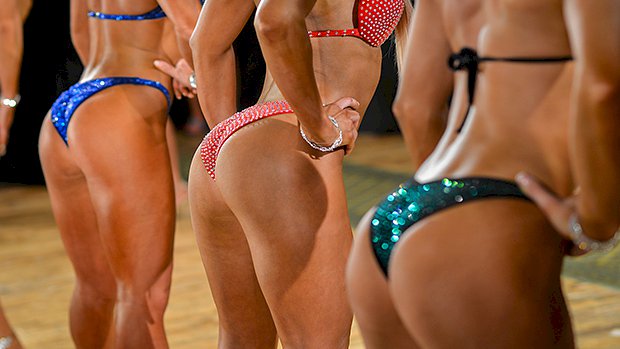 Begging Made Easy! I had never heard of requesting money from strangers for something as trivial as a bikini contest. Then someone told me about it. Had to be a joke, right? Nope, it wasn’t. On GoFundMe.com you’ll find numerous requests for donations to support bikini competitions. Google “GoFundMe bikini competition” and you’ll see how common it is. If you’re not familiar with GoFundMe, it’s a crowdfunding platform typically used to raise money for charities, disaster relief, and people with illnesses. Or at least it used to be. Then the wannabe bikini competitors moved in, sharing their sob stories and begging for your money. Because, you know, competing in a T I’m saying don’t perpetuate a problem. If you toss some broad 50 bucks with no return on your investment, you’re only furthering the freewheeling entitlement and false reality that this is a worthy pursuit. No one should finance that shit. If she needed the money, and actually wanted to earn it, she could be taking on second and third jobs like dog walking, babysitting, or cleaning houses for twenty bucks an hour. In fact, make that offer! Ask her to clean your house for fifty bucks. I’ll bet you fifty bucks that she’ll decline. That’d be beneath her. Digital Panhandling Unfortunately, on a more sophisticated level, panhandling can be a lucrative thing. I knew a guy back in the day who was bringing home $600 a week in cash panhandling in Venice. At the time, I was bringing home $500 working construction! With such a generous society, this odd phenomenon has metastasized to the shameful degree that you can now beg – successfully – for money online. I imagine this was just a natural progression in today’s maligned world of entitlement and bizarre expectations that technology would enable people to succumb to their lazy and entitled impulses, and provide them with a platform that amounts to digital panhandling. The most egregious of which is, in my opinion, GoFundMe. Unlike platforms such as GiveForward, which raises money for expenses related to illness or injuries, or Kickstarter and Indiegogo, which seek investment in business, charity, and artistic pursuits, GoFundMe caters to snowflakes looking to raise money for just about anything, including fake tits and sponsorship for a first bikini competition. When you do a Google search for “GoFundMe bikini competition” you’ll get over 900,000 results. And they’re fascinating to read. When you click on them they go something like this… “Hi everyone! Well, I decided that after training for the past 6 weeks it’s time to enter a NPC bikini competition. I was kinda shocked to see how much it would cost, especially those crystal-studded suits, hair extensions, and a boob job, lol! “So I’m reaching out to see if anyone would be willing to sponsor my fitness journey by contributing to this fund. $3,000 covers almost all of my costs including the entry fee, the suit and shoes, hair, makeup artist, trainer, diet coach, posing coach, chiropractor, life coach, all my food, supplements, and a few different colors of Six Pack coolers to match my gym outfits. “And now after WEEKS of grueling training, my fitness journey has brought me here. And I want to be able to bring my best package to the stage. I use my Instagram page to be an inspiration for others (meal plans available). And I will give you a shout-out there. You can’t help but see my love and dedication to building the best package on the planet. So thank you for taking the time to read my story and a bigger thank you for your donations!” Go Fund Your… Boobs? Now, not all bikini girls ask for money for boob jobs, but enough girls have used GoFundMe and similar donation sites for that purpose that you can link the two together. Really, it’s all the same entitled bullshit, no different than asking someone to buy them a car because they’re tired of walking the four blocks to the gym. Secondly, there isn’t a single philanthropically-minded dude out there who’s going to finance all that body work and stuff it into a thong without “visitation rights.” If such rights are indeed discussed and an agreement of sorts is made, you have ostensibly created a transaction known as “prostitution.” And if you don’t think that happens in our beloved little world, I have a nice bridge to sell you. No woman wants to be considered a whore. Be that as it may, if you take a guy’s money for all your contest needs, and in return offer him unfettered access to the most intimate corners of your nook and cranny, honey, you a ho. The last thing our industry needs is more hoes, but prostitution has many faces. I know for a fact that there are ladies in our industry who’ve sold some visitation rights, or traded for the odd “session” that has a happy ending for at least one of the parties involved. There used to be a crowdfunding site specifically for breast augmentations. It introduced guys willing to finance the augmentation to the panhandler and her chest. In what can
Origin: Go Fund Yourself!
 All about sport xlsport.club