
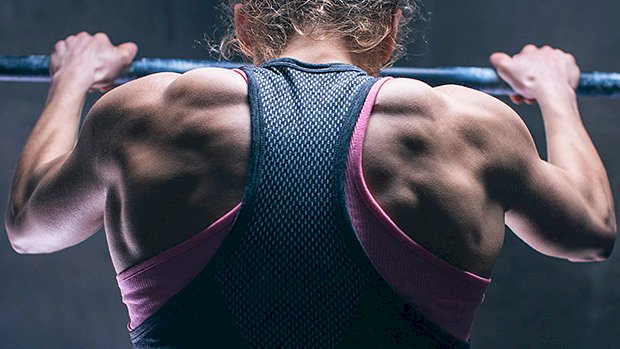
 The Key to a Chiseled Upper Back The lats get a lot of attention, but what’s often missing in back training is hitting the mid-back musculature like the rhomboids and mid/lower traps. Training these muscles will beef up your upper back, making you look impressive with or without a shirt. Having strong mid-back muscles is also crucial for maximizing performance since they’re often a limiting factor when it comes to overhead presses, rows, and vertical pulling. Here are two exercises that’ll fire up your mid back: Wide-Grip Double Pulley Row Set two cables up high and about a foot outside of shoulder width. Ideally, it would line up with how wide your elbows are when flared. Pull the cables from high to low as you bring your elbows down and back. Keep your elbows flared out to engage the mid back. Squeeze your shoulder blades together in the shortened position. Think about pulling the handles back and apart simultaneously. Dumbbell Rhomboid Hold To set up, hold two moderately heavy dumbbells at your side and hinge forward about 30 degrees. Keep your shoulder blades depressed and retract them together. Hold this position and squeeze for as long as you can. Really focus on the mind-muscle connection with this one. Programming Do these at the end of an upper-body day as a superset for 3-4 sets each. You’ll get both static and dynamic contractions to trigger hypertrophy and strength gains. Your rhomboids and traps will get thicker and fuller as a
Origin: Tip: Two Back Muscles You’re Missing
Tag: You’re
Tip: Drop The Bro Splits If You’re Over 40
 Grown Men Don’t Need Bro Splits You’re not 15 anymore. The traditional bro split where you train one body part each workout (usually 5 workouts a week) isn’t efficient or effective, especially for an adult with a job who actually communicates with real-live women in their non-pixilated form. Your muscles recover in about two days, so why let them go fallow for a whole week? Besides, what happens if life intervenes and you miss a day or two one week? That mucks up the whole schedule and you might not train the same body part for another 8 to 10 days instead of 7. A Split That Makes More Sense You’re much better off doing an upper body/lower body split where you work out 4 days (or even 6 days) a week: Monday:Lower Body Tuesday:Upper Body Wednesday:Off Thursday:Lower Body Friday:Upper Body Saturday:Off Sunday:Off As Charles Staley pointed out in his The Single Most Effective Workout Split, this upper/lower split does a couple of things: It makes the best use of time. Since muscles recover in about two days, muscles trained on Monday should be trained again on Wednesday. If you don’t, you’re losing ground. You get to train muscles more often with fewer workouts. With a bro split, you work out 5 times a week and each muscle gets hit once. With an upper/lower split, you work out 4 times a week and each muscle gets worked
Origin: Tip: Drop The Bro Splits If You’re Over 40
Tip: You’re Still an Ego Lifter
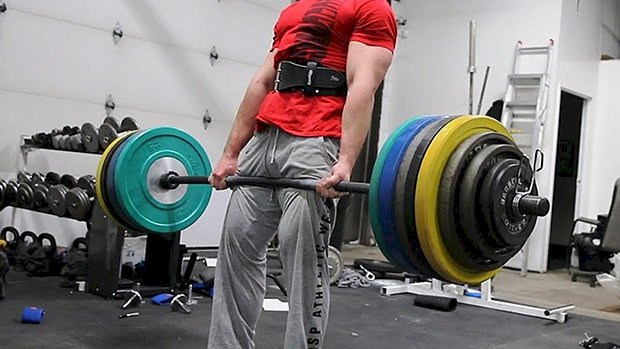 When you hear the term “ego lifting” you probably think of one-fourth squats, curls that use everything but biceps, and bench presses that double as the spotter’s deadlift workout. As a T Nation reader, you know better. However, you can easily fall prey to a more subtle version of ego lifting where you train at or too close to your 1RM. This is especially common with the bench press and deadlift. A lifter trains hard and can eventually hit a plate milestone. It might be a three-plate bench press or a four-plate deadlift with proper form. Now he’s hooked. Each time he trains that lift, he wants that feeling again (and wants everyone in the gym to see him). As a result, his training session consists of working back up to that 1, 2 or 3RM. A typical deadlift workout might look like this: Set 1:5 x 135 Set 2:3 x 225 Set 3:2 x 315 Set 4:1 x 365 Set 5:1-2 x 405 The problem with subtle ego lifting is that the intensity is too high. This can easily lead to burnout, plateaus, and injury. The other problem? The volume is too low to actually build muscle and achieve long-term strength gains. If you’re serious about results, swap subtle ego training for true strength building. True strength building is when you… Check your ego at the door Come to the gym to build strength, not to demonstrate it Lift heavy, but not maximal, weights Train hard, but leave a rep or two in the tank each set Use a moderate, repeatable amount of volume (3×5, 5×5, 4×6, 3×8, 5-8×3) Work on your weaknesses A true strength training deadlift workout might look like this: Warm-up sets Set 1:5 x 135 Set 2:3 x 225 Set 3:2 x 275 Set 4:1 x 315 Set 5:1 x 345 Work sets 2-3 sets of 5 reps with 365 This may not seem as cool at first, but this is a very easy way to add 5-10 pounds per week for quite a while. Before long you’ll be doing a perfect set of 5 with your old
Origin: Tip: You’re Still an Ego Lifter
Why You’re Wrong About Machine Training
 I Used to be Anti-Machine Like many people who came to lifting heavy objects via the sports of weightlifting and powerlifting, I viewed machines with contempt. I believed people who used them lacked the intestinal fortitude to learn how to use free weights (which are “obviously” superior). Thankfully, I’ve managed to evolve to a less ideological viewpoint, opting for one that’s more evidence-based instead. I ask myself a simple question: “What’s the best way to get big and strong?” Answering this question allows me to be much more open and objective to considering any and all rational methods that take me from point A to point B. I care about the result, not how you get the result. And that’s what allowed me to view machine training in an altogether different light. An Evidence-Based Discussion Current scientific thinking suggests that muscles get bigger and stronger when they’re exposed to unaccustomed levels of tension. The magnitude of that tension is most important for strength goals, and the volume of that tension – the number of times your muscles experience tension per unit of time – matters most for hypertrophy (size) development. Both machine and free weight exercises expose your muscles to tension, but with slightly different pros and cons. So abandon your ideological thinking and think of both options simply as tools that have varying degrees of utility, depending on context and circumstances. And remember, you’re not restricted to one or the other. Machines and Free Weights: The Key Differences By definition, a machine-based exercise is a movement where you’re required to exert force against a resistance without needing to do much in the way of controlling that force, at least compared to similar free-weight exercises. Let’s examine two very similar exercises – the Smith machine squat and the barbell squat. They both stimulate the same muscles, but in slightly different ways. Let’s examine the pros and cons… Advantages of the Smith Machine Squat More technique options. Because the bar slides up and down a fixed rail, you can do a number of things you can’t do with a barbell, like placing your feet in front of (instead of directly under) the bar. This strategy allows you to assume a more upright position than you could achieve with a barbell squat, which means greater quadriceps recruitment. You can use more weight because you don’t need to balance or stabilize. This results in more muscular tension, which in turn equates to more pronounced strength and hypertrophy adaptations. The Smith machine is much more forgiving of relatively minor errors such as positioning yourself slightly off-center under the bar. Disadvantages of the Smith Machine Squat It doesn’t require you to control bar path. While this is the most often-cited criticism of machine training, I’ve never once – in my many years of studying motor unit recruitment – come across the notion that control was a necessary or even a desirable precondition for strength or muscle development. Again, muscle fibers adapt and grow when they’re forced to generate high levels of tension. Not only do Smith and barbell squats both afford the ability to provide this tension, in many cases, the Smith squat is a better way to provide this tension. If you only squat on a Smith machine, you’ll never learn how to do a proper barbell squat. While undeniably true, I wonder how consequential this really is, assuming that you don’t plan to compete in powerlifting. It’s much like pointing out that if you only play the piano, you’ll never learn to properly play the organ. If the goal is organ mastery, this is a problem. But if the goal is to cultivate more generalized musical skills, it’s not. The strength acquired by using free weight exercises has greater positive transfer to many “real world” skills. While we’re now at least getting into a more plausible defense of free weights, the concept of transfer is often poorly understood and applied, largely because movement structure is only one component of transfer. Now, don’t get me wrong, movement structure certainly matters. For example, it’s intuitively obvious that the strength gained from squatting will positively transfer better to a vertical jump than the strength you’d acquire doing leg extensions, mostly because the structure of a squat is much more similar to a jump than the structure of a leg extension. However, if you’re comparing the positive transfer potentials of Smith and barbell squats, there’s really not a whole lot of difference between the two, unless you place your feet considerably in front of the bar when Smith squatting. But even here, the differences are relatively minor. But does needing to control your muscular efforts during a barbell squat transfer over? While there might be something to this, unless you find the vertical jump to be a complex maneuver (in terms of balance and/or overall body control), I’m far from convinced that barbell squatting would offer a
Origin: Why You’re Wrong About Machine Training
The Best Squat You’re Not Doing
 Here’s what you need to know… Landmine squats are the solution for lifters who can’t squat correctly because of joint pain or mobility problems. For novice lifters, landmine squats teach proper squat form. For veteran lifters, they’re gentler on joints so you can augment your heavy back squats with landmine squats without repercussion. The arc of the bar travels back as you squat down, so you have no choice but to sit back and stay upright. Doing so builds and strengthens the quads. The Problem With Squats Squats are hyped-up as the king of leg exercises, but that only applies to a very small percentage of lifters: ones who actually squat well and ones who aren’t injured. Most lifters actually suck at back squats, at least initially. Mobility restrictions or their own anthropometry makes it tough to squat with an upright torso. As a result, the movement ends up looking like an ugly good-morning-squat hybrid. Even those with good form find back squats to be problematic when they have lower back, knee, or shoulder issues. Front squats are an option, but many find it tough to hold the bar, and it takes a lot of practice to get the hang of it. Learning to squat correctly is worth the effort, but trying to add heavy loads to an exercise you can’t do well is asking for trouble. The Landmine Squat Solution Landmine squats teach the squat pattern, so they’re an excellent way to work towards being able to do back squats and front squats. They’re also a great alternative for those who can’t perform regular squats because of injury. Start with one end of the bar in a landmine unit, or if you don’t have a landmine, just put one end of the bar in a corner using a towel to pad the bar so you don’t scratch the wall. If your gym has 45-pound plates with holes in them, you can also put a plate flat against a wall and put one end of the bar in one of the holes. From there, hold the other end of the bar against your chest and squat down and try to touch your elbows to the tops of your thighs or just inside your knees, depending on the width of your stance. It’s important to set up with the bar against your chest instead of away from your body so that you maintain an upright torso and don’t have to rely solely on your arms to hold the weight. The Goblet Squat Comparison Compare the landmine squat to the goblet squat. They’re similar to goblet squats in that they’re anteriorly loaded, but they’re better for teaching a good squatting pattern because the bar moves in a slight arc. Take advantage of that arc to help reinforce the pattern of sitting back into the squat and maintaining an upright torso – two things people struggle with most when it comes to squatting well. Since the arc of the bar travels back as you come down, you have no choice but to sit back, and you’re also forced to stay upright lest the bar jam into your sternum. Notice that the landmine squat allows the lifter to stay much more upright with far less forward knee travel, making it more joint-friendly for the knees and lower back while still crushing the quads. The landmine squat also allows for far greater loading than goblet squats, meaning it’s not just a teaching tool but a viable way to build strength and muscle if you load it up. Landmine Box Squats Here’s what a landmine box squat looks like as demonstrated by UFC athlete Brendan Schaub. It can also be helpful to perform landmine squats to a box or low bench that serves as a depth gauge. A box or bench will also act as a reminder to sit back into the squat, which is especially useful for folks who tend to come too far forward rather than just sitting back and engaging the hips. Just make sure to set up close to the box so that your calves are just in front of it or even lightly touching it. When and How to Use Them Combined with a heavy dose of mobility work, they’re a perfect gateway to regular squats and front squats to groove the pattern. For lifters looking to increase the volume of their lower body training, try landmine squats as an adjunct to regular squats since they’re a lot easier on the joints. Most people can’t tolerate doing heavy squats more than 1-2 times a week, but you could augment traditional squats with 1-2 days of landmine squats to train the squat pattern and work the quads without beating up the lower back and knees. For lifters who can’t do traditional squats because of injuries, landmine squats are a good alternative. Before you scoff at the idea, try doing them heavy and see what I mean. Landmine squats are a great option for taller guys who struggle to stay upright and have trouble targeting the quads with traditional squats. Doing 10-20 after you’ve completed your heavier leg work will blast your quads into
Origin: The Best Squat You’re Not Doing
 All about sport xlsport.club