
 Combo Pyramids for Big Delts Heavy overhead pressing should be a part of your shoulder training, but for fully developed delts you’ll also need some higher volume, longer time under tension exercises. One way to do this is with combo exercises and pyramid training. Here are four shoulder exercises that use the pyramid loading scheme. Most of these are combo exercises, meaning two different exercises performed together. For most of these loading protocols, tap out at 6 reps because this already equates to 21 reps per exercise (or 42 if it’s a combo move) because of the pyramiding rep scheme. Kettlebell Swing to Press Grab a kettlebell that’s about 20 pounds lighter than what you’d use for a single-arm overhead press for 6 reps. Start with one kettlebell swing. Transition right into the rack position for a press. Do one press and go back to the kettlebell swing, but now for two reps. Complete two reps of the overhead press. Continue this pattern until you hit 6 reps of each. Snatch to Overhead Press Load up a barbell or a practice bar. Adjust your hands so that they’re outside shoulder width. The snatch is somewhat of a combination of a front raise and a snatch, essentially a front raise with some hip drive. For each snatch, do a wide-grip overhead press, ramping up to 6 reps. Overhead Press to Lateral Raise Pick two different weights. The overhead press weight will be heavier than the lateral raise weight by 10-15 pounds. In one hand, take the kettlebell or dumbbell into the rack position. The other hand is at your side with the lighter weight. Complete 1 rep of each, then ramp up by a rep until you get to 6. Sled Pyramid You’ll need a sled and some type of suspension training device for this. We’re going to be pairing an overhead press with a reverse flye. Ramp up by 1 rep for each round until you get to 6 reps. You’ll need a decent amount of space for this one, so use it when you
Origin: Tip: 4 Untraditional Delt Workouts
Tag: Workouts
Tip: A Great Reason to Do Whole-Body Workouts
 Most of the time, whole-body workouts are just something you do when your week is bollixed up with appointments and you can only get to the gym a couple of times. You’re having a root canal on Monday, the twins have oboe class on Wednesday, and your wife needs you to lay out some fresh mulch on Thursday. If you don’t curse your life and run away to Bora Bora first, you’re stuck doing whole-body workouts on the occasional obligation-free day or weekend. Otherwise, you’d sure as hell be hitting the gym four or five time a week and doing upper body and lower body splits. Wonder of wonders, though, a new study suggests that you build considerably more muscle when you do whole body workouts, and it’s largely because the change in the ratio of two directly-oppositional muscle-regulating proteins – myostatin and follistatin – is almost twice as large when you combine upper body and lower body training. What They Did The researchers recruited 40 middle-aged men and randomly assigned them to one of four groups: Upper-body resistance training Lower-body resistance training Combined resistance training (lower body and upper body) Control The three resistance-training groups did three exercise sessions a week for 8 weeks. Blood samples were taken before training began and 48 hours after the last session. What They Found Muscle mass increased significantly in all three resistance-training groups: The upper-body training group gained 0.76 kilograms, +/- .46 kilograms. The lower-body training group gained 0.90 kilograms, +/- .29 kilograms. The combined upper-body/lower-body training group gained 1.38 kilograms, +/- 0.70 kilograms. Clearly, the combined training led to more muscle, but what’s really interesting is how the different training regimens affected a couple of growth-regulating proteins that play a big role in determining how muscular someone (or something) is. You’ve probably heard of myostatin. It’s a growth factor that actually limits muscle growth in humans and other animals. You know those “double-muscled cattle” you sometimes see pictures of, the ones who look like something a CGI artist conjured up to pull Conan’s corpse wagon to the gates of hell? They have a mutation that limits the activity of myostatin, which allows them to grow enormous muscles. Most of us probably wish we had at least a mildly dysfunctional myostatin gene, but there’s another growth factor that works to inhibit levels of myostatin and it’s called follistatin. When levels of follistatin increase, levels of myostatin decrease, thereby allowing more muscle growth (assuming all other factors are optimal). As you probably guessed, resistance training increases levels of follistatin in general, but the researchers in the training study found that while lower-body training increased levels of follistatin (and decreased myostatin) more than upper-body training, whole-body training had almost twice as large an effect on the ratio of follistatin to myostatin. How to Use This Info It looks like the volume of muscle involved in a workout is a factor in determining how much follistatin you produce, which would logically mean that whole-body training increases its levels more than other types of body splits. Of course, like most studies, this one doesn’t perfectly mimic real life. After all, I’ve never met any lifters other than amputees who consistently worked just one half of their body. It could be that when, over the course of a training week or month, the total amount of follistatin produced (and, consequently, the amount of myostatin inhibited) by performing an upper body/lower body split could approximate or equal the amount you’d get from training total body. Regardless, at the very least, this study underscores the value of increased levels of follistatin. It’s possible that you can also increase levels of the protein through diet, too. Egg yolks contain follistatin, but it’s not known for certain if orally ingested follistatin actually leads to additional muscle. Another tactic involves ingesting high levels of epicatechins, a polyphenol found in cocoa powder, dark chocolate, blackberries, and pomegranates. Aside from enhancing mitochondrial biogenesis and improving the skeletal muscles’ response to exercise, increased levels of epicatechins lead to increased levels of follistatin. Like most things that smack of legitimacy, it’s worth a try to up your epicatechin intake while experimenting with a couple of months of whole-body
Origin: Tip: A Great Reason to Do Whole-Body Workouts
6 Push-Up Workouts for Hypertrophy
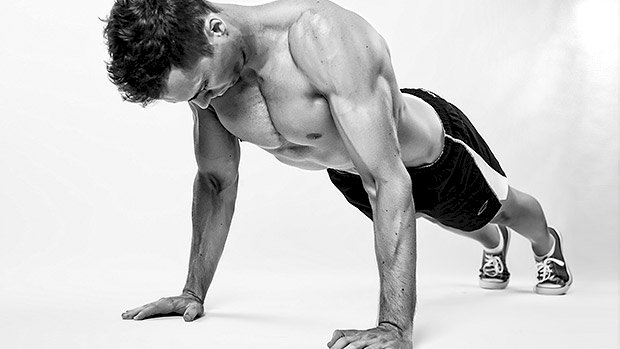 There’s no better all-around upper body exercise than a push-up. But for some reason, people stop doing them. Oh, you think you’re too “advanced” for push-ups? Think again. Push-Up Complexes To build muscle you need to produce tension, metabolic stress, and tissue breakdown. But if you’re able to knock out fifty reps or more, you’re rendering traditional push-ups useless for muscle or strength building. It’s not enough of a challenge at that point. You’ll develop some endurance and maybe even get a good poolside pump, but that’s about it. That’s where complexes come in. They’re highly effective for stimulating muscle growth. You’ll start by choosing a challenging variation, then extending the set using easier variations – a mechanical drop set. The hardest exercise always goes at the beginning. It’s the one you can get the smallest load or do the fewest number of reps with. Then as you reach failure, you’ll move to an easier version. You might even drop again (and again). So let’s look at six examples. 1 – The Chest and Triceps Builder Exercise Sets Reps A1 Close-Grip Push-Up on Medicine Ball 2-3 4-10 A2 Switchover Push-Up on Medicine Ball 2-3 4-10/side A3 Offset Push-Up on Medicine Ball 2-3 4-10/side Hat tip to Coach Nick Tumminello, for this one. Starting with the hardest one – close-grip and squeezing the ball – you’ll then switch to a switchover variation either walking the ball across or hopping yourself over a static ball. Finally, you’ll stay on one side to squeeze out some extra reps before blurting out a few curse words. This medball push-up complex makes a great finish to your chest workouts. The ball also challenges those oft-neglected shoulder stabilizers. If you can do more than 10 reps in the close-grip position, then use a weighted vest to add some load. 2 – The Jacked Shoulders Complex Exercise Sets Reps A1 Vertical Press Push-Up 2-3 6-12 A2 Hand Release Push-Up to Y-Reach 2-3 6-12 A3 Y-Reach 2-3 6-12 A4 Y-Reach Iso Hold 2-3 20 sec. The vertical press push-up is a great variation on its own. It’s like a pike push-up but more comfortable for those who struggle with tight hamstrings. Placing your body in a more vertical position with feet on a bench changes the pressing angle to bias your shoulders in a joint-friendly position. When going from the hand release push-up to Y-reach there should be some external rotation of the shoulder since your thumbs are pointing up towards the end of the reach. You’ll be asking quite a bit of your delts and shoulder external rotators by this point, as well as getting some extra shoulder range of motion. Next, you’ll be dropping the push-up component and just doing the Y-reaches to really burn out the shoulders. You’ll then finish with an isometric hold. Simply hold for 10-20 seconds, stay tight, and think of America (or respective homeland). This is good combination of exercises to hit the entire shoulder complex while improving overall shoulder health. Plus, it burns like a MOFO! 3 – The Strong Shoulders encrypted-media” allowfullscreen> Exercise Sets Reps A1 Pike Push-Up 2-3 6-12 A2 Reverse Yoga Push-Up 2-3 failure A3 Yoga Push Up 2-3 failure This complex also has a shoulder emphasis. If your hamstrings have seen better days then use the previous one instead. If you’re only a little tight then see these as a good opportunity to gain some upper body strength and size, while bringing out your inner yogi. A few sets at the end of your next upper body workout would be a great way to finish. 4 – Simple Mechanical Drop-Set Exercise Sets Reps A1 Feet Elevated Push-Up (loaded or bodyweight) 2-3 8-12 A2 Push-Up 2-3 6-10 A3 Hands Elevated Push-Up 2-3 4-6 This one’s the most simple complex, so if you’re lacking the coordination to do any of the others, try this. Elevating your feet is the hardest variation. Once your feet are on the floor it gets a little easier, then the hands-on-bench variation is the easiest. This sequence reduces the percentage of bodyweight you’re lifting by adjusting the leverages. A resistance band works well here since you get the benefit of accommodating resistance. A weighted vest is excellent too. Try to complete one extra rep of each move every workout, or gradually add a little weight each week. 5 – The Triceps Finisher You might be thinking these are more like bodyweight triceps extensions than they are a push-up variation. Well, whatever you want to call them, they work. There are a few ways you could do them and using a weighted vest is always an option too. Harder Exercise Sets Reps A1 Decline Bodyweight Skull Crusher 2-3 6-10 A2 Bodyweight Skull Crusher 2-3 6-10 A3 Decline Narrow Grip Push-Up 2-3 AMAP Easier Exercise Sets Reps A1 Bodyweight Skull Crusher 2-3 6-10 A2 Incline Bodyweight Skull Crusher 2-3 6-10 A3 Narrow Grip Push-Up 2-3 AMAP Skull crushers do a great job of hitting the long-head of the triceps brachii. Doing them
Origin: 6 Push-Up Workouts for Hypertrophy
 All about sport xlsport.club