
 So I’m doing a set of overhead dumbbell presses at the gym when I overhear a client complaining to her trainer that she needs to “shrink her stomach” for an upcoming high school reunion. Now get this, her trainer – a guy I know and normally respect – didn’t ask about her diet. Nor did he at least march her 10-years-past-high-school cheeks over to the treadmill. Instead, he leads her through a 15-minute ab routine consisting of incline sit-ups, crunches, and (groan), side bends. What’s annoying about this is that the trainer knows that all the ab exercises in the world aren’t going to do a damn thing about a midsection grown soft by a steady diet of wine, gouda cheese, and avocado toast. But then I started thinking about it. Maybe he doesn’t know ab exercises don’t result in spot reduction. And if he doesn’t know, how many other trainers and regular folk don’t know? Maybe it’s one of those myths that still persist despite all contrary evidence, like how you’re supposed to pee on your leg if you get stung by a jellyfish. So I was curious to see if there were any studies to either confirm (ha!) or, once and for all, disprove the notion that ab exercises lead to fat reduction around the waist. There aren’t many that deal with the subject, but the best one seems to have been published in the Journal of Strength and Conditioning a few years ago. Here’s what the researchers did and what they found. Consider it a public service announcement and send it to any trainers, friends, or acquaintances still suffering from Ab Exercise Delusion Syndrome. What They Did The researchers recruited 24 participants (14 men and 10 women) and randomly assigned them to either a control group or an exercise group. Anthropometrics, body comp, and abdominal endurance were tested before and after training. The exercise group performed 7 different ab movements: Bent-Knee Sit-Ups Lateral Trunk Flexion Leg Lifts Oblique Crunches Stability Ball Crunches Stability Ball Twists Abdominal Crunches Each exercise was performed for 2 sets of 10 reps. Subjects trained 5 days a week for 6 weeks. What They Found “Abdominal exercise did not result in change in measures of abdominal fat (android fat measured by DXA, waist circumference, abdominal skinfold) compared to the control group.” The exercise group did, of course, build greater abdominal strength and endurance, though. What This Means to You No matter how much we want it to be true, ab exercises won’t give you a Hymenopteran waist (that’s “wasp-like” to you non-entomologists). Women in particular should take note of this fact because legions of them have fallen victim to doing too much direct ab and oblique work. They’ve bought into the notion of spot reduction but sadly, it’s led to thicker midsections. Why? Because the more you train a muscle, the bigger it gets. That woman who wanted to “tone up” her stomach for her class reunion that I mentioned in the intro? By working her abs hard and long, she’ll likely have even more trouble fitting into that floral bodycon number she picked up at Dress Barn. And, okay, maybe that slightly thicker waist is okay with her when she’s lean, but when she puts on even a little fat, she’s going to look even less hour-glass shaped than before. If you’re like most women, you want a flat, tapered waistline. You get that through a combination of diet, metabolic conditioning, and whole-body exercise – not by doing countless ab exercises. Unless you want your abs to stand out in sharp relief, you should work them briefly, infrequently, and probably without any additional resistance. If, however, you want your abs to pop (like most men), you can add resistance and train them like any other muscle group so that they’ll grow and say
Origin: Tip: Can You Shrink Your Waistline by Working Abs?
Tag: Working
Tip: Your Lateral Raises Aren’t Working
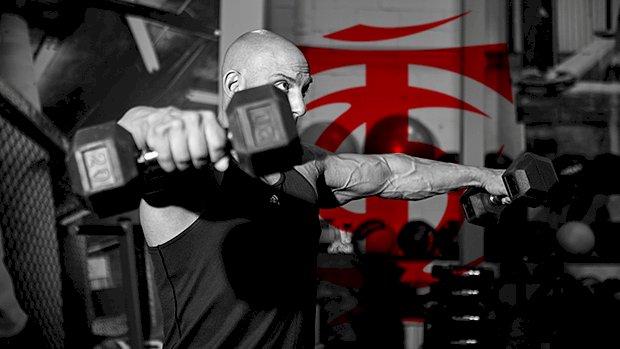 To make the lateral raise effective at recruiting the delts (and not just the traps) first focus on pushing the dumbbells AWAY, not on lifting them up. Try to bring the dumbbells as far to your sides as possible. They should only go up as a result of you pushing sideways. This minimizes trap recruitment. Here are three alternative exercises to try: 1. The Backpack Raise No, you won’t be doing lateral raises while wearing a backpack (although that would likely work too) but with resistance bands looped around your shoulders to keep them down. The traps get involved when the shoulders raise up instead of just rotate. The bands, by keeping the shoulders down, help you focus on the delts better. To set up, you step on the inside of the band and hook the other end around the shoulder. Then do that on the other side with a second band. The bands’ position on the shoulder is important. You want to place it on the AC joint, not on the trap. If the band is on the trap it will actually increase the recruitment of the trap by creating a greater mind-muscle connection with that muscle and a reactive contraction because of the pressure. You’ll still need to focus on pushing the dumbbells away instead of lifting them up, but the bands will make that a lot easier. 2. The Handcuff Raise with a Mechanical Drop Set For this one you’ll use a short resistance band looped around your wrists, like handcuffs. Use a band with only a small amount of resistance; no need to go crazy here since you’re only using it to shift the tension to the medial delts. Choose dumbbells that are a bit lighter than what you’d normally use for 10 strict reps. Let’s say a weight you could do 12-15 quality lateral raises with. The first step of the mechanical drop set is to do partial lateral raises with the band and dumbbells. Go as high as the band will allow, which should be around a third to a half of the way up. Do as many good reps as you can. Then immediately drop the band and do regular lateral raises with dumbbells only. Shoot for 8-10 reps. Then, drop the dumbbells and put the band back on and do partial reps (like in step one) with only the band. Don’t rest between each step of the mechanical drop set. If you want to set your medial delts on fire, this is the exercise for you! 3. The Incline Lateral Raise This is the “less cool” option but one that I’ve been using for at least 15 years successfully with people who have dominant traps. Sit down on an adjustable bench angled at around 30 degrees and do lateral raises from that position. Still focus on pushing the dumbbells out, not lifting them up. This greatly decreases trap activation, but you still have to focus on pushing the dumbbells far away from your side instead of
Origin: Tip: Your Lateral Raises Aren’t Working
 All about sport xlsport.club