
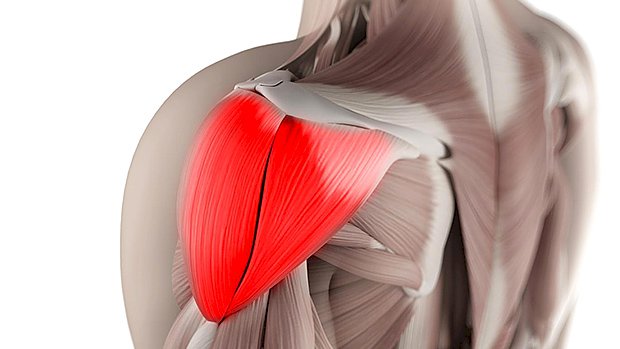
 Stop Pissing Off Your Shoulders Years in the iron game can leave the shoulders beat to crap. The last thing you want to do is to piss off some of the most important joints in the body more than they already are. Your shoulder work should enhance the way this region of the body looks AND functions while improving your performance. Here are three pain-free strategies to decrease joint stress while maximizing the pump effect for growth and strength. 1 – Use Bands With Dumbbells Using bands and chains for accommodating resistance is usually reserved for the big lifts, but they should also be a staple in smart shoulder training. The only problem is the equipment restrictions. Bands are often too thick and chains are too heavy to complete enough full range of motion reps to get a good training effect. The secret is to use the ultra-light, handled bands that have become popular in commercial gyms. These bands have much smaller diameters and thickness, allowing you to apply accommodating resistance when used in combination with dumbbells. Holding the handles of the bands together with the handles of dumbbells works with the lateral raise and its variations. Staying consistent with the light band and increasing the dumbbell poundage allows you to train in strength, hypertrophy, endurance, and metabolic-stress based rep schemes without sputtering out on range of motion or losing control of shoulder stability. Another advantage bands provide during lateral raises is the ability to train explosively without losing shoulder stability at the top of the movement. Because the load is lighter at the bottom of the range when your hands are down by your sides, you’re able to engage the delts more explosively and have the speed of contraction slowed down by the increased resistance through the bands at the top. This is great for targeting the fast twitch motor units in the shoulders while also providing a novel, pain-free stimulus for shoulder training. Remember, train the shoulders explosively with this method. Focus on increasing the contraction speed in the concentric (lifting) part of the movement while slowing down the eccentric (lowering) part of the exercise. Don’t let the bands pull you down fast. 2 – Train Between the Usual Planes of Motion Open up an anatomy textbook and you’ll see that the deltoid is broken down into three distinct fiber orientations: the anterior, lateral and posterior. Though traditional training protocols have called for training shoulder flexion, abduction, and extension, it’s not the most effective way. Sure, isolating different parts of the deltoid is better than just barbell overhead-pressing yourself into an AC joint injury, but let’s try to be better than the industry standard, shall we? Training not only the three cardinal planes of motion, but BETWEEN these planes of motion is pivotal to finding what variation of shoulder raises fits your specific body type, while also taking into account things like functional instability, weakness, or even past injury. This strategy gives you endless angles to emphasize, adding novelty to traditional movement patterns while also minimizing chronic joint stresses commonly associated with sloppy lateral raises and overhead pressing. Check out the dumbbell scaption raise that works between the sagittal and frontal planes, emphasizing fibers between the anterior and lateral heads of the deltoid. Dumbbell Scaption Raise There’s a huge need for posterior and posterior-lateral direct deltoid training as many lifters place too much emphasis on vertical and horizontal pressing. To protect your shoulders and build some muscle in the posterior shoulder area, do 2-3 times more volume on the posterior shoulder than the anterior. 3 – Trigger the Metabolic Pump Effect The shoulders don’t traditionally respond well to heavy-ass loads. The deltoid is comprised of a majority of slow twitch muscle fibers, meaning that the average lifter will be more likely to get results from higher rep ranges of around 12-20 reps. While this is based on individual presentation of fiber and body typing, higher reps can be advantageous to almost every lifter by decreasing external loads placed on the shoulder joint, thus decreasing cumulative joint stress over time. Less weight moved equals less stress on the joints. But this doesn’t give you the excuse to get fluffy with your shoulder training and go light without challenging yourself. Building strength and size in the shoulders requires placing an emphasis not only on progressively overloading staple movements, but also on eliciting a huge metabolic pump effect in the tissues. The pump has been crapped on for decades by elitist powerlifters and strength athletes who are usually chronically injured, but tapping into metabolic stress is one of the most intelligent training variables to exploit for performance, aesthetic, and orthopedic success. There are a few key methods that will increase the metabolic stress of the
Origin: The 3 Smartest Ways to Train Shoulders
Tag: Ways
3 Ways to Control Insulin and Get Jacked
 Here’s what you need to know… Insulin is an anabolic hormone. Some people think that it only causes fat storage, but it also increases muscle growth. Insulin sensitivity in muscle is key. It will allow you to build more muscle and get lean. Exercise, diet, and certain supplements can improve insulin sensitivity. Two weeks is all it takes to start seeing benefits. Insulin gets a bad rap, but it’s simply a hormone the body makes in response to the food we eat. It can either help us store the energy we get from food in muscle cells (good) or in fat cells (not good). The more muscle you have –and the more insulin sensitive that muscle is –the greater capacity you’ll have to store muscle glycogen. Ideally, you’ll store more of what you eat as muscle while also getting leaner, i.e. reducing the amount of fat you’re storing. Impossible? Nope, you can change your body composition by changing your insulin sensitivity. And you can change your insulin sensitivity with these three tools. 1 – How to Control Insulin with Food Insulin regulates our metabolism and is released in greatest amounts when we eat. This is to our benefit depending on when, what, and how we’re eating. Some think that avoiding carbs is the key to leanness, but cutting them altogether makes muscle glycogen synthesis more difficult. And if you play sports or care about your lifting performance, then it’ll keep you from maximizing your potential. Carbs are a fast acting bioenergetic fuel source. Sure, an unnecessarily high carb intake throughout the day isn’t without consequence. It may even make you more insulin resistant depending on how excessive it is. Instead, consume the majority of your carbs around the time of your workout when you’ll need and use them most. Get Adequate Fiber, But Not Around Workouts: Increased fiber intake has been shown to have blood glucose lowering effects and may increase total body insulin sensitivity. The only caveat? Don’t have your high fiber meal around workout time. That’s when you’d want to have a greater insulin spike so that your workout nutrition can be directed to your muscle cells. Eat Slower: Multiple studies have shown that faster eaters are also more insulin resistant. These studies even accounted for factors like genetic predisposition, BMI, caloric intake, waist circumference, and triglyceride levels. Fast eating has been linked with obesity and it’s believed that speed eating makes it more difficult for your appetite suppressing hormones to take effect, which ultimately affects insulin’s ability to do its job. 2 – How to Control Insulin with Exercise Exercise is the antidote for raising insulin sensitivity in muscle cells. Studies show that a single workout can increase your insulin sensitivity for at least 16 hours post training. Both strength training and conditioning have been shown to make significant improvements to our insulin sensitivity in a short amount of time. Strength Training: Researchers have found that both insulin sensitivity and glucose uptake capacity in muscles increases with resistance training. Storing glycogen in the muscle cells is a gift that keeps on giving. As you train, you use your muscles, they use up the glycogen, you burn more total calories, and then when you eat you replace that depleted glycogen with more energy for later use. Add some glycogen-depleting finishers to your normal strength training: Timed kettlebell swings, snatches, clean and jerks CrossFit WODs Supersets Circuit training AMRAP (as many reps as possible) bodyweight exercises Conditioning: Both long, slow cardio and fast, intense cardio have their place in improving insulin sensitivity. And the improvements come quickly. One study showed that just two weeks of high intensity exercise (4-6 sets of 30 second sprints) made subjects significantly improve their insulin sensitivity. Researchers have found that aerobic exercise (in the zone-2 cardio range, 65-75 percent of VO2 Max) has been shown to improve insulin sensitivity. Their studies show that this happened through the activation of AMPK (AMP activated protein kinase), an enzyme involved in glucose and lipid metabolism. Likewise, high intensity exercise (greater than 80 percent of VO2 max) has been shown to improve insulin sensitivity and lower blood glucose for up to 1-3 days post exercise. Try intervals with these for a high intensity insulin sensitivity boosting workout. Incorporate 5 sets of 30 second intervals a few times a week into your program. Hill sprints Prowler pushes Jump rope Rowing ergometer Battling ropes 3 – How to Control Insulin with Supplementation You can also improve insulin sensitivity with proper supplementation. Although these substances can be found in food sources, it’s easier to get a potent and condensed source from supplementing. In fact, you may not even get the benefits without using a concentrated supplement. Cyanide 3-Glucoside: C3G comes from a powerful chemical from nature called anthocyanin. It’s
Origin: 3 Ways to Control Insulin and Get Jacked
 All about sport xlsport.club