
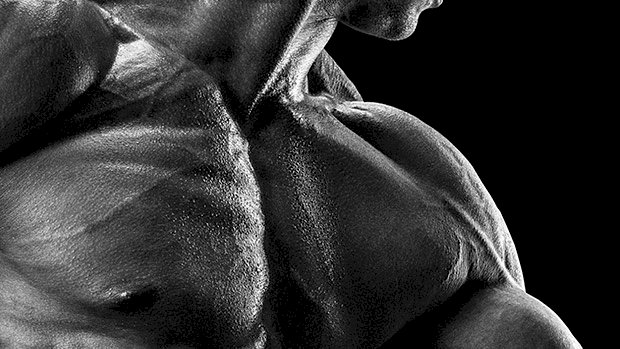
 While many lifters get decent mid and low-pec development, it’s rare to see a truly filled-in upper chest. When it comes to aesthetics, the upper pecs are a game changer. Here are eight things you need to know (and do) to build yours. 1 – Check Your Ego at the Door The biggest reason guys lack upper pec development? They turn chest day into ego day. Flat bench pressing gets all the love because they can use more weight. But if you’re serious about reaching your pec potential, you need to put your ego aside and focus on incline movements – even if you train in a public gym and you currently suck at inclines. Upper pecs are a tricky area. Unless you won the genetic lottery, just emphasizing incline pressing may not be enough. 2 – Hit BOTH Parts of Your Upper Pecs When people think about the upper pecs, they only think about the clavicular portion of the pectoralis major. But there are TWO major portions. The clavicular part originates on your clavicles and run almost parallel to your anterior deltoids. When doing incline presses, many lifters mistakenly use the same grip and style they use for flat bench presses. However, research shows that one great way to emphasize the clavicular portion of your pecs is to use a narrower grip when doing inclines (1). This brings your elbows in and gets your shoulders moving in the direction of your clavicular fibers. Note: Don’t bring your elbows in all the way; this will place stress on the anterior delts. If you use a barbell, use a shoulder-width grip and focus on squeezing your hands together as you press the weight to increase the recruitment of your pecs. You can also do this with dumbbells and your arms at a 45-degree angle: This elbow tuck position is so powerful that you may not even need to use an incline. Research shows that simply doing flat bench press with a reverse grip lights up your clavicular fibers (2). The downside of the reverse-grip bench press? You move your arms into external rotation. While it works, it may not be optimal because the pecs assist in internal rotation. As a result, a better approach is to press with dumbbells (off floor or bench). With dumbbells you get the same elbow position at the bottom as a reverse-grip bench press, but you can internally rotate your arms as you press up for max pec recruitment. The other part of your pecs that’s often forgotten is the upper sternal portion. If you look at the pec anatomy, you’ll see sternal fibers running all the way up to the top of your sternum. If you look at the line of pull of these fibers, you’ll see they’re still pulling your arm across your body. If you only press with your elbows tucked, or a steep incline, you might miss this part. To develop the upper sternal fibers, you need a low incline and a wider elbow position. Note: If you have shoulder problems, or experience pain pressing this way, don’t do it! However, if you want to give it a go, here are some tips that’ll help hammer your pecs while sparing your shoulders: Don’t force the elbow flare – maintain a slight elbow tuck. Remember, you’re on a slight incline. Flat bench pressing with wider elbows is riskier for your shoulders because your shoulders are abducted (out to the side) and internally rotated. This puts you in a position of shoulder impingement. But when you use a slight incline, you externally rotate your arms which moves you out of that shoulder impingement position. Stop when your elbows are in line with your shoulders. This is where most people naturally stop anyway. Also note that the distance between the dumbbells and your shoulders will vary depending on your arm length, so stop looking at the dumbbells and start looking at your elbows. 3 – Find YOUR Optimal Bench Angle If you’re trying to build your upper chest, the angle matters. If your bench angle is too high, your upper pecs will drop out and your anterior delts will take over. What’s your optimal angle? Research shows that a bench angle of about 30-45 degrees may be best for hitting your upper pecs (3). However, before you pull out your protractor, you should know that this study was done with only 14 subjects. That leaves us with the question, “What about individual variation?” If you look carefully at a bunch of different people, you’ll notice significant variance in chest cavities (sunken, flat, barrel, etc.). How can people with different chest structures press on the same bench angle and expect the same muscle activation? The optimal angle for you might be higher or lower than the next bro at your gym. To find your best angle, try this test: Attach a light band to a rack or post at about eye level. Keep the band tension very light. Grab the band and raise your hand overhead. Place your opposite hand on your upper pec of the raised arm. Draw your hand in until it’s at or just past the midline of your body. Slowly lower your hand. Stop the movement when you feel your upper pec light up. Turn to a side mirror and
Origin: 8 Secrets For Building Your Best Upper Chest
Tag: Upper
Tip: The 5-Minute Upper Body Finisher
 Hit this quick workout for a super pump at the end of your training sessions. Yes, it’s short, but aim for controlled reps with minimal rest. The routine consists of these three simple exercises: 1. TRX Bicep Curl Lean back away from the anchor point and have your elbows about shoulder height, palms facing up. Keep your shoulders back and down and curl from the elbow. Just pull to beside your head without letting the elbows drop. Avoid lifting from the shoulders and pulling behind yourself. Keep these slow and controlled and really focus on isolating the biceps while maintaining posture. 2. TRX Row Turn your palms so they face each other. Fully lock out the arms and think about engaging the lats before you pull. When you reach your chest to the handles, squeeze your shoulder blades together as much as you can before slowly returning to the start position. 3. The Push-Up Move to the floor. Place your hands shoulder distance apart, keep your belly tight, and push your feet into the ground. Fully extend the elbows at the top – no half reps. If you need to regress to your knees that would be better to maintain a full range of motion. The Rep Scheme 5 TRX bicep curls 8 TRX rows 10 push-ups Do 5 full rounds If don’t struggle with the exercises and your form stays strong throughout, then aim to go unbroken (no resting) between all five rounds. If you’re fairly new and your arms burn out quickly, take 30 seconds of rest between rounds. Remember the aim is quality movement with good tension. If you feel like you’re able to relax too much at the top of the rows or curls then walk your feet forward to put yourself more toward horizontal. This workout should take you around five minutes. If you can do it in 3 or 4 minutes, you’ve performed the exercises too
Origin: Tip: The 5-Minute Upper Body Finisher
15 Exercises for a Powerful Upper Body
 The Need for Speed Speed work is most often used by those wanting to build power and explosiveness. When it comes to upper-body power training with bands (dynamic effort) a lot of non-powerlifters copy what they see powerlifters doing – attaching Superbands to each side of a bar and doing fast bench presses. That’s fine. However, you don’t need to just use a barbell to do power training with bands. In fact, it makes more sense to do multi-angled speed work for both pushing and pulling actions. Here are a variety of banded power training exercises for non-powerlifters: 1 – Speed Press These are JC Bands, but you can do these exercises by anchoring regular bands or bands with handles to a stable piece of equipment. This allows you to keep the bands longer, which creates a smoother, less drastic resistance change as they lengthen. Using a split-stance provides a better base of support so you’ll be able to generate maximum force. Press until just before your elbows fully extend, and allow your elbows to travel just beyond your torso on each rep. Sets and reps: 3-5 x 8-12 seconds of as many reps as possible (AMRAP) Use a band tension and stand at a distance that allows you to move at a pace of at least 3 reps per second. 2 – Alternate-Arm Speed Press Press until just before your elbow fully extends, and allow your elbow on your back arm to travel just beyond your torso. Be athletic by using a little rotation at your torso and even your lower body. Make sure they work together in a smooth and coordinated manner. Sets and reps: 3-4 x 6-8 seconds AMRAP, per stance Move at a pace of at least 3 reps per second. 3 – Speed One-Arm Press If you’re pressing with your right arm, stand in a split-stance with your left leg in front. Be athletic by using a little rotation, shifting weight at your torso and lower body to work together in a coordinated manner. Sets and reps: 3-4 x 8-12 seconds AMRAP, each side Perform at least 2 reps per second. 4 – Speed Incline Press Keep the bands in contact with the top of your arms. You want the pressing action of your arms to be in line with the angle of the bands, which should be set at roughly 45-degrees. Switch lead legs on each set, but it doesn’t matter if you end up doing one more set on one stance versus the other. (That goes for most of these exercises.) The lower body is doing less than when doing the alternate-arm versions because there’s no rotational element involved. Sets and reps: 3-4 x 8-12 seconds AMRAP Move at a pace of at least 3 reps per second. 5 – Speed Incline Alternate-Arm Press Press each arm at the same angle as the band. Press until just before your elbow fully extends, and allow the elbow of your back arm to travel just past your torso. Sets and reps: 3-4 x 6-8 seconds AMRAP, per stance Do at least 3 reps per second. 6 – Angled Barbell Speed One-Arm Press In my Ultimate Guide to Landmine Presses, I talked about using a band to perform presses. You can also use the band for dynamic effort reps by performing angled barbell presses as fast as you can. Sets and reps: 3-4 x 8-12 seconds AMRAP, each side Use a band for tension and stand at a distance that allows you to move at a pace of at least 2 reps per second. 7 – Angled Barbell Speed Leaning One-Arm Press This variation is more like an incline pressing action, whereas this leaning torso version is more like an overhead press. For both versions, make sure the band is anchored on your same-side foot directly underneath your pressing arm. Same sets and reps as above. 8 – Speed One-Arm Overhead Press You can use a Superband for this but here I’m using an NT Loop because I designed it to be a far more comfortable and stable band to place around your limbs, waist, or hips. Sets and reps: 3-4 x 8-12 seconds AMRAP, each side Move at a pace of at least 2 reps per second. 9 – Speed Row Make sure not to alligator-arm this. Using a split-stance provides a better base of support. Pull until your elbows travel just beyond your torso, and extend your arms just before your elbows fully extend on each rep. Switch lead legs on each set. Sets and reps: 3-5 x 8-12 seconds, AMRAP Do at least 3 reps per second. 10 – Speed Alternate-Arm Row Pull until your elbows travel just beyond your torso, and extend your arms just before your elbows fully extend on each rep. Use a little rotation at your torso and even your lower body so they work together in a smooth manner. Sets and reps: 3-4 x 6-8 seconds AMRAP, per stance Do at least 3 reps per second. 11 – Speed One-Arm Row If you’re pulling with your left arm, stand in a split-stance with your right leg in front. Sets and reps: 3-4 x 8-12 seconds AMRAP, each side Do at least 2 reps per second. 12 – Speed Overhead Pull Anchor the bands at around bellybutton height and hinge forward at your hips so your torso is roughly parallel to the ground. This allows you to use a vertical pulling action like a lat pulldown. On all of
Origin: 15 Exercises for a Powerful Upper Body
 All about sport xlsport.club