
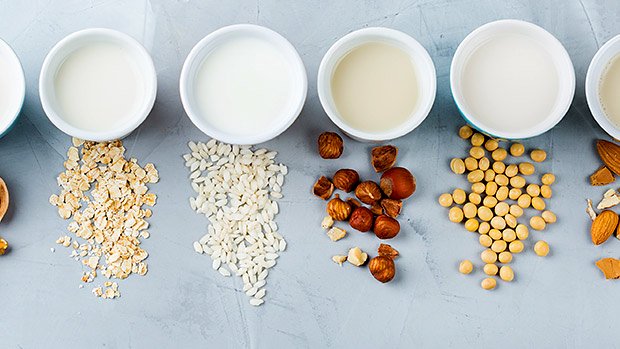
 Let’s First Get One Thing Straight… Milk is what female mammals secrete to nourish their young, so calling the liquid you get by pulverizing any of various seeds, nuts, or fruits “milk” is hugely inaccurate. There are, after all, no soybeans, almonds, oats, or coconuts that lactate, even though the last one kind of looks like a hairy hooter. Regardless of what you call them, these plant-based juices are hugely popular. Just stand in line at your local Starbucks and see how many hamsters signal their nutritional virtue by ordering their lattes with one of these milk alternatives (as if replacing milk with a dollop of one of these sugar-saturated Frankenjuices is going to make a difference in their health). Any way you look at it, though, regular, whole-fat milk is nutritionally superior to all of the plant-based alternatives. There are, however, two completely valid reasons not to make milk your choice of liquid to pour on your cereal, mix in your protein drink, or whiten up your coffee – one, you’re vegan, which by definition rules out cow’s milk, or two, you’re lactose intolerant, in which case cow’s milk is your digestive enemy. I should also accept that many of you, because of pasteurization, the China Study, or maybe because it comes out of a cow’s lady parts, think that cow’s milk is what the devil dips his raspberry scones into and thus won’t touch it. Fine. Those delusions are, as they say, beyond the scope of this article. Regardless of your reasons, there’s one, possibly two, milk substitutes that make for a valid alternative to milk. They’re oat milk and cashew milk. A Bunch of Players But None of Them Starters The idea behind most plant-based milks sounds great. Sure, mash up some plant matter. Strain out the crap, add water, and fill up on pure plant nutrients, proteins, and fatty acids. Too bad it doesn’t really pan out that way. Take almond milk, for instance. It gives you none (or very little) of the benefits of almonds, which include proteins and good fats, and neither does it give you the benefits of regular milk since it lacks calcium. For one thing, each carton only contains a handful of almonds, and the handful in question is a wee, gnarled, arthritic thing that can only scoop up a couple of almonds without spilling them onto her orthopedic shoes. Not only that, but when you strain out the insoluble stuff from the “milk,” you lose most of the stuff you’d eat almonds for in the first place. Of course, manufacturers usually add calcium and vitamins A, D, and B-12 (along with a bunch of sugar, unless you get unsweetened variety), but you’re still getting very little protein – about 1 gram per cup, compared to about 8 grams for milk. It’s true, though, that almond milk is generally 50% lower in calories than cow’s milk since it lacks any significant amounts of fat and, since it’s not an animal product, it contains no saturated fat or cholesterol… if any of that matters to you. (Unsweetened almond milk is also virtually carb-free if that’s something you’re looking out for.) Few of the other milk substitutes fare much better as they each have their individual drawbacks. Pea protein milk is higher in protein than almost all of the others, but it’s not made with the whole pea and, as such, lacks the polyphenols that would make it a truly healthy drink. Plus, its second major ingredient is sunflower oil, which is rich in the omega 6 fatty acids that most of us already sop up too much of every day. Coconut milk tastes great as it’s just watered down coconut fat. It’s probably similar in nutritional value to some of the nut drinks, but it’s really calorie dense, especially if you choose a sweetened variety. Of course, if you want to cash in on MCT oils (of which all four varieties are present in coconut milk), drinking it is an okay strategy since approximately 60% of its fatty acid content is made up of MCTs. Soymilk, one of the pioneers of the genre, is higher in protein than some of the nut based milks, but it’s basically intolerable, taste-wise (unless you choose one that’s been sweetened up the wazoo), and it’s so pale and watery that I’m surprised they haven’t slapped a Coors label on it to expand their market. Another strike against soymilk is the possible presence of certain plant isoflavones that mimic estrogen and can, in the long run, create hormonal havoc in both men and women. That pretty much leaves us with oat milk and cashew nut milk. So Why Do Oat Milk and Cashew Nut Get a Pass? Most oat milks are made of nothing but oats, water (in the ratio of 1 cup of oats to three-fourths cup of water), sea salt, and a bit of rapeseed oil. Nutritionally, each cup has about 120 calories, 5 grams of fat, 16 grams of carbs (of which 7 are from naturally occurring sugars), 2 grams of fiber, and about 3 grams of protein. Compared to milk, that’s a little more sugar, a little less fat, and a lot less protein, but drinking milk alternatives for their protein is like eating rum
Origin: Tip: Which Type of Milk Should You Drink?
Tag: Type
Unlock Natural Gains: Neuro Type 1
 Part 1 – Nonstop Natural Gains: The Neuro Typing System Part 2 – Unlock Natural Gains: Neuro Type 1 Part 3 – Double Your Natural Gains: Neuro Type 2 Part 4 – Never-Ending Natural Gains: Neuro Type 3 Part 5 – The Neuro Type Workouts Part 1 of this series introduces you to neurological typing. In short, your baseline levels of three neurotransmitters (dopamine, serotonin and norepinephrine) strongly influence your personality and dictate your how you should train and eat for best results. Your personality profile is largely determined by three key neurotransmitters: dopamine, serotonin, and norepinephrine. Your baseline levels of these chemical messengers are determined by genetics. The three basic personality types are: Type 1: Novelty seeker Type 2: Reward dependant Type 3: Harm avoider Each has its positives and its negatives. If you adopt a training style that doesn’t match your psychological and neurological type, you simply won’t get results from it, no matter how well-designed the program is. In this series, we’ll go over each type and what type of training, nutrition and supplement plan is best for each. To determine your type, review Nonstop Natural Gains: The Neuro Typing System. Below we’ll cover the novelty seeker. This type has a low dopamine level, causing him or her to seek out new things to stimulate it. You could call them “adrenaline junkies.” Optimal Training for Type 1: Novelty Seekers 1 – Training Preparation Novelty seekers have less dopamine than serotonin. They must increase dopamine prior to starting the actual workout to have good motivation and work capacity. If they don’t, performance will suffer in the first part of the workout. For that reason, it’s very important for them to focus on activation drills prior to starting their workouts: jumps, throws, high speed movements, etc. The focus needs to be on speed – moving violently but without creating a lot of fatigue. Example: 3 sets of 5 vertical jumps. Or striking a tire with a sledgehammer for 3 sets of 12 seconds. When it comes to the main heavy lift of the day, they should ramp up to the working weight while doing gradually heavier sets and focus on compensatory acceleration (CAT). That’s where you accelerate the weight as fast as possible during the concentric or lifting phase of the rep. This acceleration will increase force production and will amp up the nervous system by increasing the release of dopamine. A ramp should start at around 60% of your max. Do around 5 ramp-up sets before doing the work sets. These ramp-up sets should only be done for the same number of reps that you plan to do on your work sets, or lower. You want to amp up the nervous system without creating fatigue. A ramp could look like this: Ramp-Up Sets: Set 0: bar x 10 Set 1: 165 x 3 Set 2: 195 x 3 Set 3: 215 x 3 Set 4: 235 x 3 Set 5: 255 x 3 Note: Use maximum concentric acceleration on sets 1-5. Work Sets: Set 6: 275 x 5 Set 7: 275 x 5 Set 8: 275 x 5 Set 9: 275 x 5 Remember that dopamine and adrenaline are connected. Dopamine is used to produce norepinephrine which is used to produce epinephrine/adrenaline. So anything that amps you up will raise dopamine levels. Just be careful not to overdo it. This type has a low baseline dopamine level and can produce spurts of it, but they crash if they have to produce too much. When that happens during a workout, their willpower and motivation goes down the drain. 2 – Training Variation Type 1 lifters need a lot of variation in their training. They’re your typical “I can’t follow a program” guys. They always want to try something new. If you put them on programs like 5/3/1 or The Power Look (programs based around doing the same stuff over and over) they’ll get de-motivated and won’t get results. We often say that we need to stick to a program to make progress, but in their case it’s not necessarily true. Remember, whatever helps you train the hardest will give you the best results. On a static program, novelty seekers get bored easily and will lose focus if the training is too repetitive. In their case, a lack of sufficient variety is actually a stressor. This neuro type… Can stay on a program for 2 weeks. Does better on multiple types of stimulation in a week. Does better when different types of stimulation are included within a workout. Cybernetic periodization (freedom within a structure) is a great approach for them. This refers to pre-planning the first big lift of the workout but selecting the assistance work based on the performance of the main lift. Surprisingly, a lot of powerlifters are novelty seekers. The Westside Barbell system is the perfect example. They vary the main lift every one to two weeks, they do three types of stimulation per week (four if you include conditioning), and they use cybernetic periodization by selecting their daily assistance exercises based on how they performed on the main lift. Oddly enough, CrossFit is also a perfect example, especially the shorter 8-15
Origin: Unlock Natural Gains: Neuro Type 1
 All about sport xlsport.club