
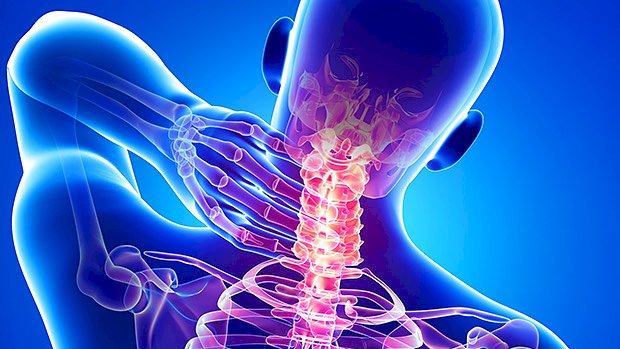
 Whether it’s due to explosive Olympic lifting, tons of shrugging, or just straining under the bar, your neck can become irritated due to overactive traps. Although this is a problem in and of itself, it can also lead to worse problems down the road, like tension headaches or migraines. Your upper traps, after all, are attached to the base of the skull. Making things worse, overactive upper traps will “take over” during rows and other pulling exercises which will lead to poorly developed middle and lower traps, rhomboids, and lats. If you’re ready to ditch your neck pain, use these mobility, stretching, and strengthening exercises to loosen your traps and retrain your mid-back. Step 1 – Soft Tissue Work Begin your workout by doing a little soft tissue work on the traps. Releasing your overactive traps first is a must if you want to fix your neck pain. It’s tough to foam roll your traps, so try applying pressure with a barbell. Step 2 – Do Some Light Stretching Once you’ve released your bound-up traps, do the following stretch on your neck/traps to restore your range of motion. Side Tilt Neck Stretch with Shoulder Depression Attach one end of a band to a low anchor and the other end to your wrist to depress one shoulder. Use your other hand to pull your head in the opposite direction. First, bring your chin to your chest, followed by taking your chin toward the ceiling. Stay in the range where you feel the most tension. Step 3 – Strengthen and Activate the Mid-Back The goal here is to both depress and retract your shoulder blades. Strengthening and activating your mid-back will help balance out your upper traps. To make sure your mid-back is doing the work, you’ll want to go much lighter and do more volume than you normally would for these exercises. One-Arm Lat Pulldown Visualize your shoulder blade sliding down your back with each pull. The goal is to pull your traps down by activating your lats. One-Arm Seated Cable Row Visualize squeezing your shoulder blade so that it moves closer to your spine each time you pull the handle towards the bottom of your rib cage. This will keep the shoulder from elevating and the upper traps from taking
Origin: Tip: Fix Your Cranky Neck and Traps
Tag: Traps!
Avoid the Trend Traps!
 It’s a Trap! The pattern just keeps repeating itself. A “new” exercise or diet trend comes along, the mainstream crowd jumps on it, eventually gets bored, and moves on to the next big thing. Even trainers and coaches can fall into the trend trap. We need to avoid getting caught up in these fitness and nutrition trends. We need to focus instead on the basic principles that always work and will never go out of style. To do that, let’s look back and see what lessons we’ve learned so far. Workout Trends In the 70’s and 80’s there was an explosion in isolation exercises and bodybuilding-style training among men. And while actual women bodybuilders existed, it was fairly uncommon for the average woman to want to build muscle. Nautilus machines made their debut in 1970 and isolating muscle groups became a trend. Aerobics like jogging, Jazzercise, and step classes took off. Many of these introduced small dumbbells, but their emphasis stayed on cardio. Some of these programs made their way to video cassette by the late 80’s and early 90’s (Buns of Steel, The Firm) and people began “toning up” in the privacy of their living room. In the late 90’s exercising on stability balls or wobbly boards became known as the hot new thing celebrities did with their expensive personal trainers. This gained mass appeal and the trend trickled into the masses by the 2000’s. Somehow it became known as “functional” training. Group fitness classes like Les Mills Body Pump (which required a lightly-loaded barbell and hundreds of reps to get a “burn”) also began to take off in the late 90’s and early 2000’s. In the 2000’s group circuit training and boot camp-style workouts blew up. Some were called “MMA workouts” or “hardcore” or “underground” workouts. These classes emphasized getting you extremely fatigued, sometimes to the point of feeling pukish. Then in the 2010’s we saw another variant of group interval conditioning classes explode promising super intense, calorie-torching workouts – think Spin classes, Orange Theory, and 9-Round. In the weight room, the focus has shifted toward powerlifting (standard barbell movements) and bodyweight exercises. Are these trends bad? Of course not. But recognize your bias. You probably believe that what you’re doing right now is the superior way to work out… because that’s what every generation thinks. The Lesson Workout trends fall in and out of favor like clothing styles. And it’s often thought that every new wave is better than the previous one. However, history proves otherwise. Every era has its fans and its great-looking celebrities. They’re on board with the hot fitness methods of their respective time. So you can’t look at whatever methods athletes and celebrities are using as the “secret” to their success. Because in a different era they’d be doing something else. The last thing you need to do is see what others are doing and feel like that’s exactly how you need to exercise in order to get their look or athleticism. It’s okay to not be on-trend. What all the successful fitness fans from each generation have in common is that they stayed dedicated to exercising regularly and eating well. And this should tell us that a lot of exercise methods can work if done with effort and consistency. So, find a form of exercise (or a few) that you’re interested in because you’re much more likely to stay consistent if you do. If you think about it, when people fail to get fit, it’s not because they didn’t try to change their lifestyle; it’s because the lifestyle changes they made were unrealistic or misguided. For example, when beginning to exercise, many otherwise intelligent adults ignore the universal life lesson of taking things one step at a time, and instead think, “I’ve never exercised before, so why don’t I begin like a Navy SEAL?” That’s just not realistic or sustainable for most people. So it’s no surprise that trend-chasers will often think that to get into better shape, they must either be a gym rat or do extreme routines like the ones we see athletes and models doing in the media. It’s simply not true. Sure, if you’re trying to become a bodybuilder or a high-level athlete, you have to exercise like one. However, if you’re someone who’s interested in simply getting into shape, you certainly don’t need to organize your entire life around kitchens and gyms. You just need to improve your eating habits in a realistic way that fits your lifestyle, and make sure you’re getting regular exercise (in forms you enjoy) on most days of the week. That’s how you ensure consistency, and consistency is the common thread that runs between athletes and the great-looking celebrities from each era. Diet Trends In 1972 the Atkins diet was created and variations of it have continued to make a comeback every decade since. (Believe it or not, before it became a hit among the masses, the extremely low-carb diet was first administered by a doctor named William Banting in the 1800’s.) In the
Origin: Avoid the Trend Traps!
 All about sport xlsport.club