
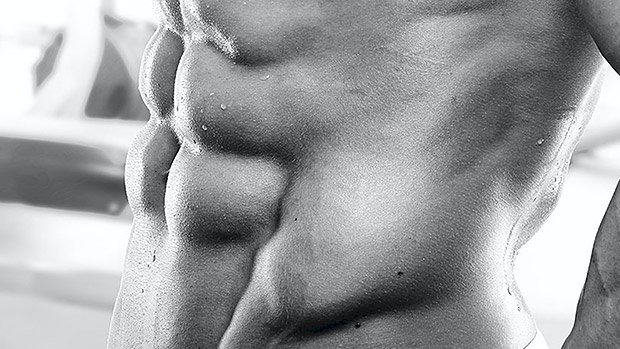
 So, the exercises presented here focus on helping you maximize the strength of your abdominals and obliques, and they also help you improve your rotational strength and power. Category 1 – Spinal Flexion Exercises Although some coaches claim that spinal flexion exercises are inherently dangerous, research has shown that those exercises can not only help promote nutrient delivery to the intervertebral discs, but may also provide superior muscle and performance gains versus isomeric ab exercises (4). However, some exercises may be contraindicated for people who have pain when performing them. In other words, spinal flexion exercises are no different than any other resistance training exercise. All exercises can induce stress, which causes tissue adaptation, but there’s a tipping point where you exceed your capacity. That’s the individual nature of training, and exactly what’s meant by training smart! That said, my top two spinal flexion exercises are stability-ball plate crunches and stability-ball reverse crunches, which is a more advanced version of a reverse crunch from the floor. Make sure you’ve got good control on regular reverse crunches before programming them. Stability Ball Plate Crunch Keep your knees bent at roughly a 90-degree angle throughout and flex and extend your spine with control over the ball. Hold the plate straight above your shoulders and reach your arms straight up toward the sky. Focus on making your knees drive the motion (bending and extending), not your abs. Stability Ball Reverse Crunch Most people use momentum and jerk their body up and down by kicking their legs to create the movement. Eliminating that momentum forces the abs to perform the action. Once you get your legs up over your body, slowly reverse this motion, lowering your spine back down toward the bench, one vertebra at a time. Don’t allow your legs to extend or your head to lift off the ball at any point. These spinal flexion exercises are my go-to movements because they allow for greater abdominal muscle stretch than floor crunches. This is important because full-range resistance training regimens, which train the muscles at long (stretched) lengths and include an eccentric component, can improve flexibility as well as, if not better than, typical static stretching. In other words, strength training at longer (stretched) muscle lengths (that includes an eccentric component) not only causes muscles to be stronger at long lengths, but also promotes flexibility by causing muscle fibers to produce new sarcomeres in series within a muscle, which allows the muscle to lengthen more (6, 7). Cable Side Bend A great example of a common exercise that doesn’t make biomechanical sense is side bends performed while holding a dumbbell on each side. Of course, the weight of the dumbbell offsets the weight on the other side, making this exercise ineffective at sufficiently loading the lateral flexors of the torso. Even performing side bends while holding a single dumbbell on one side of the body isn’t very effective at targeting the lateral core because of the angle of force involved. There’s just not much resistance. The dumbbell is very close to your body, giving you a mechanical advantage over the weight. You’d have to hold a very heavy weight, which may exceed your grip strength, to have a reasonable training effect. So instead of using dumbbells, use a single cable that’s at roughly a 45-degree angle to your body. It’s much more effective than holding a single dumbbell (or two). Stability Ball Side Crunch This exercise creates a great stretch on the lateral trunk flexors. If you’ve never done this one before, it can feel a bit awkward until you find the right foot placement against the wall and the right body position over the ball. Place your top leg about a foot-length behind your bottom leg and keep your back heel slightly off the wall while your front foot is flat against the wall. Also, position your torso over the ball such that you can create a stretch while bending over the ball without feeling like you’re going to fall over it. Lastly, make sure you move over the ball, instead of the ball moving under you. Medicine Ball or Weight Plate Side Lean Yes, this is like doing the “I’m a little teapot” dance you did as a kid. With your feet roughly hip-width apart, hold the weight plate or medicine ball directly above your head with your elbows slightly bent. While keeping the weight plate or ball directly above your head, lean your body laterally to one side and shift your hips to the opposite side until you feel a mild stretch. Reverse the motion and repeat, leaning your torso and hips to the opposite direction without pausing in the middle between reps. Category 2 – Rotational Exercises Rotary exercises are by nature cross-body exercises, which makes them a valuable aspect of strength training since rotation is such a big part of human functioning and athletics. Tight Cable Torso Rotation with Hip
Origin: Dynamic Training for Abs & Obliques
Tag: Training
Interval Training on the Rowing Ergometer
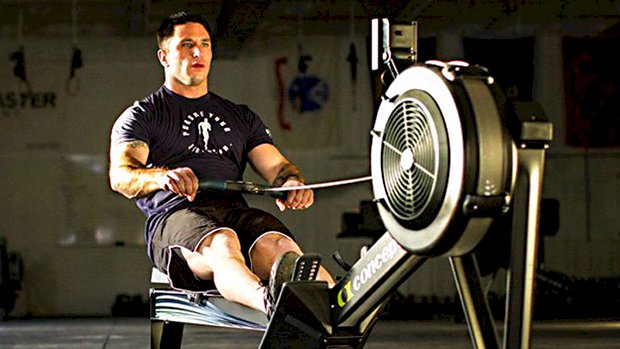 Lead Photo Credit: Again Faster Equipment (Jim Rego at CrossFit Southborough) Here’s what you need to know… The rower is unlike typical cardio machines. It’ll get you gassed immediately with zero impact on the joints. Move through your hips, not your spine. If you have back or hip issues, this may not be for you. There are a variety of workouts. Try intervals of 500-400-300-200-100 meters with 60 rest in between. Test yourself with a 2,000 meter row, or break it up into two sessions of 1,000 meters. Do 5 intervals of 300 meters with little rest in between, or just row as hard as you can for the length of a song. A Different Cardio Machine For the first decade of my career in the strength and conditioning field, I wasn’t too charitable when it came to cardio machines. But I learned the value of the rowing ergometer or “erg.” I learned this by getting my butt handed to me! Gassed, Wheezing, and Red-Faced I bought my wife a rowing machine for her birthday. Believe it or not, at an intimidating 5′ 3″, she was captain of her nationally ranked college crew team. The week we got it, I walked down to the basement to see her get after it on the erg. She was humming along, and making it look easy. I decided to hop on and try it out myself. I cranked out a 500-meter time trial and narrowly edged the 500-meter pace she’d just maintained over 2000-meter. In short, my wife kicked my ass. What’s worse, when I got off the erg I was completely gassed. When I was done wheezing, I joked with her that I couldn’t believe she used to wake up at 5 a.m. to do that in the middle of winter on an icy river. It was awful. Why was it so awful? Well, first, I was wildly inefficient with this cardio approach. Second, the stress was distributed over my entire body, so I felt like I was limited more by my ability to breathe than by local muscular endurance. Third, I’m a competitive bastard, and the thought of being out-rowed by my little wife didn’t sit well with me. So I decided I’d do it once a week as my interval training, and it’s proved to be one of the best training decisions I’ve made. Short Workout, Faster Recovery Why the love for the erg? First, you can get in a lot of work in a short amount of time. And because the stress is distributed over your entire body, rowing won’t gas your lower body like sprinting does. It’s a tough fitness challenge that can actually help you recover from heavy squatting and deadlifting — better than sprinting twice a week. Is Rowing For You? Before we get to the training protocols, note that this absolutely isn’t for everyone, so let’s outline the contraindications. You should not row if: You have symptomatic low back pain, or a history of symptomatic intervertebral disc pathology. Repeated flexion/extension of your spine is an injury mechanism for discs, particularly under compressive loading. You have hip pain of any sort. The full flexion nature of the rowing motion can exacerbate problems in this regard. You have an outrageously aberrant posture. If you’re really kyphotic (rounded shoulder), this approach to rowing will likely make it worse by feeding into your posture. You’re better off doing more controlled, lower-volume rowing variations in your strength training program in a position of thoracic extension. If you have an excessive anterior pelvic tilt and lordosis, it’ll just feed into that as well. You sit all day. If you’re at a desk for 8-10 hours a day, you really should avoid any sitting during your exercise session, and that certainly means avoiding it for 15-20 minutes at a time. You plan to do deadlifts or good mornings the following day. No matter how good your technique is, you’re still going to use your lower back a bit. I’ll typically row a day or two after I do these exercises. You have baggy shorts on. I made this mistake once. Don’t do it. Note on Technique There are coaches who devote their entire career to building elite rowers and optimizing technique. I’m not one of them. However, I do have one bit of advice: Move through your damn hips, not your spine. Got it? Good. That said, most advanced rowers pull a bit higher up, essentially toward their nipples/sternum. Effectively, it looks a bit more like an upright row — or Olympic lift pattern, when you effectively use your legs — than a true “row.” For the general fitness folks just looking for a training benefit as safely as possible, it’s probably more shoulder healthy to pull a bit lower down. The upper abs is a good reference point, even if it means you’ll go a bit slower. Rowing Workouts Use the rower for shorter duration intervals. When people who haven’t been properly educated on rowing technique try to crush 20-30 minute sessions, bad things happen. For that reason, stick to shorter bouts on the erg. Or just get up and walk around between sets, adding in some filler mobility or activation exercises. 1 – 5 x 300-meter with diminishing rest intervals The 300-meter distance is awesome because
Origin: Interval Training on the Rowing Ergometer
Tip: 3 Strength Training Mistakes to Avoid
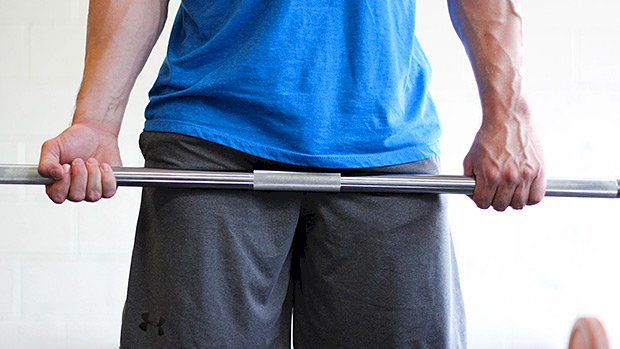 Strength Basics Getting stronger is pretty simple when you break it down. If you’re doing basic, whole-body compound movements like squatting, hinging (deadlifting etc.), pushing, pulling, and carrying heavy objects, then you’re on the right track. Unfortunately, there are a lot of people out there selling gimmicky programs and exercises that will make you anything but strong. To help you reach your goals and make sure you’re not wasting your time on someone else’s BS, don’t make these mistakes. Mistake 1 – Overcomplicating Exercises When it comes to compound movements, simple is generally better. Holding a kettlebell by the handle overhead with one arm as you do a horizontal banded press with the other arm while standing on one foot on an unstable surface is not “achieving core activation, balance, and coordination.” It’s just making you look like a douchebag. Being a functionally strong human being requires that your muscles work together to lift or resist an external load. If you’re trying to do too many things at once, your body won’t be able to recruit the necessary motor neurons to get your muscles to synergistically fire. If your body can’t get an appreciable amount of muscle involved to lift or resist an external load, then you won’t get strong. It really is as simple as that. Picking simple compound movements like the back squat, trap-bar deadlift, pull-up, and press – and doing them with a lot of weight – will make you infinitely stronger than doing combined exercises such as lunging while doing curls. Trying to do multiple movements in one exercise is like a baseball pitcher thinking he needs to take up juggling in order to throw the ball harder. Confusing your body arbitrarily doesn’t mean you’re getting any closer to achieving your goal. Mistake 2 – Doing Too Much Isolation Work If you’re a natural lifter, you need to start seeing your body as one unit instead of a lot of individual parts. If you’re the person who does chest/triceps on Mondays, legs on Tuesdays, and back/biceps on Fridays, you’re probably not seeing the results you’d like see. It’s not from a lack of effort, but from a lack of good strategy and programming. You’re in a weird situation where you’re both doing too much work and not nearly enough work at the same time. Performing ten different chest exercises for 3-5 sets each on Monday is too much volume that day (if you’re not juicing). At the same time, you’re doing nothing with the chest the rest of the week, so it’s not being worked frequently enough. If you’re on this type of program, your progress is going to stall out quickly. Instead, try to do whole-body lifts three times per week. Not sure where to start? Use the 3 day per week template below. This program will have you doing five exercises per day and will allow you to train your body frequently enough to get some results. You’ll squat, hinge, lunge, push, pull, and carry heavy objects – all the stuff that makes a person strong. Day 1 A1 Back Squat:5×5 A2 Dumbbell Bench Press:5×8 A3 1-Arm Dumbbell Row:5×10 B1 Farmer’s Walk:3×20 yards B2 Pallof Press: 3×10 each side Day 2 A1 Standing Barbell Strict Press:5×5 A2 Pull-Up:5×8 A3 Step-Back Lunges:5×8 each B1 Waiter’s Carry: 3×20 yards B2 Hanging Knee Raises:3×10 Day 3 A1 Trap Bar Deadlift:3×5 A2 Incline Dumbbell Bench Press:5×8 A3 Chest-Supported Row:5×10 B1 Suitcase Carry (a farmer’s walk carrying weight only on one side):3×20 yards B2 Cable Chop: 3×10 each side Mistake 3 – Using Percentage Training (If You’re a Newbie) When you’re just starting out, using a program based off a percentage of your one rep max is a mistake. Asking strong guys what program they’re doing can help you with your goals, but only if you have a similar training background. If you’re a beginner and the person you’re asking recommends a program based off a percentage of your 1RM, you should probably find a new program. New lifters shouldn’t be basing anything off of a one rep max because they don’t have the experience to perform a true 1RM. The first couple of weeks when you begin a weight training program are some of the most fun weeks you’ll ever have. You’ll make tremendous progress because you’re learning to recruit motor neurons to carry out new movement patterns. The strength gains you make for the first 4-8 weeks will come in leaps and bounds, so you shouldn’t be limiting yourself by basing your program off of the perceived 1RM you could do on day one. Instead, try to work up to a weight that causes you technical failure: go as heavy as you can until your technique starts to break down. Do this for approximately 6 months to a year as you vary your exercises and rep ranges. Adopt a program based on percentages AFTER you’ve become proficient at your
Origin: Tip: 3 Strength Training Mistakes to Avoid
Interval Training on the Rowing Ergometer
 Lead Photo Credit: Again Faster Equipment (Jim Rego at CrossFit Southborough) Here’s what you need to know… The rower is unlike typical cardio machines. It’ll get you gassed immediately with zero impact on the joints. Move through your hips, not your spine. If you have back or hip issues, this may not be for you. There are a variety of workouts. Try intervals of 500-400-300-200-100 meters with 60 rest in between. Test yourself with a 2,000 meter row, or break it up into two sessions of 1,000 meters. Do 5 intervals of 300 meters with little rest in between, or just row as hard as you can for the length of a song. A Different Cardio Machine For the first decade of my career in the strength and conditioning field, I wasn’t too charitable when it came to cardio machines. But I learned the value of the rowing ergometer or “erg.” I learned this by getting my butt handed to me! Gassed, Wheezing, and Red-Faced I bought my wife a rowing machine for her birthday. Believe it or not, at an intimidating 5′ 3″, she was captain of her nationally ranked college crew team. The week we got it, I walked down to the basement to see her get after it on the erg. She was humming along, and making it look easy. I decided to hop on and try it out myself. I cranked out a 500-meter time trial and narrowly edged the 500-meter pace she’d just maintained over 2000-meter. In short, my wife kicked my ass. What’s worse, when I got off the erg I was completely gassed. When I was done wheezing, I joked with her that I couldn’t believe she used to wake up at 5 a.m. to do that in the middle of winter on an icy river. It was awful. Why was it so awful? Well, first, I was wildly inefficient with this cardio approach. Second, the stress was distributed over my entire body, so I felt like I was limited more by my ability to breathe than by local muscular endurance. Third, I’m a competitive bastard, and the thought of being out-rowed by my little wife didn’t sit well with me. So I decided I’d do it once a week as my interval training, and it’s proved to be one of the best training decisions I’ve made. Short Workout, Faster Recovery Why the love for the erg? First, you can get in a lot of work in a short amount of time. And because the stress is distributed over your entire body, rowing won’t gas your lower body like sprinting does. It’s a tough fitness challenge that can actually help you recover from heavy squatting and deadlifting — better than sprinting twice a week. Is Rowing For You? Before we get to the training protocols, note that this absolutely isn’t for everyone, so let’s outline the contraindications. You should not row if: You have symptomatic low back pain, or a history of symptomatic intervertebral disc pathology. Repeated flexion/extension of your spine is an injury mechanism for discs, particularly under compressive loading. You have hip pain of any sort. The full flexion nature of the rowing motion can exacerbate problems in this regard. You have an outrageously aberrant posture. If you’re really kyphotic (rounded shoulder), this approach to rowing will likely make it worse by feeding into your posture. You’re better off doing more controlled, lower-volume rowing variations in your strength training program in a position of thoracic extension. If you have an excessive anterior pelvic tilt and lordosis, it’ll just feed into that as well. You sit all day. If you’re at a desk for 8-10 hours a day, you really should avoid any sitting during your exercise session, and that certainly means avoiding it for 15-20 minutes at a time. You plan to do deadlifts or good mornings the following day. No matter how good your technique is, you’re still going to use your lower back a bit. I’ll typically row a day or two after I do these exercises. You have baggy shorts on. I made this mistake once. Don’t do it. Note on Technique There are coaches who devote their entire career to building elite rowers and optimizing technique. I’m not one of them. However, I do have one bit of advice: Move through your damn hips, not your spine. Got it? Good. That said, most advanced rowers pull a bit higher up, essentially toward their nipples/sternum. Effectively, it looks a bit more like an upright row — or Olympic lift pattern, when you effectively use your legs — than a true “row.” For the general fitness folks just looking for a training benefit as safely as possible, it’s probably more shoulder healthy to pull a bit lower down. The upper abs is a good reference point, even if it means you’ll go a bit slower. Rowing Workouts Use the rower for shorter duration intervals. When people who haven’t been properly educated on rowing technique try to crush 20-30 minute sessions, bad things happen. For that reason, stick to shorter bouts on the erg. Or just get up and walk around between sets, adding in some filler mobility or activation exercises. 1 – 5 x 300-meter with diminishing rest intervals The 300-meter distance is awesome because
Origin: Interval Training on the Rowing Ergometer
Interval Training on the Rowing Ergometer
 Lead Photo Credit: Again Faster Equipment (Jim Rego at CrossFit Southborough) Here’s what you need to know… The rower is unlike typical cardio machines. It’ll get you gassed immediately with zero impact on the joints. Move through your hips, not your spine. If you have back or hip issues, this may not be for you. There are a variety of workouts. Try intervals of 500-400-300-200-100 meters with 60 rest in between. Test yourself with a 2,000 meter row, or break it up into two sessions of 1,000 meters. Do 5 intervals of 300 meters with little rest in between, or just row as hard as you can for the length of a song. A Different Cardio Machine For the first decade of my career in the strength and conditioning field, I wasn’t too charitable when it came to cardio machines. But I learned the value of the rowing ergometer or “erg.” I learned this by getting my butt handed to me! Gassed, Wheezing, and Red-Faced I bought my wife a rowing machine for her birthday. Believe it or not, at an intimidating 5′ 3″, she was captain of her nationally ranked college crew team. The week we got it, I walked down to the basement to see her get after it on the erg. She was humming along, and making it look easy. I decided to hop on and try it out myself. I cranked out a 500-meter time trial and narrowly edged the 500-meter pace she’d just maintained over 2000-meter. In short, my wife kicked my ass. What’s worse, when I got off the erg I was completely gassed. When I was done wheezing, I joked with her that I couldn’t believe she used to wake up at 5 a.m. to do that in the middle of winter on an icy river. It was awful. Why was it so awful? Well, first, I was wildly inefficient with this cardio approach. Second, the stress was distributed over my entire body, so I felt like I was limited more by my ability to breathe than by local muscular endurance. Third, I’m a competitive bastard, and the thought of being out-rowed by my little wife didn’t sit well with me. So I decided I’d do it once a week as my interval training, and it’s proved to be one of the best training decisions I’ve made. Short Workout, Faster Recovery Why the love for the erg? First, you can get in a lot of work in a short amount of time. And because the stress is distributed over your entire body, rowing won’t gas your lower body like sprinting does. It’s a tough fitness challenge that can actually help you recover from heavy squatting and deadlifting — better than sprinting twice a week. Is Rowing For You? Before we get to the training protocols, note that this absolutely isn’t for everyone, so let’s outline the contraindications. You should not row if: You have symptomatic low back pain, or a history of symptomatic intervertebral disc pathology. Repeated flexion/extension of your spine is an injury mechanism for discs, particularly under compressive loading. You have hip pain of any sort. The full flexion nature of the rowing motion can exacerbate problems in this regard. You have an outrageously aberrant posture. If you’re really kyphotic (rounded shoulder), this approach to rowing will likely make it worse by feeding into your posture. You’re better off doing more controlled, lower-volume rowing variations in your strength training program in a position of thoracic extension. If you have an excessive anterior pelvic tilt and lordosis, it’ll just feed into that as well. You sit all day. If you’re at a desk for 8-10 hours a day, you really should avoid any sitting during your exercise session, and that certainly means avoiding it for 15-20 minutes at a time. You plan to do deadlifts or good mornings the following day. No matter how good your technique is, you’re still going to use your lower back a bit. I’ll typically row a day or two after I do these exercises. You have baggy shorts on. I made this mistake once. Don’t do it. Note on Technique There are coaches who devote their entire career to building elite rowers and optimizing technique. I’m not one of them. However, I do have one bit of advice: Move through your damn hips, not your spine. Got it? Good. That said, most advanced rowers pull a bit higher up, essentially toward their nipples/sternum. Effectively, it looks a bit more like an upright row — or Olympic lift pattern, when you effectively use your legs — than a true “row.” For the general fitness folks just looking for a training benefit as safely as possible, it’s probably more shoulder healthy to pull a bit lower down. The upper abs is a good reference point, even if it means you’ll go a bit slower. Rowing Workouts Use the rower for shorter duration intervals. When people who haven’t been properly educated on rowing technique try to crush 20-30 minute sessions, bad things happen. For that reason, stick to shorter bouts on the erg. Or just get up and walk around between sets, adding in some filler mobility or activation exercises. 1 – 5 x 300-meter with diminishing rest intervals The 300-meter distance is awesome because
Origin: Interval Training on the Rowing Ergometer
Interval Training on the Rowing Ergometer
 Lead Photo Credit: Again Faster Equipment (Jim Rego at CrossFit Southborough) Here’s what you need to know… The rower is unlike typical cardio machines. It’ll get you gassed immediately with zero impact on the joints. Move through your hips, not your spine. If you have back or hip issues, this may not be for you. There are a variety of workouts. Try intervals of 500-400-300-200-100 meters with 60 rest in between. Test yourself with a 2,000 meter row, or break it up into two sessions of 1,000 meters. Do 5 intervals of 300 meters with little rest in between, or just row as hard as you can for the length of a song. A Different Cardio Machine For the first decade of my career in the strength and conditioning field, I wasn’t too charitable when it came to cardio machines. But I learned the value of the rowing ergometer or “erg.” I learned this by getting my butt handed to me! Gassed, Wheezing, and Red-Faced I bought my wife a rowing machine for her birthday. Believe it or not, at an intimidating 5′ 3″, she was captain of her nationally ranked college crew team. The week we got it, I walked down to the basement to see her get after it on the erg. She was humming along, and making it look easy. I decided to hop on and try it out myself. I cranked out a 500-meter time trial and narrowly edged the 500-meter pace she’d just maintained over 2000-meter. In short, my wife kicked my ass. What’s worse, when I got off the erg I was completely gassed. When I was done wheezing, I joked with her that I couldn’t believe she used to wake up at 5 a.m. to do that in the middle of winter on an icy river. It was awful. Why was it so awful? Well, first, I was wildly inefficient with this cardio approach. Second, the stress was distributed over my entire body, so I felt like I was limited more by my ability to breathe than by local muscular endurance. Third, I’m a competitive bastard, and the thought of being out-rowed by my little wife didn’t sit well with me. So I decided I’d do it once a week as my interval training, and it’s proved to be one of the best training decisions I’ve made. Short Workout, Faster Recovery Why the love for the erg? First, you can get in a lot of work in a short amount of time. And because the stress is distributed over your entire body, rowing won’t gas your lower body like sprinting does. It’s a tough fitness challenge that can actually help you recover from heavy squatting and deadlifting — better than sprinting twice a week. Is Rowing For You? Before we get to the training protocols, note that this absolutely isn’t for everyone, so let’s outline the contraindications. You should not row if: You have symptomatic low back pain, or a history of symptomatic intervertebral disc pathology. Repeated flexion/extension of your spine is an injury mechanism for discs, particularly under compressive loading. You have hip pain of any sort. The full flexion nature of the rowing motion can exacerbate problems in this regard. You have an outrageously aberrant posture. If you’re really kyphotic (rounded shoulder), this approach to rowing will likely make it worse by feeding into your posture. You’re better off doing more controlled, lower-volume rowing variations in your strength training program in a position of thoracic extension. If you have an excessive anterior pelvic tilt and lordosis, it’ll just feed into that as well. You sit all day. If you’re at a desk for 8-10 hours a day, you really should avoid any sitting during your exercise session, and that certainly means avoiding it for 15-20 minutes at a time. You plan to do deadlifts or good mornings the following day. No matter how good your technique is, you’re still going to use your lower back a bit. I’ll typically row a day or two after I do these exercises. You have baggy shorts on. I made this mistake once. Don’t do it. Note on Technique There are coaches who devote their entire career to building elite rowers and optimizing technique. I’m not one of them. However, I do have one bit of advice: Move through your damn hips, not your spine. Got it? Good. That said, most advanced rowers pull a bit higher up, essentially toward their nipples/sternum. Effectively, it looks a bit more like an upright row — or Olympic lift pattern, when you effectively use your legs — than a true “row.” For the general fitness folks just looking for a training benefit as safely as possible, it’s probably more shoulder healthy to pull a bit lower down. The upper abs is a good reference point, even if it means you’ll go a bit slower. Rowing Workouts Use the rower for shorter duration intervals. When people who haven’t been properly educated on rowing technique try to crush 20-30 minute sessions, bad things happen. For that reason, stick to shorter bouts on the erg. Or just get up and walk around between sets, adding in some filler mobility or activation exercises. 1 – 5 x 300-meter with diminishing rest intervals The 300-meter distance is awesome because
Origin: Interval Training on the Rowing Ergometer
 All about sport xlsport.club