
 People often ask why training in the evening is such a bad thing. Wait, is it? Yep. It has to do with cortisol production. Training spikes cortisol. So let’s look at what cortisol does. Its main function is putting your body in the best possible state to face danger or stress. It mobilizes stored energy, increases wakefulness, and shuts down the immune system momentarily so you have more energy for the muscles and organs, which are needed to face the stress. It also amps up the brain, mostly by increasing the conversion of noradrenaline to adrenaline. The ideal cortisol cycle is high in the morning and low in the evening. The cortisol spike in the morning is what makes you wake up (when you wake up on your own). The cortisol spike also increases adrenaline levels, which assist in waking you up too. Then, as your cortisol decreases in the evening, it puts your autonomous nervous system in parasympathetic mode – also known as rest-and-recover mode. That allows you to fall asleep more easily, recover better, get more time in deep sleep, and have a higher production of growth hormone. If your cortisol stays elevated in the evening, it’ll be much harder to fall asleep and get quality deep sleep. That’s why training in the evening isn’t the best choice. Let’s say you do train at night regularly and have restless sleep as a result. This may lead to chronically elevated cortisol, which is bad for your gainz, bro. First because cortisol increases protein breakdown. The amount of muscle you build is a function of the difference between protein synthesis (anabolism) and protein breakdown (catabolism). If you break down more it’ll be harder to add muscle tissue, especially if you’re a natural lifter. Then there’s the impact on myostatin. Myostatin is a myoprotein that plays a role in how much muscle your body will allow you to carry. The more myostatin you have, the less muscle you can build. Well, cortisol can increase myostatin and inhibit muscle growth. It also decreases the rate of muscle glycogen resynthesis – storing glycogen in the muscles after you used it up during training – delaying recovery. For all of these reasons, the more you can spike cortisol from training in the earlier part of your day, the more you can respect the natural cycle of your body and the better you’ll recover. Enhanced lifters have fewer problems because steroids decrease the action of cortisol significantly. But natural lifters need every advantage they can get. Who Can Get Away With It? Now, some people can actually pull evening training off: those who fall asleep easily even if they’ve had a killer workout two hours prior. Normally these guys have either a high level of GABA or a high level of serotonin, allowing them to shut their CNS down as soon as the workout is over, putting them in parasympathetic mode. Ingesting your carbs in the evening (post-workout) can also help lower CNS activation and decrease cortisol if you train at
Origin: Tip: Why Evening Training is the Worst
Tag: Training
The Truth About Rest-Pause Training
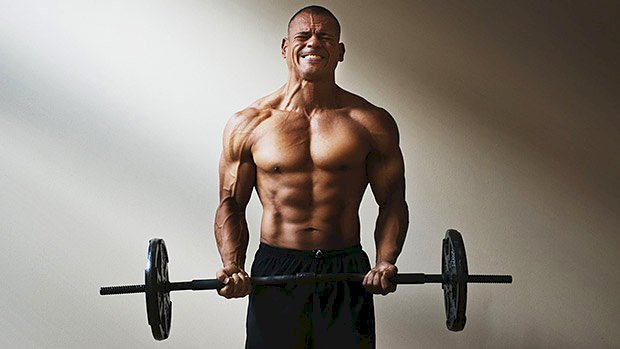 Wait, What’s Rest-Pause Training? Rest-pause is an intensity extending method that’s long been praised for its strength and hypertrophy benefits. It’s where you perform an exercise to technical failure. After your initial set, you pause briefly. This “rest period” is typically 15-30 seconds. Then you’ll do another set until failure before taking another brief break. You do this until you’ve completed a targeted number of total reps. The total reps you choose depends on a variety of factors, but generally speaking, it should be double the amount of reps you were able to perform during the first initial set. So for example, if I were able to bench a weight for 8 reps in the first set, I’d aim to accumulate 8 more reps in the following sets to hit the targeted total of 16. Here’s what that might look like: Set 1:8 reps to failure (8 total reps completed) 15 seconds rest Set 2:4 reps to failure (12 total reps completed) 15 seconds rest Set 3:2 reps to failure (14 total reps completed) 15 seconds rest Set 4:1 rep to failure (15 total reps completed) 15 seconds rest Set 5:1 rep to failure (16 total reps completed) Does It Work? Yes, it can work for both muscle and strength gains because you’re able to maintain high motor unit recruitment. It also allows you to use the same high loads for all sets, unlike something like drop sets where you reduce the load with each subsequent set. Anyone who’s tried rest-pause knows it works… to a degree. The research confirms its efficacy, too, but a lot of coaches have probably exaggerated how well it works, especially as it relates to strength and size. Are the benefits of rest-pause more from the rep scheme itself, or is it just a matter of basic lifting principles like intensity, volume, and effort? I’d argue it’s more of the latter, especially when you compare it to boring old traditional lifting where you do a set, take a full rest period, and then do another set. Rest-Pause and Hypertrophy A 6-week study comparing strength, hypertrophy, and muscular endurance between rest-pause training and traditional training found all measures were equal after the study, except lower body endurance and lower body hypertrophy, both of which were higher in the rest-pause group (1). If taken at face value, this study shows you can get equal strength but induce more muscle growth and more endurance benefits by switching from traditional sets to rest-pause sets. However, if you look a little closer, you’ll realize you probably can’t have your cake and eat it too. Both groups (which included both men and women) trained 4 times a week with 2 days designated as upper-body push days and 2 days devoted to training back, biceps, and legs. The rest-pause group lifted with 80% of 1-rep max to failure with a rest-pause protocol that included 20-second rest periods between sets until lifters reached 18 total reps. The traditional group did each exercise for 3 sets of 6 using 80% of 1-rep max. They rested 2 to 3 minutes between sets. This study should get a lot of credit as its design was better than most studies. It used trained individuals, controlled for the same 1-rep max, and made sure both groups did 18 total reps, but unfortunately there were some issues that would obviously favor the rest-pause group: 1 – Intensity was matched, but effort wasn’t. Both groups used their respective 80% of 1-rep max, but the rest-pause group trained to failure while the traditional group not only didn’t train to failure but couldn’t have, given their protocol. The traditional group did 3 sets of 6 at the same load of 80% of 1-rep max. In general, someone using 80% of 1-rep max load should be able to crank out at least 7-8 reps when taken to failure (6), but they were only instructed to do 6 reps per set. Furthermore, if you consider the following personal differences, the participants might have easily done an even greater number or reps: Individual differences:Research consistently shows that different people can crank out a different number of reps even with the same 1-rep max (2). Adaptation differences:The more endurance you have, the more reps you can complete before failure at a given 1-rep max percentage, even when using as high as an 80% load (3). Gender differences:Women can perform more reps given the same 1-rep max (4). Any guy who’s trained with a girl can easily testify to this. Some women are just insane volume queens. Considering all this, there are plenty of reasons to think the traditional lifting group stopped short of, or pretty far from, failure. The study had another problem, too. 2 – Progressive overload wasn’t matched. The rest-pause group used progressive overload, but not the traditional group. Since the rest-pause group was instructed to train to failure until reaching 18 total reps, progressive overload was naturally built into their program. Hypothetically speaking, as they got stronger, their weekly progression for a given exercise could’ve looked something like
Origin: The Truth About Rest-Pause Training
Tip: Simple Power Training for Muscle
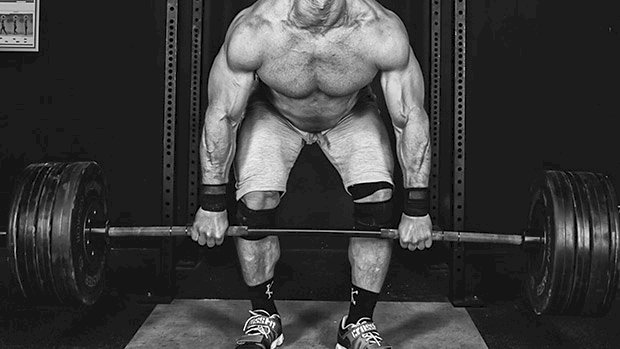 How many lifters train to become more powerful? Do YOU make power training part of your program? Well, you should consider it. You’ll unlock more strength, more athleticism, and more muscle. How’s That Work? Power is the ability to produce force quickly. And remember, as you age you lose power twice as fast as strength. But a recent study by Franchi et al. showed that plyometric training is an effective intervention. It produces a rapid increase in muscle mass and power, no matter your age. Jumping, throwing, sprinting, and the Olympic lifts will heavily recruit fast twitch muscle fibers (which have the highest propensity for growth) as well as help improve your athleticism and prime your nervous system for the heavier strength training that follows. Luckily, this doesn’t require a complete program overhaul, just a few extra minutes and a bit of planning. Looking at the force velocity curve, the far left is max strength. This is the heavy stuff, and of course the loads don’t move very fast. This is where most lifters spend the majority of their time, and rightfully so. However, if you never venture outside of that, you’re leaving a lot of progress on the table. As you slide down the curve, the loads will lighten up and the speed of movement will increase. Knowing what you’re trying to accomplish will help you pick the right tools at the right loads for the task at hand. For example, if you’re performing 10 reps of hang cleans, you’re not really training strength-speed like you might think. The speed of the reps isn’t fast enough to be improving speed-strength either. You end up in a middle ground: doing things that make you tired, but don’t make you more powerful. Or maybe you’re using a medicine ball that’s far too heavy to throw fast enough to make any improvement in the speed-strength area, or “sprinting” for a minute or so. Again, the tools aren’t the issue, but the application of them needs to be better. How To Do It Better Before your strength training sessions, pick one or two movements from various sections on the force velocity curve that match up with the main movement pattern you’ll be tackling in your lifting. Here are some ideas: Squat Olympic lifts Box jumps Loaded squat jumps Heavy sled marches (10 yards) Sled sprints (10-20 yards) Single-leg hurdles Short sprints Deadlift Olympic lifts Heavy sled marches (10 yards) Sled sprints (10-20 yards) Loaded trap bar jumps Broad jumps Kettlebell swings Short sprints Upper Body Days Medicine ball throws: chest passes, lateral throws, overhead soccer throws, slams Keep your reps on the low end. Make sure the last rep of each set is just as explosive as the first. As a rule of thumb, do 2-4 sets of 3-10 reps. The lighter the implement, generally the higher the rep range (8 medicine ball throws isn’t the same as 8 dumbbell snatches). The trickiest part of training for power is figuring out how much weight to use on things like sled sprints and loaded jumps. Remember, moving with speed is the goal, not loading the movements up so heavy that you hardly leave the ground or are moving at the speed of smell. And don’t get caught up in the “more is better” game. More just means slower, and slower doesn’t equate to more
Origin: Tip: Simple Power Training for Muscle
Why You’re Wrong About Machine Training
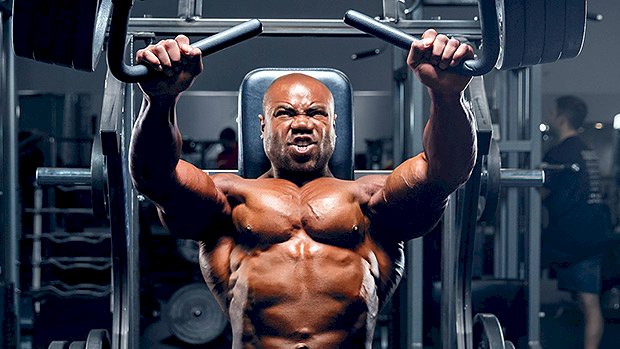 I Used to be Anti-Machine Like many people who came to lifting heavy objects via the sports of weightlifting and powerlifting, I viewed machines with contempt. I believed people who used them lacked the intestinal fortitude to learn how to use free weights (which are “obviously” superior). Thankfully, I’ve managed to evolve to a less ideological viewpoint, opting for one that’s more evidence-based instead. I ask myself a simple question: “What’s the best way to get big and strong?” Answering this question allows me to be much more open and objective to considering any and all rational methods that take me from point A to point B. I care about the result, not how you get the result. And that’s what allowed me to view machine training in an altogether different light. An Evidence-Based Discussion Current scientific thinking suggests that muscles get bigger and stronger when they’re exposed to unaccustomed levels of tension. The magnitude of that tension is most important for strength goals, and the volume of that tension – the number of times your muscles experience tension per unit of time – matters most for hypertrophy (size) development. Both machine and free weight exercises expose your muscles to tension, but with slightly different pros and cons. So abandon your ideological thinking and think of both options simply as tools that have varying degrees of utility, depending on context and circumstances. And remember, you’re not restricted to one or the other. Machines and Free Weights: The Key Differences By definition, a machine-based exercise is a movement where you’re required to exert force against a resistance without needing to do much in the way of controlling that force, at least compared to similar free-weight exercises. Let’s examine two very similar exercises – the Smith machine squat and the barbell squat. They both stimulate the same muscles, but in slightly different ways. Let’s examine the pros and cons… Advantages of the Smith Machine Squat More technique options. Because the bar slides up and down a fixed rail, you can do a number of things you can’t do with a barbell, like placing your feet in front of (instead of directly under) the bar. This strategy allows you to assume a more upright position than you could achieve with a barbell squat, which means greater quadriceps recruitment. You can use more weight because you don’t need to balance or stabilize. This results in more muscular tension, which in turn equates to more pronounced strength and hypertrophy adaptations. The Smith machine is much more forgiving of relatively minor errors such as positioning yourself slightly off-center under the bar. Disadvantages of the Smith Machine Squat It doesn’t require you to control bar path. While this is the most often-cited criticism of machine training, I’ve never once – in my many years of studying motor unit recruitment – come across the notion that control was a necessary or even a desirable precondition for strength or muscle development. Again, muscle fibers adapt and grow when they’re forced to generate high levels of tension. Not only do Smith and barbell squats both afford the ability to provide this tension, in many cases, the Smith squat is a better way to provide this tension. If you only squat on a Smith machine, you’ll never learn how to do a proper barbell squat. While undeniably true, I wonder how consequential this really is, assuming that you don’t plan to compete in powerlifting. It’s much like pointing out that if you only play the piano, you’ll never learn to properly play the organ. If the goal is organ mastery, this is a problem. But if the goal is to cultivate more generalized musical skills, it’s not. The strength acquired by using free weight exercises has greater positive transfer to many “real world” skills. While we’re now at least getting into a more plausible defense of free weights, the concept of transfer is often poorly understood and applied, largely because movement structure is only one component of transfer. Now, don’t get me wrong, movement structure certainly matters. For example, it’s intuitively obvious that the strength gained from squatting will positively transfer better to a vertical jump than the strength you’d acquire doing leg extensions, mostly because the structure of a squat is much more similar to a jump than the structure of a leg extension. However, if you’re comparing the positive transfer potentials of Smith and barbell squats, there’s really not a whole lot of difference between the two, unless you place your feet considerably in front of the bar when Smith squatting. But even here, the differences are relatively minor. But does needing to control your muscular efforts during a barbell squat transfer over? While there might be something to this, unless you find the vertical jump to be a complex maneuver (in terms of balance and/or overall body control), I’m far from convinced that barbell squatting would offer a
Origin: Why You’re Wrong About Machine Training
Tip: Ramp Up Your Prowler Training
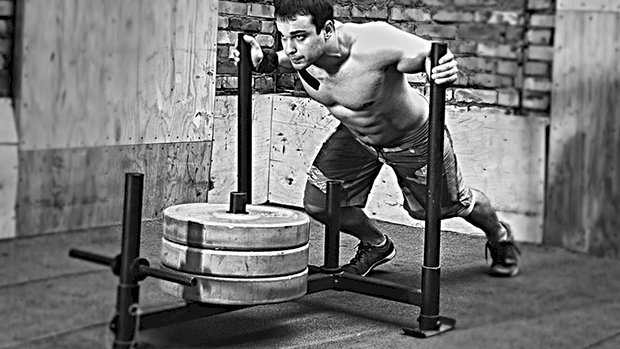 There are variables when it comes to sled pushing, like the height of the handles, the height of the pusher, and whether you push the sled with straight arms or bent arms. Since the bent-arm style usually involves a slightly more upright torso position, it tends to create a shorter stride length than when you push on the handles with your arms extended. Most people can push more weight on the Prowler-style sled with the bent-arm pushing style, so the weight-load you use can influence your arm position. When you’re pushing heavier loads for shorter distances or durations, you may want to choose the bent-arm position. Conversely, when you’re and pushing the sled for longer distances or durations with lighter loads, you may want to go with using the straight-arm position. Straight Arm vs. Bent-Arm Sled Pushes Here’s how to take advantage of this straight arm/bent arm distinction and get more out of your Prowler work: Straight-Arm, Then Bent-Arm With Same Weight: Take advantage of the fact that the bent-arm position is slightly easier because of the reduced range of (stride) motion. You can increase your work volume by extending a set of pushes by switching from the straight-arm version to the bent-arm version when fatigue starts to set in. Straight-Arm, Then Bent-Arm With Heavier Weight: Do 2-3 sets of straight-arm pushes. Then do a few more sets of bent-arm pushes using a heavier load for roughly the same distance or duration. Bent-Arm, Then Straight-Arm With Lighter Weight: This is the reverse of the previous strategy. Do a few sets of pushes with bent-arms, followed by a few more set with a straight-arm using a lighter weight. In this scenario, the bent-arm sets are done first using heavy loads for shorter distances or durations. You then do the straight-arm sets with lighter loads for longer distances or
Origin: Tip: Ramp Up Your Prowler Training
Growth Factor Chest Training
 Here’s what you need to know… To make a muscle grow, put it under constant tension for 50-70 seconds. This technique mimics the benefits of occlusion training. Occlusion training deprives the target muscle of oxygen during lifting and increases the release of growth factors in a muscle. The growth factor workout is a series of complexes that place your pecs under constant tension. You’ll use several flye and press variations. Contract the pecs. Focus on squeezing at the top. Don’t just go through the motions. Muscle Growth: The Short Version To build a muscle, make it release local growth factors. How? By keeping it under constant tension for 50-70 seconds. This does two things: A lot of lactate and hydrogen ions will accumulate inside the muscle. The muscle will be put in a relative hypoxic state – not enough oxygen enters the muscle which becomes oxygen-deprived. The result? Muscle growth is triggered. Growth Factor Training Growth factors are substances such as insulin-like growth factors (IGF-1, IGF-2) and mechanical growth factors (MGF) that have a very high impact on protein synthesis (muscle building). Stimulate the release of these in a muscle and you’ll build it. Studies have shown that growth factors are stimulated mostly via an accumulation of lactate/hydrogen ions inside the target muscle as well as depriving the target muscle of oxygen during lifting. The latter was found when doing studies on occlusion training: performing sets where blood flow to the muscle is greatly reduced by wearing a compressive cuff. Doing so diminishes oxygen transport to the muscles as well as the clearance of metabolic waste (lactate/hydrogen ions). Sets under these conditions have shown a similar hypertrophy response even when very light weights were used compared to regular, heavier sets. Researchers found that the main contributing factor was the release of growth factors. But you don’t have to create an occlusion with a pressure cuff to get the same effect. When a muscle is either tensed (flexing) or stretched, blood entry inside the muscle is greatly reduced. Less oxygen gets in and less metabolic waste is taken out, which creates the same effect as occlusion training in regard to the release of growth factors. How to Mimic The Effects of Occlusion To mimic the beneficial effects of occlusion training, keep the muscles contracted for 50-70 seconds. Out of those 50-70 seconds, spend as much time as possible with the muscles being flexed. So it’s not just about doing the exercises for the duration required, but about focusing on keeping them under tension/flexed throughout. Sure, you could simply perform one exercise for 50-70 seconds non-stop. But there are several reasons to do compounded exercises in one set: It’s easier mentally. You can maintain better focus (after doing an exercise for more than 30 seconds it’s easy to lose focus). It allows you to hit a greater variety of muscle fibers. You can use a bit more weight overall for each exercise (since you have fewer reps of each than you would if you only did one exercise for the same duration). First, Heavy Work Start the chest growth factor workout with a “heavier” exercise that’s still in line with the growth factor way of thinking – longer time under tension – but doesn’t require all the principles (constant tension, constant focus on the pecs). The whole upper body benefits from training heavier on the bench press, and doing so will “turn on” the pecs which will make the subsequent pump work more effective. One method is a multi-contraction drop set. It requires some specific equipment: light resistance bands and Mark Bell’s slingshot. I find this to be the best option but I’ll provide other ones for those who don’t have these tools. Bench Press First do 5 reps with added band resistance. Then remove the bands and immediately do 5 more reps. Then put on the slingshot and pump out as many reps as you can. Do 3 sets. If you don’t have access to a slingshot and bands here are two options you can use: Option 1 5 reps bench press, then as many top-half bench press reps as possible (going down until elbows are just above 90 degrees). Then hold the top position, squeezing the pecs for 15-30 seconds. Option 2 5 reps: Bench press, close-grip 5 reps: Bench, mid-grip 5 reps: Bench, wide-grip Take 10 seconds between each step. Growth Factor Work Complex 1: Press Medley Start with a medley that will blow up your pecs in only one set. This is brutal work even though light weights are used. It’s a long complex, so pay attention! Here’s the whole thing, then I’ll go through the individual elements below: 8-10 reps: Incline dumbbell press, reverse grip Max reps: Incline dumbbell press, regular grip (same weight) Max reps: Push-up, feet elevated Max reps: Flat dumbbell press, reverse grip (same weight) Max reps: Flat dumbbell press, regular grip (same weight) Max reps: Push-up The reverse grip dumbbell press is a great way to hit the upper
Origin: Growth Factor Chest Training
Hard Body Training for Women
 Here’s what you need to know… Women tend to have a higher pain tolerance when it comes to training, can recover faster between sets, and are able to sustain a higher volume of work. Men are welcome to try the program, but they may not be able to hang! This program has you training the same muscles two days in a row: heavy lifting the first day and pump work for the same muscles the next day. Training the same muscles two days in a row facilitates recovery and lengthens the duration of the anabolic phase. The workout plan calls for five mandatory training days per week with an optional sixth day. That extra day will help you get leaner super fast, but you’ll get amazing results with just the five main workouts. What To Expect This program will be uncomfortable at times, painful at others. It will force you to focus on performance. You’ll get stronger, faster, more powerful, and more resilient. The end result will be fat loss, more muscle in the right places, and a strong body. This is the type of training I used with one of my clients who won her first two physique competitions this year, training without drugs, while having two kids and a full time job working construction. Can Men Do It? Maybe, If They’re Woman Enough Can guys do this program? Sure, they can try. Muscle is muscle and we’re all the same species, but women don’t have the same needs when it comes to building an aesthetic physique. They don’t need to emphasize building the pecs. Instead, they need more focus on the glutes. And since they need muscular but not massive arms, tons of direct arm work isn’t necessary. Women also tend to have a higher pain tolerance when it comes to training. Females can recover faster between sets, and are able to sustain a higher volume of work during a session. So if you’re a guy, you’re welcome to try the program, but it will be even more uncomfortable for you! The Basic Structure The program calls for five mandatory training days per week with an optional sixth day. That extra day will help you get lean faster, but you’ll get amazing results with just the five main workouts. This program uses a cool concept: train the same muscles two days in a row. You hit them hard with heavy lifting the first day and then you do pump work for the same muscles the next day. This actually facilitates recovery and lengthens the duration of the anabolic phase. Protein synthesis stays elevated for 24 hours post-training, but by having a second session the next day that’s less traumatic, you extend protein synthesis significantly, thus building more muscle. It’s important that the second session is pump work and not heavy lifting, though. We don’t want to cause any muscle damage on that second day. We only want to activate the cell signaling responsible for stimulating hypertrophy and pumping nutrients into the muscles. I also include metabolic conditioning (metcon) to get you lean fast without risking the loss of muscle mass. The metcon will actually help you build more muscle while getting leaner. Explosive work also plays a big role in the program. It increases the insulin sensitivity of muscle, making you more prone to storing ingested nutrients in the muscles instead of the fat cells. Additionally, explosive work gives the body a harder, more sculpted look by improving myogenic tone. The schedule looks like this: Monday: Lower body strength/hypertrophy work Tuesday: Lower body pump complex/lower body metcon Wednesday: Upper body strength/hypertrophy work Thursday: Upper body pump complex/upper body metcon Friday: Optional sprint/energy systems session Saturday: Whole body explosive work Sunday: OFF Load Progression The program uses two main systems of progression: programmed progression and double progression. Programmed progression refers to a cycle where the weights are planned in advance based on your 1RM. So you’ll need to establish your maximum load for one technically solid rep on the back squat, push press, and power clean from the hang. The percentages used during this whole program are all based on that 1RM. Double progression is a system where you have a target rep range instead of a precise number of reps to do, 6 to 8, for example. You will use the same weight for all your work sets. The goal is to be able to do all the work sets with the upper limit of the range (8 in our example) with the same weight. When you’re able to do that, you increase the weight at your next session. If you can’t get 8 reps for all of your work sets, that’s fine, but it means that you’ll keep the same weight during next week’s workout. So when you see a percentage given for an exercise below, it uses the planned progression. When you don’t see a percentage, it means you’ll use the double progression approach. The Program Monday Exercise Wk Sets x Reps %1RM Rest A Box Jump 3 x 10 B Back Squat 1 2 3 4 5 6 7 8 9 10 5 x 4 5 x 5 5 x 6 3 x 3 5 x 3 6 x 3 3 x 3 3 x 2 3 x 3 Test Max 80% 80% 80% 90% 90% 90% 95%
Origin: Hard Body Training for Women
The New High Frequency Training
 Here’s what you need to know… Training more often is better for building muscle than cramming more and more into a long workout. Ideal High Frequency Training (HFT) exercises include pull-ups, push-ups, dips, lunges, single-leg squats, and single-leg deadlifts. Do one of these exercises every day outside of your normal workout, adding a rep each day. Use HFT for the long haul. The best gains come in the last two months. You may find yourself being the most muscular you’ve ever been. Long Workouts vs. More Frequent, Short Workouts There’s a mind-numbing array of training programs out there. But most modern programs fail to provide faster muscle growth than lifters achieved in 1969. True, today’s bodybuilders are much bigger than they were then, but that difference is largely due to drugs. Why so little progress? There are two possible conclusions. Maybe we’ve already tapped out our ability to grow muscle as fast as our physiology allows. Maybe we can’t achieve hypertrophy at a faster clip because our genes have a limit set. There’s still a better way that no one has figured out yet. From a training perspective, there are only two possible angles for cracking the hypertrophy conundrum: Stimulate more growth in a single workout. Train more often. If we consider option #1 and put our energy into figuring out a way to get more growth out of a single workout, we quickly run into a wall. How can I say this? Because if 100 sets of curls over the course of two hours could add an inch to our biceps, we’d all find time to do it. Furthermore, this hypothesis is easiest to test. Every guy who’s tried a four-hour training session ultimately realized how futile and impractical that approach was for muscle growth. I’m not saying that option #1 is unequivocally a dead-end. But if the answer is that we need significantly more volume in a single workout, I have no idea how to approach it without inducing severe stress to your immune system and joints. So that leaves us with option #2: train more often. If there’s one irrefutable truth about training for hypertrophy, it’s that twenty workouts can build more muscle than four workouts. The question then becomes one of fatigue and recovery. How can you manage them? Most lifters train a muscle group three times per week or less, so I categorize training four or more times a week as High Frequency Training (HFT). I’ve been experimenting with all sorts of HFT programs since 2001. If your primary goal is muscle growth, this new version was built for you. HFT Overview Choose one exercise that you’ll train every day, like pull-ups or push-ups. Follow your usual training plan at the gym, but hit this extra exercise every single day following the rules and progression plan below. 1 – Start with Less Than You Think You Need If you forget everything else about HFT, remember rule #1 because it’s the key element – you’re much better off feeling like the first few weeks of a targeted HFT plan are too easy. On January 5, 2011, I embarked upon a six-month long daily pull-up journey. The day I started, I did five pull-ups from the bar I had hanging in my doorway. The next day I did six reps. I could have easily done 20 reps at a time, but I didn’t. I was in it for the long haul and I had already learned my lesson by doing too much too soon. On July 1 of that year I did 182 pull-ups spread throughout the day. The day before I did 181 reps. The day before that it was 180 reps. Yet I had absolutely no soreness or joint pain during those final days. The reason was because I spent six months slowly building up to that volume. When you look at my new rules of a targeted HFT plan, I know you’ll think you can start with more reps, but as my Russian gymnastics coach likes to say in his thick accent, “Just because you can doesn’t mean you should.” Here’s what to do: Start with an exercise that you can do for 12-22 reps while fresh. Let’s say you can do 13 straight pull-ups. Split that total into two sets, as evenly as possible: in this case, 1×7 and 1×6. That’s how many reps you should do on day 1. The next day add an extra rep. So you’ll do two sets of 7 reps. Spread those sets out as far as possible. It’s best to do one set in the morning and one in the evening. This won’t seem necessary in the early days when the volume is low, but once you keep adding reps day after day and reach 60 reps or more it becomes invaluable and necessary to spread the sets throughout the day. 2 – Choose the Right Exercises and Use Perfect Technique Perform every rep with perfect form. There’s no excuse for sloppy technique when you’re doing half as many reps per set as you actually could be doing. Here’s a list of some of the top exercises to use for the HFT methodology explained in Rule #1. Whatever exercise you choose should be removed from your current training program (the one you do in the gym). Pull-up: Ideally, perform them from rings. If rings aren’t an option, use a hammer grip (palms facing
Origin: The New High Frequency Training
Tip: A Common Chest Training Mistake
 Dumbbell Flye Bench Press: Redundant? Dumbbell flyes and dumbbell bench presses both involve horizontal shoulder adduction. They also create the most tension on the pecs when the forearm is parallel to the ground, which is 90-degrees to the force vector. So they’re basically the same exercise when it comes to how they load your pecs, thus making them redundant to one another. You don’t need to do them in the same workout. Dumbbell Bench Press Dumbbell Flyes The reason you can use much more weight when doing a dumbbell bench press is because it allows the triceps to contribute. The weight is also much closer to your shoulder joints, which gives your pecs and front delts a much better mechanical advantage. Do Cable Flyes Instead Cable flyes aren’t redundant to dumbbell bench presses because they load the pecs in a different manner than flyes with dumbbells. Dumbbell flyes provide little to no force on your pecs when your wrists are directly above your shoulders. However, since cable flyes involve working against 45-degree force vector (the cables themselves), your pecs end up dealing with a great deal of load when your hands are directly in front of your
Origin: Tip: A Common Chest Training Mistake
Natural Gains: The Proven Training Strategies
 Lead Photo Credit: Brad Neathery What’s the Best Training Program? Is it the workout plan used by the biggest and leanest pro bodybuilder? The strongest lifter with the most powerlifting records? Probably not. Their programs work for their (often drugged) bodies, not necessarily your (probably natural) body. Instead of getting lost searching for the perfect program, you need to adopt a set of strategies and methods that have been proven to work for everyone. You can then take this template of strategies and customize it by choosing the best exercises for your body and your goals. First, let’s review the strategies: Strategy 1 – Train Frequently Natural lifters often make two common mistakes. First, they try to specialize in building muscle too early. They never really build a base of strength to support more advanced, bodybuilding-style training. Second, they change exercises too often. This can even lead to program hopping: jumping from one plan to the next before they’ve even given the first plan a chance to work. This is a monkey-mind mentality. Increasing your workout or movement frequency – lifting 4-5 days a week – is a foundational strategy for building both strength and mass. Here’s what it’ll do for you: Increase your motor learning Motor learning is basically familiarizing yourself with a particular exercise until that movement becomes natural. It’s simple really. The more often you perform a movement, the more familiar your muscle memory becomes in performing that movement. Better motor learning will yield better long-term progress because you’ll be able to move more weight, improve muscle fiber recruitment, and create more mechanical tension directly in your muscles. Increase your protein synthesis The more often you train a muscle the more protein synthesis you’ll trigger. Protein synthesis is the fundamental biological process by which cells build their specific proteins – and your muscles grow through this process. High movement frequency is the key that unlocks the protein synthesis process for days on end. Studies have shown that protein synthesis responds to resistance training and lasts about 24-48 hours afterward. That’s one of the main reasons why training a muscle group frequently (verses once a week or so on “chest day”) is a crucial aspect of making strength and size gains – because it keeps protein synthesis at its peak. The more often you train the muscle the more consistent protein synthesis will be. Also, protein synthesis keeps you in an anabolic (muscle building) state and keeps your testosterone levels elevated. As a result, you can expect to make consistent gains in size and strength. Strategy 2 – Use Micro-Adjustments The smallest changes to your technique can be the key to busting through training plateaus. Here’s why: Micro-adjustments reduce injuries You can’t make regular gains if you’re always tweaking your shoulder or pulling a muscle. And that’s where the smallest adjustments can make the biggest difference – keeping you away from the injuries. By making small changes in bar position, foot placement, or grip, you can create enough variation to prevent overuse injuries (and boredom), without completely altering your workout. This works with just about every exercise. Here’s an example of a micro-adjustment: Your lower back is acting up when you squat. Instead of hurting yourself or tossing the squat out of your workout, make a small adjustment to where you position the bar on your back. Go from high-bar to low-bar squats to take some stress off your lower back and even decrease the range of motion in the movement. Micro-adjustments drive progress Sustainable systems are the key to gains. So when you hit a small bump in the road with your training, whether it’s an injury or simply feeling less motivated, don’t upend the entire system. A pothole on Gains Street doesn’t require ripping up the entire program. Just repair the pothole. Stay consistent. Push yourself and make small adjustments when necessary. Strategy 3 – Use Lower Volume, Heavy Strength Work Your goal when you walk into the gym is simple: get stronger. If getting stronger isn’t your goal, you’ll miss out on muscle gains as well as the obvious strength gains. Every muscle building and fat-burning technique is limited if you don’t start with a great strength base. Think of it like this: The person who trains to “build muscle” will do okay for himself and make modest gains for a while. But the person who trains to “get stronger first, then build muscle second” will make better gains and KEEP making them. Once you build your base of strength then other conditions, like improving your mind-muscle connection, become increasingly important. But with all other factors being equal, the stronger guy is going to be bigger. So increase the weight on the bar, even if it means lowering the amount of reps you do. Now, if you’re going to build the most strength and size, you need to put an emphasis on the
Origin: Natural Gains: The Proven Training Strategies
 All about sport xlsport.club