
 All of us have trigger foods. These are foods that send us spiraling right into the seventh circle of gluttony hell. Those triggers vary greatly from person to person. This is one area where I’d define foods as being “good” or “bad” based on your reaction to eating them. Contextually, a bad food is one that meets the seventh circle criteria when you’re trying to get lean. It’s up to you to be aware of what foods cause you to eat more even after you’ve had your fill. For me, it’s basically anything that doesn’t fall under the bro-diet umbrella. So basically anything that’s not eggs, oatmeal, rice, chicken, etc. I don’t just eat a slice of pizza; I eat four pizzas. I don’t just eat one doughnut; I clean out the bakery. Some people CAN just have two Oreos. They’re called sociopaths and they feel nothing, have no emotions, and lack empathy. It’s up to you to identify your trigger foods and eliminate them during the time that you’re trying to have a high degree of compliance. No, this isn’t something you have to do forever. But if you’re wanting to shed fat and you don’t want to screw it up, then just eliminate the foods that cause those problems. Beware the Scarcity Effect This is one obstacle to look out for. It’s when we end up wanting something because of the perceived lack of availability. The less access we have to something, the more we tend to crave it. This can be a lethal combination when it comes to trigger foods. The solution to replace those trigger foods with foods that are “close enough.” If you love pizza, try a thin crust or cauliflower option using toppings that are higher in protein and lower in calories: grilled chicken instead of sausage, extra veggies, half the cheese, etc. If you love cookies and brownies, try the low fat and/or low carb recipes for those foods. If it’s easier for you to just abstain all together, then do that. But figure out what you need to do to stop short-circuiting the fat loss process by giving in to your trigger
Origin: Tip: Know Your Triggers
Tag: Tip:
Tip: A New Way to Hammer the Triceps
 While the close-grip bench press is great, MRI research shows that it emphasizes your lateral and medial triceps heads, not your long head (1). However, things change when you follow Mark Rippetoe’s advice to combine a pullover with a traditional skull crusher. EZ-Bar Pullover Triceps Extension While it looks like you’re cheating with your lats, the long head of your triceps is a two-jointed muscle. It extends your elbow and extends your shoulder. Yes, your lats help, but they simply work with your triceps and allow you to use more weight for more reps. Benefits You hammer the long head of your triceps – the biggest head which makes the biggest difference in your overall triceps size. Less elbow stress than traditional triceps extensions. Tips Bring the weight back behind your head like you’re doing a pullover. Get a nice triceps stretch, but don’t overdo it. As you come up, simultaneously move your elbows up as you extend them. Don’t bring your upper arm all the way to vertical; this will take tension off your triceps at the top. Start slow to get the hang of this, then add some controlled speed. Remember, your triceps are fast-twitch dominant muscles and they love speed. As you get stronger, hook your feet under a sturdy object or have a training partner hold your knees
Origin: Tip: A New Way to Hammer the Triceps
Tip: The Cable Chop for Rear Delts
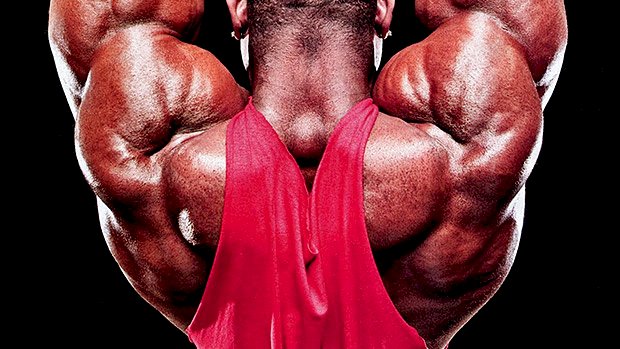 Every rear delt movement I see has the lifter start with his hands and arms in line with his body, then proceeding to move them outward (think of rear delt flyes). There’s nothing wrong with this, other than the fact that solely focusing on this kind of path severely limits how much of your muscle you’re going to hit. To change things up, try setting up on a cable machine for constant tension: This is a very isolated pattern that, when done correctly, absolutely torches the rear delts. It’s important to maintain the same elbow angle throughout the entire range of motion. This isn’t a triceps exercise; the fulcrum is the shoulder. Pull the arm all the way across the body as though you’re trying to cover your mouth with your biceps. Then aim down toward your outside shoe with your fist. It’ll take a few reps to initially feel, but once you’re rolling, you’ll get an insane pump in the target
Origin: Tip: The Cable Chop for Rear Delts
Tip: Should You Bench With Your Feet Up?
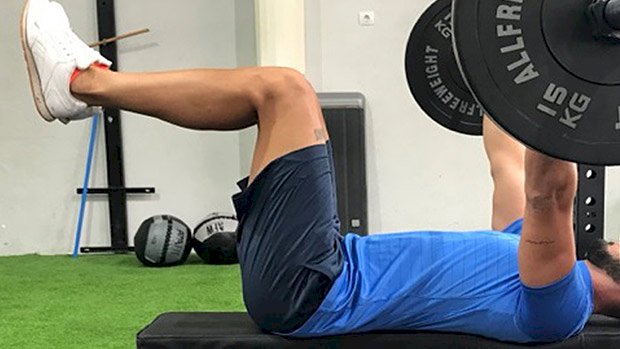 Charles Poliquin used to have a term for guys who bench-pressed with their legs off the floor and their knees bent at a 45-degree angle. He called them “future orthopedic patients.” He thought that benching that way was plain stupid and totally useless, unless maybe Ludmilla, the one-eyed Russian former Olympic shotputter who works in custodial services at the gym was mopping up around the bench press and you had to lift up your legs because you were afraid of getting a meaty backhand across the face for mucking up her clean floor. I’ve always thought it was a stupid way to bench, too, and I can’t help but shoot condescending stares at any moron I see doing it. That’s why it was particularly painful to read this new study. It seems, cough, hem, haw, that benching with your feet off the floor actually increases the involvement of the pecs, delts, triceps, and even the muscles in the forearms. But then I thought about it a bit and decided that their findings, while legitimate, weren’t applicable to anyone who wants to add muscle or get stronger. What They Did Spanish scientists recruited 20 young men and carefully established their 1 RMs (the most weight they could lift for one rep). They then wired them up with enough electrodes to make them look like the dudes in a Marvel Comics origin story, just before something went horribly wrong and turned them into super heroes or super villains that spat lighting bolts out of their wazoo. After thoroughly warming up, the subjects performed 8 reps of bench press with 60% of their 1 RM with either their feet on the ground or their feet elevated. They did a set of 8 reps using a 2:2 tempo (both lowering and raising the bar to a count of 2). After an appropriate rest period, the participants repeated the lifts, doing the opposite (feet up or feet down) of their first test. What They Found Doing bench presses with the legs up significantly increased the recruitment of the pectoralis major (clavicular portion, sternal portion, and costal portion), anterior deltoid, triceps brachii (medial head), forearms (flexor digitorum), rectus abdominis, external oblique, and rectus femoris muscles. This prompted the authors of the study to write, in Yoda-speak, the following: “To perform the bench press exercise with flexed hips could be recommended for training in sports where the upper limbs and hip flexor muscles are required.” How to Use This Info While I don’t doubt the findings of this study, I’m still not going to do or recommend the “legs up” bench press. I’ve got several reasons. For one, the slow tempo they used in the study doesn’t reflect how people normally bench and I’m pretty sure that lifting explosively, or at least quickly, would show a different recruitment pattern. Secondly, their study showed that there’s more activation of the rectus femoris in the legs-up bench than there is in the conventional bench. The trouble with that is, the bench, when it’s done with any amount of significant weight, is actually a whole-body lift with all kinds of involvement from the legs. Clearly, these guys were using a weight that was so light that it didn’t require any drive from their legs. If they had used a heavier weight, it would surely have shown a higher level of recruitment of the rectus femoris than just lifting up your legs so Ludmilla can mop under your feet. Third, other studies have shown the opposite – that the conventional bench recruits more muscle than the legs-up version. (Of course, those studies used a BOSU ball underneath the lumbar spine to introduce instability, and the weight of the lifter plus the weight on the bar just might have smushed the ball down so it was, in effect, close to being a flat or semi-flat surface.) Lastly, recruitment of motor units isn’t the end-all and be-all of hypertrophy or strength. What matters more is the mechanical loading the muscle fibers are subjected to. Look at it this way, if you were to put on a chicken costume, climb atop your house and jump off, you’d recruit a whole lot of pectoralis-muscle fibers as you frantically sought to achieve flight, but all the flapping in the world wouldn’t lead to additional strength or size. What you need is adequate load, but if you attempted legs-up benches with much more than the 60% of 1 RM used in the Spanish study, you’d eventually run into the same problem you do with any type of instability training – having to balance the bar lengthens the amount of time between the eccentric and concentric part of a movement, resulting in a much-impaired stretch-shortening cycle, which impedes strength gains. Also, the limiting factor in any kind of instability training becomes the strength of the stabilizer muscles involved in the lift. In other words, muscle fiber recruitment of the chest, delts, and triceps ultimately would suffer because the amount of weight you’d need to coax the muscle to grow would likely be more than you could balance and keep from ending up an orthopedic
Origin: Tip: Should You Bench With Your Feet Up?
Tip: The Athlete’s Floor Press
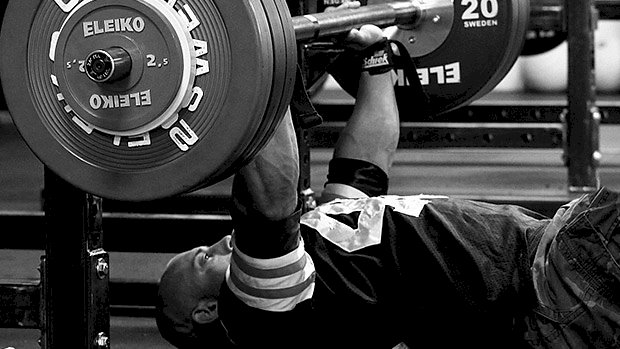 The floor press is a classic bench-building, triceps-focused lift. It’s also a great alternative for people who suffer from low back pain, especially extension-based pain. But for my athletes, I’ve found that the standard floor press doesn’t have the greatest transfer when it comes to sports performance. The good news? One simple adjustment will not only make the exercise more athletic, it’ll make you stronger in this position! Check it out: Floor Press With Glute Bridge Simply perform a glute bridge before you unrack the weight. Really focus on staying tight in the core by using your abs to pin the ribcage down. Contract your glutes hard to hold your hips in position. You’ll notice a couple things: Your core is challenged hard, so you must focus on maintaining the bridge position throughout the lift. You’re actually stronger in this position than a regular floor press. Try a rep without the glute bridge and a rep with it. You can lift slightly more in the bridged position. This probably has to do with energy transfer. A regular floor press doesn’t utilize the lower body or core as much. This variation is much more athletic for a few reasons: Energy transfer from lower to upper body. Pretty much all athletic movements use ground force to initiate a movement. This creates a need to produce energy and transfer it from the ground, through the lower body, and then to the upper body. Challenging static hip stability while dynamically pressing with the upper body. Many sports require joint stability in one area while simultaneously performing a dynamic movement. Direct sport-specific transfer to ground athletes such as MMA fighters and wrestlers. Think of a wrestler pinned on the ground. You’re not just going to use your arms to get a guy off of you; you’re going to use your whole body. Bret Contreras thought of the hip thrust while watching MMA fighters. When they’re on the ground, they thrust to get someone off. This takes that to the next
Origin: Tip: The Athlete’s Floor Press
Tip: The Best Deadlift for Glutes
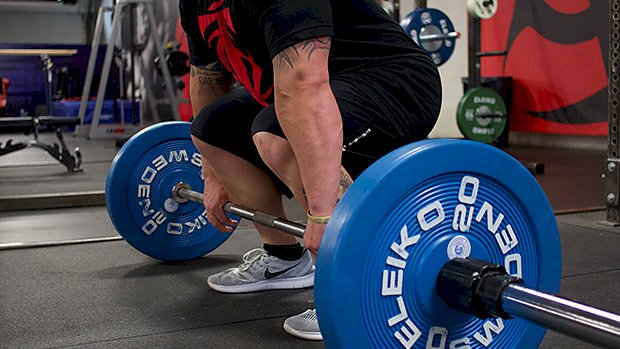 Most lifters have always assumed that the Romanian deadlift (RDL) was a tad better for the glutes and hamstrings than the conventional deadlift (CD) because the quads (specifically, the rectus femoris) play such a big role in the latter. It was a forgone conclusion, like how Eggos are better than English muffins, but no real-deal scientists had ever bothered to compare the two lifts – at least not until some researchers from Western Michigan University looked into it. What They Did The scientists found 21 men with at least three year’s experience with both the CD and the RDL. Each subject had a spider web of needles and electrodes affixed to their rectus femoris, biceps femoris, and gluteus maximus. The lifters then alternated between performing RDLs and CDs, using 70% of their one-rep maximum on both. They all used standard form on both of the lifts, with one exception: While the typical RDL range of motion usually comes to a halt when you start to feel a mild stretch in the hamstrings (which generally happens when the bar travels just south of the knees), the participants in this study were asked to at least attempt to lower the bar to the floor, flexibility permitting. What They Found To no one’s surprise, the CD evoked a much stronger response in the rectus femoris than the RDL – almost double the EMG percentage peak. The researchers also found that the CD caused significantly greater EMG values in the glutes, but this is where we have to take a brief side bar, your honor. Scientists have an entirely different definition of the word “significant” than lay people. In science parlance, significant is kind of a weasel word that just means the amount was large enough to be noticed, or large enough to matter. It’s closely related to the term “statistically significant,” which means a difference that’s unlikely to be caused by random chance. However, if you said you had a significant amount of sex last night, it would likely mean something far different than an amount of sex that, when compared to the amount of sex you normally had, was unlikely to be caused by random chance. So while the CD evoked a “significantly” greater response in the glutes than the RDL, the difference in EMG value in normal, non-science language was just a smidgeon, a duck snort that probably doesn’t matter in the long run. And while the CD came out on top with biceps femoris activation, too, the difference here was even less than we saw with the glutes. In short, the CD definitely caused the rectus femoris, or predominant quadriceps muscle, to work a lot harder. As far as the biceps femoris (the predominant hamstrings muscle) and the glutes, the amount was pretty much a wash between the two lifts. How This Info Might Change Your Training The real eye-opener in this study is just how much the CD relies on the rectus femoris, which presents a potential problem: A lot of us split our leg training as part of a push/pull workout, doing quad dominant movements (like the squat, leg extensions, etc.) on one training day and then doing hip-dominant exercises (deadlifts, glute thrusts, etc.) on another. Since the CD recruits the rectus femoris so heavily, incorporating it into a push/pull workout is problematic. Let’s say your push/pull workout includes squats on “push” day and CD’s on “pull” day. That means you’re working the quads twice as often as you intended. Given this study and the results described in this article, it would be much more logical and efficient to keep the squats in your push workout but replace the CD with the RDL in your pull workout. The glutes and biceps femoris recruitment is virtually the same as with the CD, but you’re getting minimal involvement of the rectus femoris. Max Glute and Biceps Femoris Recruitment with the RDL If you’re going to do RDLs instead of CDs, I suggest you make them count and do them on the Smith machine, as T Nation contributor Paul Carter suggests. (He prefers them to barbell RDLs because the stability afforded by the machine allows you to sit back farther.) Paul also suggests you do them with with a 5-second eccentric to further accentuate the targeted glutes and biceps femoris. To really maximize recruitment, slap a couple of step platforms underneath the bar and stand on them. This will allow you to extend the range of motion (provided your spine is flexible enough). A couple of sets of 10 should more than do the
Origin: Tip: The Best Deadlift for Glutes
Tip: Do Sprint Snacks to Build Conditioning
 Metabolic conditioning, cardio, aerobics, HIIT, or whatever you want to call it, is to weightlifting what flossing is to dental health. You know, good for us. Still, it’s a grim, joyless, kind of disgusting semi-compulsory act. Granted, we’re not getting drool and masticated burrito bits all over our fingers when we do cardio, but none of us started lifting weights so we could spend hours running or peddling to nowhere on machines, or flogging Mother Earth with old ropes your gym manager stole from the USS Ronald Reagan. Still, we have to do conditioning work, both for health and to improve work capacity. There may, however, be a way to make it more palatable. Scientists have found that doing short sprint “snacks” separated by an hour or more worked just as well as doing them together in one session. In other words, you could do short bouts of peddling or running or presumably any HIIT-type training modality throughout the day when you had a minute to spare and you’d accrue the same benefits as if you’d done them all at once in one tedious, mind-numbing session. What They Did Scientists at the University of British Columbia recruited 28 healthy, young, inactive adults and randomly assigned them to one of two groups that performed 18 training sessions over 6 weeks. One group did traditional sprint interval training (SIT) that involved doing three 20-second bouts of full-out cycling, each 20-second bout interspersed by 3-minute rest periods. The other group did sprint “snacks” (SS) consisting of three, separate 20-second full-out bouts each interspersed by 1 to 4 hours of rest. What They Found As far as cardiorespiratory fitness, both the SIT group and the SS group increased their absolute VO2 peak with no difference between groups. Both groups also showed similar improvement in their 150 kilojoule (kj) cycling time trial. How to Use This Info If you’re somebody who hates doing cardio, you can use the results of this study to make it more palatable. Say for instance you’ve got a stationary bike at home. You can hop on the thing any old time when you’ve got a few seconds to spare, like when you’re waiting for your toast to pop up. Simply get on the bike (or treadmill, or whatever apparatus you use), go balls out for 20 seconds, and then resume whatever you were doing. Then, when similar opportunities present themselves throughout the day, whip out another couple of 20-second high-intensity efforts. Similarly, you could do a single 20-second burst as part of your warm up for your workout and then do another an hour later when you’re finishing up, then doing a third bout later on at home. If we believe the results of this current study, the effects on cardiorespiratory fitness would be the same as if you’d done all three bouts at the same time. It Controls Appetite, Too This type of exercise may also suppress appetite. In a separate study, sport scientists at the University of Birmingham found that high-intensity cycling protocols (4 x 30 seconds) also reduced levels of the hunger hormone ghrelin while increasing levels of the satiety hormone GLP-1. Of course, unlike the “sprint snacks” described in the British Columbia study, the appetite-suppressed subjects did their high-intensity bouts all at once, but it’s likely that even one high-intensity bout would have similar effects on hunger hormones, albeit to a lesser
Origin: Tip: Do Sprint Snacks to Build Conditioning
Tip: Inside-Out Shoulder Strength and Mobility
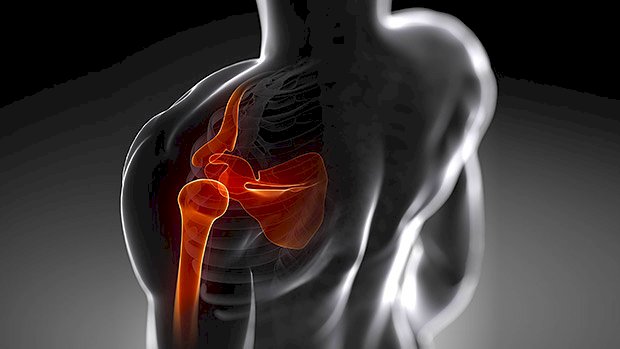 I coach CrossFit. I know, I know, I’m sorry. It was an accident. But I kinda have a problem: I like motivated people that enjoy lifting and high-skill bodyweight movements. And there’s something to be learned from this crazy “functional” stuff. Like, how can they do 20 muscle-ups followed by 30 clean encrypted-media” allowfullscreen> Let’s break each part down: Passive-Active Hang Think about pulling your shoulder blades down as much as you can to engage all your back muscles. You can either hold for 5 sets of 10 seconds or perform 5 to 10 reps with no pause. Try both and see if you fatigue easily. This is a basic shoulder movement and ideally you should feel like you could do it all day. Hanging Shoulder Rotation All the movement has to come from the shoulder and not the elbow… or weird bobbing movements from your neck. We’re looking for good shoulder mobility here, not head gestures that would accompany a naughty innuendo. Many people struggle with rotations and it can feel unnatural at first, but it really shouldn’t. If it helps, try lifting your arms overhead and rotating your shoulders without holding on to a bar. This way you’re not having to lift your bodyweight so you can get a better feeling for the movement. Then, try it on the bar with your toes on the floor for assistance and build up to fully hanging rotations. Think like a monkey in a tree. You have to be able to have that control to navigate from branch to branch; otherwise you’re just swinging and yanking your shoulder out of its socket every time. Yes, CrossFitters may look like a floppy fish when doing butterfly pull-ups, but there’s actually a lot of coordination, control, and strength that goes into them. Butterfly pull-ups without the prerequisite control are a quick way to a dislocated shoulder or torn rotator cuff. Even if you never have any intention of flopping about on a pull-up bar, this control and strength is important to your general shoulder health. Single-Arm Hang It’s incredibly important to be able to hold yourself from one arm and still be able to engage the lat, provided you’re not a heavyweight powerlifter. A great strength test is to see how each arm matches up to the other. If one arm has tremendous endurance and the other slips after a few seconds, which arm you will favor in pull-ups and presses? Working on this will even help bring balance to your shoulders. Single-Arm Rotation Last in the video, we show you a demonstration of a full rotation from a supinated grip to a pronated grip. When I demo this at workshops, it’s amusing how many people freak out. But this is nothing compared to what you’d see in a gymnastics training camp! Despite the common reaction, this is simply a normal range of motion for the shoulder. We demo it in the video because I want you think about how much range of motion you’re missing out on by not having a rotational element to your shoulder work. It’s kind of like only ever training squats without doing deadlifts – there’s a whole range of strength there that needs to be worked on. However, please don’t try a full rotation unless you’re confident in one-arm hanging and you’ve tried it with your feet on the ground first. If you’re new to it, an easier way to build rotation strength is dumbbell shoulder rotations. If you work to make all these movements easy, your shoulders will not only be smarter, but a hell of a lot more durable and able to cope with punishment from any training program. More stability, more strength, and fewer injuries – that’s hard to
Origin: Tip: Inside-Out Shoulder Strength and Mobility
Tip: Pause Squats for a Healthier Spine
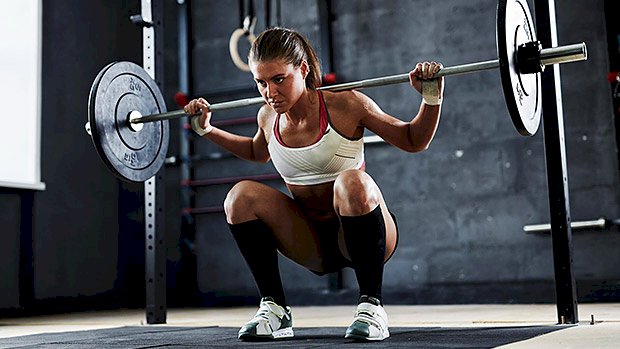 Understanding how to get the most out of stored elastic energy in the muscle has helped lifters hit new PRs on their squats. But over-relying on a huge stretch reflex or “bounce” out of the bottom of your squat can also cause a loss of tightness at the bottom. This can lead to posterior pelvic tilt or “butt wink” – your hips rotating backward which causes rounding in your lower back. When this happens, your body goes too far forward, your butt shoots back, and you end up with an awkward squat that looks more like you’re twerking than actually squatting. You may get away with this for a while, but eventually your back will have had enough and you’ll get injured. Not sure what I’m talking about? Here’s what this looks like: Back Squat – Losing Tightness Front Squat – Losing Tightness To save your back, do paused reps. This will increase your static strength from the bottom of the squat since you’ll no longer be able to generate a stretch reflex to rebound from the bottom. Paused Back Squat Paused Front Squat Pausing will strengthen your core and hips by increasing your time under tension (TUT) under the bar. Paused reps also help you learn a good bar path –your body will naturally find the most efficient way to keep the bar over your center of gravity. Finding the Right Depth Find out where you should pause by having someone film you performing light reps from a side view. Go into a full squat and watch the point at which your hips start to rotate back and you see a slight rounding of the lower back. Aim to pause right before this
Origin: Tip: Pause Squats for a Healthier Spine
Tip: Puncture All BOSU and Swiss Balls
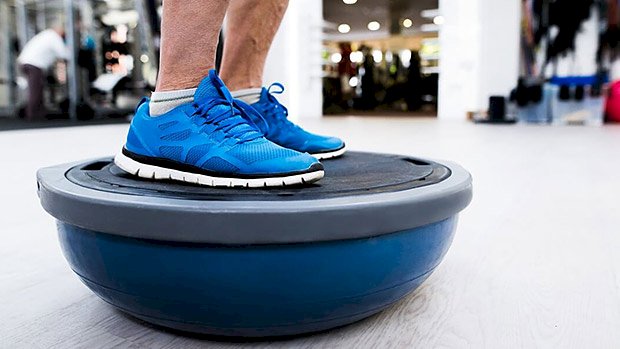 Despite what we’ve learned about the ridiculousness of most instability training for athletes, there isn’t a training day that goes by when I don’t see some yutz doing dumbbell squats, shoulder presses, or curls atop an inflatable disk, an inverted BOSU ball, or even a Swiss ball. They’re not doing it to strengthen a weak or injured joint, though; they’re doing it to strengthen their core, or to further challenge their biceps or quads in the hopes that all that wobbling will translate into more muscle, more athleticism, and more looking purty. And, most annoyingly, these wobblers always have the same smug look on their faces, as if they’re using an infinitely advanced training method while you, you corn-pone country hick, are still stuck doing here a squat, there a squat, everywhere a squat-squat on solid ground, E-I-E-I-O. Luckily, T Nation contributor and MLB secret weapon Eric Cressey saw instability training for what it was – good for sprained ankles and little else. One of these things must have smushed his pet Chihuahua, Lupe, when he was a kid because his 2007 Master’s thesis obliterated most reasons for doing them. Too bad the lessons he revealed have been largely forgotten by the masses. Hence this brief recap of his findings, along with some other things these unsteady folk need to know. What Cressey Did Cressey recruited a bunch of athletes who, while weight-trained, had never done any unstable surface training (UST). All athletes were pre-tested with two different jumps, a 40-yard sprint, and an agility running drill. They then began a 10-week strength and conditioning program. The only big difference was that the experimental group performed UST with one lower-body exercise per workout. What Cressey Found After 10 weeks, the stable training group showed improvement in both jumps while the UST group showed no significant improvement in either one. Both groups improved their 40-yard sprint time, but the stable training group experienced greater improvements than the wobblers. Both groups did equally well on their agility tests, but the stable group was 0.9 seconds slower than the UST group at pre-testing and 0.03 seconds faster after the 10 weeks of training. The Problem with Unstable Training What Cressey and others have noted about athletics in general is that just about every sport, except maybe the 50-Yard Earthquake Dash, is done on a stable surface. As such, training on unstable surfaces ignores the principle of specificity of training, at least when it comes to the lower body. UST also commits a physiological cardinal sin in that it impairs what’s known as the stretch shortening cycle (SSC). In sport and human movement in general, the length of a tendon increases during the concentric portion of a movement and when the transition to the eccentric part of the movement is lightning quick, the tendons act like a spring, releasing a bunch of energy to help complete the lift or athletic movement. But exercising on an unstable surface lengthens the time between the eccentric and concentric part of a movement, resulting in a much-impaired SSC. Cressey likened it to trying to jump out of sand. UST forces athletes to train slow and, in sports, training slow makes you slow. As far as making strength gains with UST training, fat chance. Cressey says that it doesn’t allow for adequate resistance to provide for strength gains and can actually interfere with them. And while he didn’t specifically address muscle hypertrophy, the same type of thinking applies. They don’t allow for adequate resistance as the limiting factor in how much weight you use will be the balancing capabilities of the stabilizer muscles. Are They At Least Good for Abs? Umm, not so much. Exercising on a BOSU, for instance, provides higher EMG activity in the rectus abdominis than doing the same exercise on a stable surface, but not as much as doing a heavy deadlift or front squat on regular old Terra Firma. So Are These Things Good for Anything? There is a place for UST training. It definitely helps with ankle injuries, and a 2004 study found that Swiss balls and BOSU balls in particular might be useful for upper body injuries. Say for instance your shoulders are barking and you can’t handle pressing the big weights. Sitting or lying on a Swiss Ball should allow you to maintain a high level of muscle activation while reducing the stress on joints. In other words, UST might allow you to use a lower weight than you might ordinarily use and still get something out of it. Likewise, legendary powerlifter Louie Simmons has long advocated using a Swiss ball dumbbell press to improve the shoulder health for big benchers. Lastly, Swiss balls and, occasionally, BOSU balls, make convenient and picturesque props for Instagram fitness models. So there’s
Origin: Tip: Puncture All BOSU and Swiss Balls
 All about sport xlsport.club