
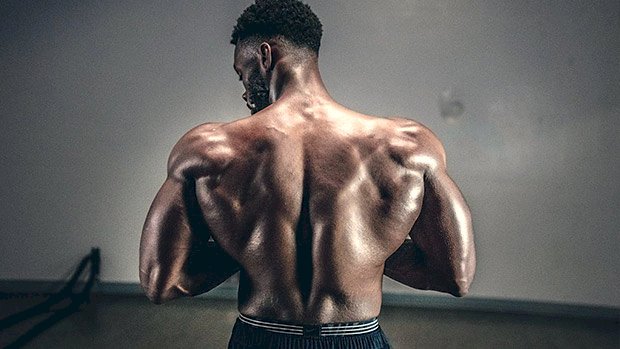
 Here’s something nobody’s ever told you before: Your technique is keeping your back small. Sure, we could talk about exercise selection, reps, sets, and frequency, but these factors are largely irrelevant if you don’t understand the back muscles and what adjustments to make to really hit them. If you want to actually gain some size on your back, there’s a hell of a lot more to it than deadlifts and pull-ups. Thick and Wide: The Muscles When people talk about building the back, they mean choosing exercises that build thickness or width. But what do those even mean? We need to differentiate between them and see which muscles create each effect. The characteristic you need more (thickness or width) will determine your best technique. Back Width The muscle responsible for creating width is the latissimus dorsi – the lats. It originates from the spine, where the fibers fan upwards and insert into the humerus. Back Thickness The muscles primarily responsible for creating thickness are the upper back muscles: teres major, rhomboids, traps (upper, middle, and lower), and the posterior delts count here too. Arm Path and Grip The path your arms take – flared versus tucked in – during pulling exercises will determine which back muscles get hit more. So if one area of your back is taking over (keeping you from building another area) you can change your arm path and focus in more on what you’re wanting to build. Grip Type The type of grip you’re using will play a role in arm path. It doesn’t wholly dictate it, but certain grips will make arm path more natural than others depending on what area of the back you’re trying to isolate. A supinated (underhand) grip will lend itself to keeping the arm path in close to the body, which will tend to bias the lats more. A neutral grip tends to do the same, but can also be used to hit the teres a bit more. A pronated (overhand) grip will be most commonly used to hit the muscles of the upper back because it’ll naturally lend itself to a more flared arm path. Grip Width A closer grip or shoulder-width grip is usually more ideal for targeting the lats. A wider grip can be a great option for the upper back, especially when doing chins or pulldowns. It can cause a bit more abduction of the humerus. That said, one reminder is to have elbow-to-wrist alignment when you’re in the fully contracted position of a pulling exercise. It’s a great overall position for the joints to be in to fully maximize the area of the back you’re trying to bias and can keep you from compensating with other muscle groups. Building a Wide Back Let’s talk about the lats. Since they attach to the spine, then fan upward to the humerus, it should make sense that to fully lengthen and shorten them, and work them in line with the fibers, the arms need to begin in front of the body (lengthening the lats). From that position, you want to take an arm path where you initiate the pull by driving the arms down and bringing the elbows in towards the hip (shortening). The Row When you focus on this execution principle, you’ll understand that a row, depending on how it’s performed, can actually be a dominant lat movement rather than an upper back movement. Various row machines can be used to bias the lats rather than the upper back if that’s what you’re wanting to do. The Pulldown The way you do a pulldown will also dictate which area of the back is working with the greatest amount of tension. Even though pulldowns are traditionally known to hit the lats, if you’re not doing them right, they’ll do more for the upper back. So keep the narrow or neutral grip in mind, and remember to keep the arm path in front of you. Cues Start with the arms in front of the body rather than out to the sides and use a narrow or shoulder-width grip. Lengthen the lats while maintaining tension. Don’t lose tension in the fully lengthened position. Drive the arms down to initiate the concentric without allowing the elbows to flare. Make your arm path come in close to the body and drive the elbow toward the hip. To Arch or Not to Arch? To hit the lats, brace with the abs rather than extending the lumbar spine (arching the lower back). You’ve probably read that to get a full lat contraction, you need to arch the lower back. You even see pictures of guys with huge backs using an arch when doing pulldowns. It’s not a bad technique, but it doesn’t preferentially build the lats. Why? Because it actually takes away from fully shortening the lats and will decrease output by them, creating more engagement in the upper back. So instead, brace with the abs to create more stability by maintaining a neutral spine. It’s in the neutral spinal position that the lats can produce the greatest amount of output and contract maximally. Building a Thick Back Hit the traps, rhomboids, and teres major. The Pulldown Let’s take a quick look at a pulldown variation that targets the upper back, also known as the “lat-less” pulldown. You’re
Origin: Thick and Wide: The Back Solution
 All about sport xlsport.club