
 My Favorite Methods: A Breakdown Q: What are your absolute favorite training methods? A: I’ve given seminars where I presented 37 different training methods, not including loading schemes. My favorite method? The one that gets you to your goal. The “best” method will vary depending on what you want to achieve. Want strength? Want size? There are different methods for those. Your level of experience will influence which ones will be a good fit. But if you forced me to choose two methods – one for strength and one for growth – I’d choose these: 1. Favorite Strength-Building Method: Clusters Cluster training is my go-to method for rapidly increasing strength. It never fails. Clusters consist of rest periods between all the reps in your set. One set becomes a series of single reps with very short rest periods in between. While you can do clusters with any type of loading and rest intervals, the traditional cluster requires you to use a load of around 90 percent of your 1RM (which is normally your 3RM load) and do four to six reps with that weight. You’d do so by resting anywhere between 10 to 20 seconds between reps depending on the exercise. A set could look like this: Unrack the bar and do rep one Rack the bar and rest 15 seconds Unrack the bar and do rep two Rack the bar and rest 15 seconds Unrack the bar and do rep three Rack the bar and rest 15 seconds Unrack the bar and do rep four Rack the bar and rest 15 seconds Unrack the bar and do rep five Rack the bar – end of set Why is it so effective? There are several factors that can influence strength gains: You recruit and fatigue the fast-twitch muscle fibers. You develop the capacity to make the fast-twitch fibers “twitch” as fast as possible. This is called a high firing rate. You build muscle mass. You desensitize the Golgi tendon organs (GTO). You become more psychologically comfortable with the lift. Clusters improve all of those! You achieve maximum fast-twitch fiber recruitment when the load on the bar is around 80-82 percent of your maximum at that moment. Sure, you can get there by using lighter weights and using fatigue to increase the relative load of the bar. But by using clusters with 88-90 percent of your max, you’re recruiting all those fast-twitch fibers from the get-go. As a result, you won’t have any reps that simply drain energy. But it’s not enough to recruit the fast-twitch fibers. The real strength gains will come from improving your capacity to use a high firing rate. This is a motor skill. And motor skill acquisition depends not only on the number of reps done with the skill emphasized, but on the ratio of “good” and “bad ” reps. The closer you are to your maximum strength, the higher the firing rate. Firing rate increases the most when you need even more force and you can no longer recruit more fibers. At 90 percent you have a very high firing rate from the start. If you do five cluster reps with 90 percent you’ll get five reps with a very high firing rate and no reps with a low firing rate. From a motor learning standpoint, that’s golden. Now compare that to doing 10 reps with 70 percent. Because of fatigue you’ll still end up with five to six reps where the fast-twitch fibers are maximally recruited and probably three reps with a high firing rate. But you also get five reps with a lower firing rate. From a motor-learning perspective, this is vastly inferior. It’s like trying to play golf and doing 30 great swings, 20 suboptimal ones, and 50 shitty ones. Chances are you won’t improve rapidly. Clusters are also very good at building muscle. Hypertrophy has a lot to do with the number of maximally-effective reps. A maximally-effective rep is a rep where you’re recruiting as many fast-twitch fibers as you can. Since these have the greatest growth potential, it’s all about stimulating them as much as possible. As we just saw, when the load represents 80 percent of the max weight you can lift at that moment, you’ll be recruiting the max number of fast-twitch fibers you can recruit. You can get there by using less weight because each rep fatigues you. As you’re fatiguing, your strength will go down (two to four percent per rep) so the weight on the bar is relatively heavier compared to what you can lift. Here’s an example: Rep Weight on Bar Fatigue Level Relative Weight 1 70% 0% 70% 2 70% 3% 73% 3 70% 6% 76% 4 70% 9% 79% 5 70% 12% 82% 6 70% 15% 85% 7 70% 18% 88% 8 70% 21% 91% 9 70% 24% 94% 10 70% 27% 97% As you can see, by rep five you’d have maximally-effective reps. That gives you six of them in the set. Now let’s look at a cluster set. Because of the rest period you’ll have some recovery, so fatigue is a bit slower. Rep Weight on Bar Fatigue Level Relative Weight 1 90% 0% 90% 2 90% 1.5% 91.5% 3 90% 3% 93% 4 90% 4.5% 94.5% 5 90% 6% 96% 6 90% 7.5% 97.5% Clusters allow you to get as many growth-producing reps as you normally would in a higher-rep set, without having to waste energy doing
Origin: Question of Strength 60
Tag: Strength
3 Psych Skills for Strength Training
 But after this solid foundation has been built, the opportunities for growth and progress are mental, not physical. Sure, you’ll always benefit from getting refreshers on a proper form, nutrition, and programming. But the real source of making gains, changing your body, and evolving your fitness lies in your ability to prioritize, motivate, execute, and repeat. And repeat. And repeat! Those functions are psychological in nature. Mental Skills 101 Psychological or mental skills are intentional thinking strategies that enhance performance, increase enjoyment, and promote persistence in pursuit of goals. Athletes commonly use mental skills for sport performance, and fitness professionals and enthusiasts can use them just as easily and effectively. There are a variety of mental skills, but three of the most widely used and studied are: Imagery/visualization Arousal/activation regulation Self-talk Let’s go over each one with a suggestion or two on how to implement them into your current training habits: 1 – Imagery/Visualization Also known as “mental rehearsal,” imagery is a skill that researchers have studied extensively in sport psych settings, and which has repeatedly been shown to enhance performance and make sports and exercise more enjoyable (Weinberg, 1981 and 2008). When you mentally rehearse, you create or recreate an experience in your mind. This could be an optimal performance from a real memory, or an ideal performance you’ve created with your imagination. Using sounds, sights, sensations, and even smells, you draw on your senses to experience success and to practice execution of a skill in your mind. You can use imagery before a workout or just before a specific lift or movement. If you compete, you can mentally rehearse on rest days, during warm-ups on practice days, and pre-performance during competition days. How to Do It Working on one of “the big 3” lifts? Or your pull-up? Visualize yourself executing it perfectly just before you practice. Let’s take the deadlift as an example. See yourself approaching the bar… planting your feet… getting your air… getting your hands on the bar and pulling the slack out… driving your heels down… pushing off the floor… finishing with the hips… Bam! Visualizing your lift can build confidence, prime your thoughts and expectations for success, and increase the practice (or “reps”) you get with the exercise. 2 – Activation-Regulation All of us have an optimal level of energy that helps us perform our best. Think of a scale of 0-10. If zero is almost asleep, super relaxed, and chill, and 10 is about-to-explode, crazy amped and way-too-anxious, what number represents the ideal level of energy for strength training? Is this different than the ideal energy level for cardio? How about while you’re at work or reading and learning? The point is that there’s a specific point along this 0-10 scale at which you’d perform your best, and you can engage in anxiety-reduction and arousal-inducing techniques to slow yourself down (or pump yourself up) in order to do your best. When the pressure is too high and you’re overly activated (nervous, jittery, anxious, panicky) the risk for error is higher and enjoyment is lower. When there’s not enough pressure, you may feel flat, fatigued, or unmotivated, which can lead to underwhelming effort and performance. How to Do It The next time you’re competing, or even performing an exercise that you want to improve on, assess your energy/arousal level on a scale of 0-10. Then, ask yourself what the optimal energy level would be. If the number needs to be higher than it currently is, you can increase activation by increasing your rate of breathing, listening to music that’s energizing, or giving yourself a pep talk. If the number needs to go down, you can try progressive muscle relaxation (PMR), wearing a heart rate monitor and attempting, with your focus and breath, to slow your heart rate 5-10 beats per minute, or creating a relaxation response (Benson Thinking only in extremes (all-or-nothing) thinking. Arbitrary Inference:Generalizing one negative comment or experience to be representative of everything in your life. Mental Reading:Presuming you know what others are thinking. Catastrophizing:Thinking that the absolute worst thing that can happen, will happen. Emotional Reasoning:Presuming that feelings are facts. “Shoulds”:Focusing on how things “should” have gone down, as opposed to how they actually are. Any of these thought patterns sound familiar? Also known as cognitive distortions (Beck, 1963), these styles of thinking often lead to discouragement, frustration, anger, sadness, and a slew of other negative emotions. When you’re discouraged and thinking negatively, you’re less likely to take a risk, push yourself hard, or persist with a challenging goal. Recognizing your own tendencies to think negatively is the first step. Once you’ve identified some problematic thinking, consider the impact those thoughts
Origin: 3 Psych Skills for Strength Training
The 7 Best Strength Exercises You Don’t Do
 Getting stronger requires more than just adding plates to the same three lifts. It requires some actual thought when it comes to exercise selection. Here are the seven most strategic lifts you’re probably not doing. We’ll go over what they target and how they’ll make you stronger on the big three. 1 – Belt Squat Targeted Muscles: Quads How It Helps: If your hips shoot up and your chest falls forward during the squat, this can help prevent that. Strength development occurs primarily as a result of neural adaptations (1). Heavy-load resistance training produces greater strength gains when compared to low-load resistance training (2). Unfortunately, training at high intensities generates significant fatigue which can become an obstacle and even lead to overreaching if left unchecked (3). When we look at primary exercises where the lower body plays a major role, like the deadlift and squat, a significant contributor to fatigue is axial loading (4). Axial loading is where your spine is under a compressive load such as a barbell squat. However, the belt squat allows you to bypass axial loading. This makes it an excellent exercise for developing strength because you can maintain high intensities without generating nearly as much fatigue when compared to a barbell squat. 2 – Floor Press Targeted Muscles: Chest, shoulders, triceps How It Helps: Ever get stuck at the midpoint of the bench press? This’ll help with that. The sticking point on the barbell bench press for most lifters occurs at the midway point (about 6-8 inches off the chest). It’s a common problem. During the typical powerlifting setup, your back is arched and you use leg drive, which generates an impulse force to rapidly develop momentum to initiate the lift. This is great in competition where you need to use every advantage, but in training we can eliminate these benefits strategically to improve bench press performance. The floor press forces you to remain flat and doesn’t allow for leg drive. And since the bottom end of the floor press and the sticking point of your competition bench press are generally the same, you can train your sticking point directly while simultaneously increasing your raw strength. 3 – Reverse Hyper Targeted Muscles: Low back, hamstrings, glutes How It Helps: Guilty of rounding the low back during deadlifts? These have your back. The reverse hyper was introduced by Louie Simmons. It’s gained popularity, but there are still a surprising number of people who are unaware of this exercise. Strength athletes generally train movements to build strength, not muscles. But this can become a limiting factor. For example, if an athlete’s quads can generate 600 pounds of force but his or her low back can only brace 400 pounds, the rate-limiting factor is the low back. This is where adopting more of a bodybuilding approach can be highly beneficial to specific athletes. The reverse hyper directly trains your glutes and hamstrings but primarily targets your low back (5). Training your low back can improve your ability to brace during heavy squats and deadlifts. An additional upside is that the exercise has a low fatigue cost and actually has restorative properties due to the decompression that occurs during the movement (5). 4 – Safety Squat Bar (SSB) Squat Targeted Muscles: Quads and core How It Helps: Hips shooting up during the squat? Chest falling forward? Here’s an exercise that’ll help prevent it. This is an effective variation of the low-bar squat. A common error many lifters make is the chest-fall pattern: their hips shoot up and their chests fall forward as they stand up with the weight. It almost looks like a good morning. This is most often associated with weak quads. But a SSB squat distributes load differently than a traditional low-bar squat which alters the torque requirements. Because of your upright position, the SSB squat requires more torque from the knees compared to a standard low-bar squat (6). So this exercise puts you into a more quad-dominant movement pattern to preferentially train your deficiency. Because you can’t grip the bar as you normally do, your upper back isn’t as tight, so this exercise also increases your upper back and core strength. 5 – Band Pressdown Targeted Muscles: Triceps How It Helps: This is another preventative exercise for those whose bench press gets stuck at the midpoint. Supplementary work for strength development is often written off because it’s not specific. Big mistake. Increasing your muscle fibers’ cross sectional area directly relates to increased force production (7). And since the triceps play an important role in the bench press, they often require additional work. To understand the benefits of the band pressdown over other triceps exercises, we need to understand torque. Torque is a twisting force that tends to cause rotation (8). This diagram shows the action of a triceps pressdown. The linear force (the external load of the cable
Origin: The 7 Best Strength Exercises You Don’t Do
Question of Strength 59
 Peaking for Powerlifting Q: I’m a competitive powerlifter and have a meet in six weeks. Tell me about peaking. What should I do with carbs and deloading? A: A lot of the information we read about peaking for a competition revolves around “supercompensation.” You dramatically increase training volume and intensity for 7-14 days then, one week out from the competition, you bring training stress way down and increase carbs to supercompensate. This leads to an increase in performance. Sounds sciency and smart. But does it really work? Well, it depends. If you’re an endurance athlete, it might. It seems to work pretty well for swimmers. But if you’re a strength athlete, it won’t do anything. It’ll give the illusion of working, but it really doesn’t. Here’s why. First, when we talk about supercompensation we’re really talking about increasing glycogen storage in the muscles. The theory? By dramatically increasing training volume and reducing carb intake, the body will upregulate the enzymes responsible for storing glucose. When you flood your body with tons of carbs and reduce volume for 3-7 days before an event, the body will store more glycogen than it normally would if you had not done things to “deplete” it. In theory, by storing more glycogen (supercompensation) you have more fuel available for your event and you’ll perform better. This can work if your sport is dependent on the amount of stored glycogen you have. Endurance sports might benefit from higher glycogen storages, and glycolytic sports certainly would. But strength sports like powerlifting and weightlifting are not at all dependant on glycogen stores for performance since the main fuel in these sports is ATP-CP. While glycogen supercompensation might help the bench press and possibly the squat by providing an increase in passive joint stability – as noted in https://www.t-nation.com/training/question-of-strength-58″ target=”_blank”>Question of Strength – it’s certainly not the main driver of performance. Does that mean you shouldn’t deload? No, you should. But you must understand what the deload will do so you can plan it properly. It also means you shouldn’t do a stress week or two (7-14 days) prior to the deload to create a supercompensation effect. You can’t supercompensate the nervous system. You can’t supercompensate the endocrine system or your muscle mass. Just because you’re trashing those systems by training too much for a short period of time, it doesn’t mean that these will rebound even higher. The nervous and endocrine systems don’t function like your glycogen storage. Here’s what happens during a deload and why it can give the illusion of supercompensation of neurological resources. First, You Need to Understand Two Things 1. The connection between cortisol and adrenaline Cortisol increases the conversion of noradrenaline into adrenaline. The more cortisol you produce, the more adrenaline will increase. Four main training variables can lead to an increase in cortisol (thus adrenaline) during training. Those are… Volume: The more energy you need, the more cortisol you release. Intensiveness: The closer to the limit you’re pushing your sets, the more cortisol you produce. Psychological stress: Mostly related to the amount you’re lifting. Neurological demands: Learning new exercises, using more complex movements, or doing a complicated workout structure. 2. Beta-adrenergic downregulation When you overstimulate the beta-adrenergic receptors, they downregulate. In layman’s terms, this means when you’re producing a boatload of adrenaline that connects to the beta-adrenergic receptors, these receptors can downregulate. As a result, you respond less and less to adrenaline. Since adrenaline increases strength, speed of contraction, and motivation (among other things), if you respond less to it, strength and power will go down. On the other hand, the more sensitive your receptors are, the more strongly you respond to adrenaline and the more force your muscles will be able to produce. Now Let’s Connect the Dots If you dramatically increase training intensity and volume (stress week), you produce more cortisol. This leads to a very high level of adrenaline. This high level of adrenaline can downregulate the beta-adrenergic receptors, decreasing strength potential. After that stress week, you feel like crap and your performance drops. Then you deload, reduce volume, intensity, and maybe even frequency. You drop assistance exercises, which decreases neurological demands too. This all leads to a decrease in cortisol levels, and in return, a much lower level of adrenaline. The beta-adrenergic receptors now become much less stimulated and they recover their original reactivity. Now you respond to your adrenaline again. You regain your strength and motivation. You think, “My deload worked, I supercompensated!” No, you didn’t. You just recovered the responsiveness to adrenaline that you lost by doing too much! A study by Fry et al.
Origin: Question of Strength 59
Question Of Strength 58
 Realistic Gains After 40 Q: How much muscle can a natural, advanced lifter build in his 40s? A: I’d love to tell you that an advanced lifter in his 40s can keep building tons of muscle… in part because I’m over 40 too. But it’d be a lie. It’s not even an age thing (although that plays a role), but a matter of training experience and adaptation. To me, “advanced lifter” means at least 15 years of hard training. That means you’ve gained quite a few pounds of muscle already. The human body has a limited capacity to build and keep muscle naturally. This is largely dependent on our genetics. The ACTN3 genotype, myostatin levels, body structure, and many more factors come into play. We don’t fully understand all the factors yet, but the fact is that the average human male can add 30-40 pounds of muscle above what his normal adult weight would be over the course of his training career. Of course, using anabolics will bypass many of the limiting factors that prevent a natural from growing to Mr. Olympia size. I’m also talking about pure muscle weight. With those 30-40 pounds you’d likely add some extra pounds in the form of glycogen, water, and collagen. Not to mention that you could add some fat and still look great. You might add 50-60 pounds of scale weight over your career, but only 30-40 pounds of that weight would be muscle. The closer you are to reaching those 30-40 pounds, the slower and harder your gains will be. So let’s take a 40-year old man who’s at a normal adult weight who would be around 175 pounds without lifting. And let’s say, after 15 years of training, he’s now 210 pounds with a similar or better body fat percentage. By lifting for all those years, he added around 30-35 pounds of muscle to his frame. Realistically, he can now hope to add 5-10 pounds of muscle at most. If a second 40-year-old man gained only 10 pounds over the course of his training career (because he hasn’t been training hard and smart consistently), he has the potential to gain more muscle than the first guy if he trains the right way. Why is the more dedicated and experienced lifter going to have a harder time building a lot of new muscle? First because of adaptation. His body is well adapted to lifting. It’s very hard at that point for training to represent a stress. If the training is no longer a stress, the body won’t change because extra muscle isn’t needed to do the work. If you want to increase the training stress you need to: Lift more weight or… Do more volume or… Push your sets harder But there’s the catch-22. All three of these things can jack up cortisol and might stop progression. Furthermore, you can’t always push them up. There will be a point where it’s hard to add 5 pounds per 6-8 weeks on a lift. And if you already train to failure or close to it, there isn’t much room to increase there either. And adding volume – especially in older lifters – is one of the best ways to halt progress. It’s also not very practical for the real world. A normal human being with a job and family can’t spend 2-3 hours in the gym every day. An advanced lifter needs an extremely high training stress to keep progressing, but doing just that might actually do more harm than good. Also, as you get older your physiology changes, and not for the best when it comes to building muscle: Testosterone levels tend to decrease. Growth hormone and IGF-1 can decrease. Stem cells decrease due to a lower IGF-1 level. Stem cells are required to repair muscle damage. Fewer stem cells means that you don’t repair and build muscle as easily. Your body likely has more chronic systemic inflammation. This can significantly decrease your capacity to build muscle (among other things) in part because it reduces insulin sensitivity. You lose nerve cells and have atrophy in others. This will decrease strength. And if strength goes down, it can be harder to maintain, much less add, more muscle tissue. The muscle tissue is adapted to a certain level of loading. If your nerves no longer allow you to produce as much force, the lower level of muscle tension produced when training might not be enough to fully stimulate growth. Finally, as you’re getting older, life tends to take over. If you have a full-time job and a family, you have a lot more stress. That can also impact your capacity to progress. Now The Good News Don’t stop trying to improve because it’s possible to surprise yourself and achieve more than you thought. I got into my best shape at 41 and I’m still able to improve a bit. Here are a few guidelines that tend to help older lifters keep making progress: 1. Don’t always train hard. I know this sounds counterintuitive, but periods of maintenance training can help re-sensitize your body to training. Call it “strategic deconditioning” if you want. For 3-5 weeks, do the minimum necessary to avoid losing muscle. If you’re a dedicated lifter, that’s going to be much less than you think. Do less volume, don’t push your sets hard (stop 2-3
Origin: Question Of Strength 58
Tip: Inside-Out Shoulder Strength and Mobility
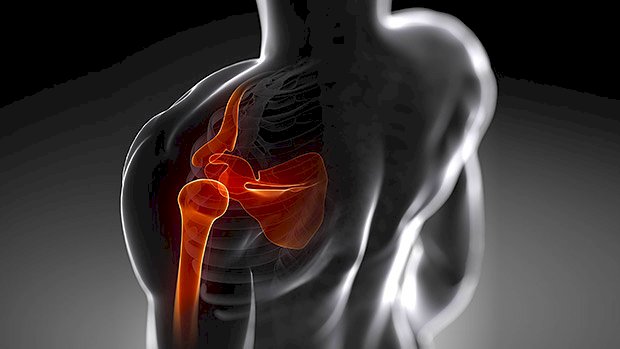 I coach CrossFit. I know, I know, I’m sorry. It was an accident. But I kinda have a problem: I like motivated people that enjoy lifting and high-skill bodyweight movements. And there’s something to be learned from this crazy “functional” stuff. Like, how can they do 20 muscle-ups followed by 30 clean encrypted-media” allowfullscreen> Let’s break each part down: Passive-Active Hang Think about pulling your shoulder blades down as much as you can to engage all your back muscles. You can either hold for 5 sets of 10 seconds or perform 5 to 10 reps with no pause. Try both and see if you fatigue easily. This is a basic shoulder movement and ideally you should feel like you could do it all day. Hanging Shoulder Rotation All the movement has to come from the shoulder and not the elbow… or weird bobbing movements from your neck. We’re looking for good shoulder mobility here, not head gestures that would accompany a naughty innuendo. Many people struggle with rotations and it can feel unnatural at first, but it really shouldn’t. If it helps, try lifting your arms overhead and rotating your shoulders without holding on to a bar. This way you’re not having to lift your bodyweight so you can get a better feeling for the movement. Then, try it on the bar with your toes on the floor for assistance and build up to fully hanging rotations. Think like a monkey in a tree. You have to be able to have that control to navigate from branch to branch; otherwise you’re just swinging and yanking your shoulder out of its socket every time. Yes, CrossFitters may look like a floppy fish when doing butterfly pull-ups, but there’s actually a lot of coordination, control, and strength that goes into them. Butterfly pull-ups without the prerequisite control are a quick way to a dislocated shoulder or torn rotator cuff. Even if you never have any intention of flopping about on a pull-up bar, this control and strength is important to your general shoulder health. Single-Arm Hang It’s incredibly important to be able to hold yourself from one arm and still be able to engage the lat, provided you’re not a heavyweight powerlifter. A great strength test is to see how each arm matches up to the other. If one arm has tremendous endurance and the other slips after a few seconds, which arm you will favor in pull-ups and presses? Working on this will even help bring balance to your shoulders. Single-Arm Rotation Last in the video, we show you a demonstration of a full rotation from a supinated grip to a pronated grip. When I demo this at workshops, it’s amusing how many people freak out. But this is nothing compared to what you’d see in a gymnastics training camp! Despite the common reaction, this is simply a normal range of motion for the shoulder. We demo it in the video because I want you think about how much range of motion you’re missing out on by not having a rotational element to your shoulder work. It’s kind of like only ever training squats without doing deadlifts – there’s a whole range of strength there that needs to be worked on. However, please don’t try a full rotation unless you’re confident in one-arm hanging and you’ve tried it with your feet on the ground first. If you’re new to it, an easier way to build rotation strength is dumbbell shoulder rotations. If you work to make all these movements easy, your shoulders will not only be smarter, but a hell of a lot more durable and able to cope with punishment from any training program. More stability, more strength, and fewer injuries – that’s hard to
Origin: Tip: Inside-Out Shoulder Strength and Mobility
Question of Strength 57
 How Limb Length Affects Training Q: You’ve said before that the front squat is a better lower-body lift than the back squat for people with long legs. How else can limb length play a role in exercise selection? A: Exercise selection is the most important training variable. Imagine if you’re a patient at the doctor’s office and the conversation went like this… Doctor:I’m going to prescribe you 200mg twice a day. Patient:200mg of what, Doc? Doctor:What do you prefer? Which medication do you feel like taking? It doesn’t make sense, right? Well it’s the same thing with training. Think of sets, reps, and training methods as the dosage and exercises as the medicine. While everybody will improve their body and performance by gradually becoming stronger on the big basics, simply doing those and nothing else will emphasize certain muscles over others, and might not end up giving you the result you’re looking for. Some people will get great pec development from the bench press while others will only grow their triceps and delts. Some will build tremendous quads from back squatting and others will build bigger glutes. Limb length relative to torso length is one of the main factors that determines which muscles receive the most stimulation. Here’s a general overview: Body Type 1 – Long Limbs/Short Torso Tend to progress more easily on pulling movements than on pressing ones Have an easier time getting stronger on the hip hinge/deadlift than on the squat Upper Body Pressing Pecs are the easiest to develop Delts are second Triceps are the hardest to develop Upper Body Pulling Lats are the easiest to develop Rhomboids, rear delts are second Biceps are third Upper traps are the hardest to develop Lower Body Training Glutes are the easiest to develop Hamstrings are second Quads are third Calves are the hardest to develop Body Type 2 – Short Limbs/Long Torso Tend to progress more easily on pressing movements than on pulling ones Have an easier time getting stronger on the squat than on hinging/deadlifting Upper Body Pressing Triceps are the easiest to develop Delts are second Pecs are the hardest to develop Upper Body Pulling Upper traps are the easiest to develop Biceps are second Rhomboid, rear delts are third Lats are the hardest to develop Lower Body Training Quads are the easiest to develop Calves are second Hamstrings are third Glutes are the hardest to develop All of this is true most of the time, but there will be some exceptions. (Arnold, for example, is long limbed and had huge biceps.) That info allows you to better select the assistance work you’re doing in a program by telling you which muscles will need added direct work. For example, I have short legs, so I don’t need any direct assistance work for the quads. They grow just fine by doing squats exclusively and I prefer to invest my training time on exercises that are actually needed to fix a weakness. However, I do need direct glute and hamstring work. You don’t need as much (if any) direct work for the muscles that are the easiest to develop, but you’ll need a lot more for those that are the hardest. Knowing this also helps us better select the big lift variations for our workouts. If I have long legs, the front squat will be better than the back squat for overall development. Why? Because with the back squat I’ll get mostly glutes and some hamstrings while with the front squat I’d stimulate the quads. A heels-elevated back squats would also do the trick. While there’s nothing wrong with good, smart programs you find on the internet, you should still give yourself some leeway in exercise selection: you can respect the spirit of a program while choosing better movements. Delt-Building Lateral Raises Q: When I do lateral raises I feel it mostly in my traps. How can I make them more effective at hitting my delts? A: Welcome to the club! I have naturally narrow shoulders and short arms which tends to favor the development of the traps over delts. But I do have a few tricks when it comes to lateral raises. Before I get into the three exercises, I must emphasize one point: to make the lateral raise effective at recruiting the delts you must focus on pushing the dumbbells AWAY, not on lifting them up. Try to bring the dumbbells as far to your sides as possible. They should only go up as a result of you pushing sideways. This tip alone should minimize trap recruitment. 1. The Backpack Raise No, you won’t be doing lateral raises while wearing a backpack (although that would likely work too) but with resistance bands looped around your shoulders to keep them down. The traps get involved when the shoulders raise up instead of just rotate. The bands, by keeping the shoulders down, help you focus on the delts better. To set up, you step on the inside of the band and hook the other end around the shoulder. Then do that on the other side with a second band. The bands’ position on the shoulder is important. You want to place it on
Origin: Question of Strength 57
Question of Strength 56
 Diagnosing Your Bench Press Problems Q: In a previous column you gave us a table explaining the problems and solutions for each sticking point in the military press. Can you do that for the bench press? A: Sure! Now, this table only lists the most probable issue causing each sticking point. There could be something more complex going on, or a technical issue that’s more unique to you. But eight times out of ten, I’ve found that strengthening the sticking point area will solve the problem. So take a look at this table, determine where your sticking point is, take note of the causes, and use the appropriate assistance exercises to strengthen that area. Bench Press Sticking Point Causes Assistance Exercises Breaking off from chest 1. Lats weak or not properly engaged 2. External shoulder rotators 3. Upper traps more dominant than lower traps and rear delts 1. Straight-arms pulldown, Pendlay row, seal row 2. Cuban press, seated dumbbell snatch, external shoulder rotations 3. Trap-3 raise, rear delt machine, Powell raise, victory raise Lower third Pecs Wide-grip bench press, Spotto press, decline bench press, floor press, dumbbell bench press, bench press with Duffalo bar Mid third 1. Anterior delts 2. Rear delts and rhomboids (Shoulder lifts up from bench) 1. Incline bench press, slight incline bench press, lying front raise 2. Bench press with resistance band around wrists, rear delt machine, face pulls Upper third (lockout) Triceps, especially long head Close-grip pin press, lockout bench press, close-grip floor press, close-grip decline bench, overhead triceps extensions If you’re unfamiliar with some of these exercises, use this list: Seal Row A seal row is a chest-supported row (using dumbbells or a bar) using a bench. Elevate the bench on blocks or plates. If you don’t have that setup, a regular chest-supported row will do. Cuban Press Trap-3 Raise Powell Raise Victory Raise Spotto Press Bench Press With Resistance Band Around Wrists Bench Press With Duffalo Bar Once you fix a muscle weakness, it’ll take some time to transfer those strength gains to the bench press. Your body will need to change the intermuscular coordination pattern. Don’t panic if your strength gains in pressing lag a few weeks behind your strength gains in the assistance lifts. CNS Stress and Trap Bar Deadlifts Q: Are trap bar deadlifts any less demanding on the central nervous system than barbell deadlifts? A: That’s a good question. Let’s look at what’s likely to increase the stress on the CNS when lifting. The Weight Lifted:The more weight imposed on your body (tendons, skeletal system, muscles), the greater the demand will be on the CNS. The Work Performed:I’m not talking strictly about volume here, but more about the amount of work you perform when doing a movement. Work is equal to force X distance. That’s why a partial lift is often less demanding on the CNS even if you’re using more weight. The Amount of Muscle Involved:If more muscles are involved at the same time, the CNS will be challenged more. This happens in part because normally more muscles involved means heavier weight, but also because the system needs to work harder to coordinate all of those muscles. The Complexity and Coordination Required:The more difficult the technique is, the harder the CNS will work. Technical Efficiency:The less efficient your technique, the harder your nervous system will work to properly execute the movement. A better engrained motor pattern, and a more efficient movement, is more economical on neurological resources. That’s one of the reasons why elite Olympic lifters with superb technique can snatch and clean Both speed (more precisely, accelerating the bar) and mass moved will increase the demands for force production. Force equals mass x acceleration. So the more force you need to produce, the greater the demands on the CNS. The Perceived Stress:When the body sees a lift as potentially dangerous, either voluntarily or subconsciously, it’ll produce more cortisol which leads to an increase in adrenaline production. More adrenaline production can lead to what we wrongfully refer to as “CNS fatigue” either by depleting dopamine (adrenaline is made from dopamine) or a desensitization of the adrenergic receptors due to overstimulation. Now, using this info, let’s compare the two. Traditional Deadlift vs. Trap Bar Deadlift The Weight Lifted:Pretty much everybody will lift more on a trap bar deadlift, especially if using the high-handle position. So if we’re talking strictly about using a certain percentage of your max, let’s say 85% of your max on that lift, the trap bar “wins” this one. The Work Performed:If you’re using the lower setting of a trap bar, the linear distance travelled will be the same as a conventional deadlift. However, the bar path is much straighter on a trap bar deadlift. So while the distance from point A to point B is the same, the path is “longer” on the
Origin: Question of Strength 56
Tip: The Strength Test Real Lifters Can Pass
 Lead Photo Credit: Daniel Bernhardt The 1RM Trap-Bar Deadlift Test As a serious lifter, you should be able to pass this test: Set up a trap bar with 2.5 times your bodyweight. Now, get one good rep. That’s it. So, a 200 pound man should try to hit a 500 pound trap-bar deadlift. Trap-bar deadlifts aren’t inherently “better” for testing strength than traditional squats or deadlifts, but they have a number of unique benefits. Squats are mostly knee-dominant, with some help from the posterior chain. Deadlifts are mostly hip-dominant, with some help from the anterior chain. There’s definitely overlap between the two, but it’s hard to determine who’s stronger: a guy with a 500 pound squat and a 400 pound deadlift, or a guy with a 400 pound squat and a 500 pound deadlift. A trap-bar deadlift can settle the debate. It’s a hybrid movement that combines the best of the squat pattern with the best of the hinge pattern. Rather than focusing on one side of the body, it requires a great deal of strength from both the posterior and anterior chain. On top of recruiting the entire musculature of the lower half, trap-bar deadlifts require significant upper back and grip strength. Plus, no lift translates more directly to overall athleticism and performance like the trap-bar deadlift. For example, a vertical jump requires exerting maximum force into the ground, which is exactly what it takes to lift a maximally loaded trap bar off the floor. Can’t Do It? Make trap-bar deadlifts your primary strength focus on lower-body days. Squats and conventional deadlifts obviously help, but nothing boosts your trap-bar deadlift more than the lift itself. Heavy singles, sets of 3-5 reps, and dynamic effort sets with bands or chains will go a long
Origin: Tip: The Strength Test Real Lifters Can Pass
Tip: The Strength Athlete’s Mistake
 Don’t Attack the Low Back There’s one very common mistake I see in a lot of strength athletes’ programs – extra low-back work. They have absolutely zero awareness of just how much work their erectors are already doing. If you’re squatting, deadlifting, and doing standing overhead presses, then your low back is getting a metric butt-ton of work; not even indirect work, but very direct work. The erectors recover more slowly than any other muscle group, yet guys will do all of the above and then decide to throw in a bunch of barbell rows, T-bar rows, hypers, and a whole slew of other movements where the erectors have to contribute mightily. I can’t tell you how many strength athletes had their squat and deadlift climb up once I removed all of the extra spinal-loading movements. The fact is, fatigue will mask fitness. The best thing you can do is choose exercises where you give the low back a break from loading while working the musculature around it so that it has a stronger support structure. That’s where the chest-supported row comes in. There are countless variations of this machine, but virtually any of them can be a strength athlete’s best friend. It allows you to really smash the entire upper back while giving you a break from more axial loading. Many times this is exactly what you need to get past a plateau. I like the seated machines rather than the ones where you’re lying at a 45-degree angle because the natural tendency on those is to arch very hard once the loading gets heavy, which defeats the whole purpose of choosing the chest-supported version. If you don’t have access to the seated machine, rig up your own with an incline bench and a low cable. The best bar to use in this situation is one with a curve in it so you aren’t banging it into the bench and can get your elbows behind you far enough to get a strong contraction in the upper back. Loading on chest-supported rows is secondary to achieving a strong mind-muscle connection. If you want to really get a smoke show going, do them after your deadlifts. You should feel an immensely strong contraction in the upper back due to the maximal loading and increased neural output that came from the deadlift. Don’t rip the weight on the initiation phase. Pull with a “roll on” rep fashion where you initiate with the upper back in a very deliberate manner and then pull aggressively into the strong peak contraction. Hold that puppy for a second before lowering. Two to three sets of 10-12 reps will do the
Origin: Tip: The Strength Athlete’s Mistake
 All about sport xlsport.club