
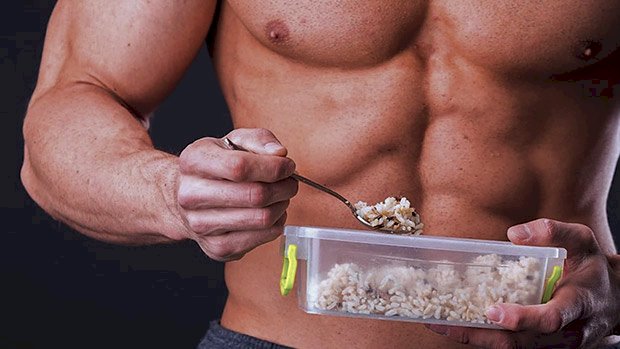
 Myth – Carbs at night will make you fat. Since your overall activity is low before bed, and then you go to sleep, the carbs you eat around that period will deposit themselves as fat cells and lead to fat gain. Truth – Carbs at night can expedite fat loss. In a study of 73 fat police officers, researchers found that shifting carb intake to the evening meal caused more fat loss compared to having carbs throughout the day. It also improved insulin sensitivity and lowered inflammation markers (1). One of the theories behind the study was that if insulin was kept low throughout the day, and limited to a single secretion in the evening, it would lead to higher relative concentrations of leptin starting 6–8 hours later (into the next morning and throughout the day). They believed this would lead to greater satiety and dietary compliance each day. The argument against carbs at night is a common one: People believe you’re not as insulin sensitive and thus you’ll be more likely to store excess carbs as fat while you’re at rest. However, if insulin is kept in check for the day, and you’ve spent the day being active, that’s not an issue. You’ll be insulin sensitive at the end of the day and should store those carbs as muscle glycogen. My Recommendation Front load protein, back load the carbs. If you struggle with binge eating in the evening and you’re front loading all of your carbs, or simply dispersing them throughout the day, then moving all of them to your last meal could lead to better dietary compliance the following day. If you want to use this approach, then front load most of your protein in the early part of the day, or even spread it out evenly over four to five meals, then shift all of your carbohydrate intake into the last meal of the day. This strategy can also help with sleep for those who have trouble relaxing in the evening. The influx of carbs can also spike serotonin. A good night’s sleep has also been proven to help increase fat oxidation compared to those who are sleep deprived. So it’s a win-win. Keep in mind, carb back-loading doesn’t mean it’s a free-for-all where you’re pounding down an entire bakery of croissants. Plenty of people do that and those people are fat. Myth – You don’t have to count calories on a keto diet. Keto fans say carbs are what make you fat, not excess calories. Their butter, bacon, and cheese-laden recommendations are often part of the idea that you’ve got to eat fat to burn fat, regardless of caloric intake. Truth – Caloric intake above maintenance will still cause fat gain. One of the most misleading statements about keto diets is that calories don’t matter if you’re not consuming carbs. This stems from the insulin-to-obesity theory. It goes something like this… Carbs cause insulin to be secreted. Insulin (the storage hormone) stores those carbs as fat. So, eliminate carbs and you’ll stop storing fat regardless of calories consumed. Become a fat-burning machine. It’s true that getting into a state of ketosis will increase fat oxidation. After all, fat and carbs are the main fuels used in the muscles for oxidation during exercise. If you eliminate carbs, then eventually the body is left with no choice except to use fat as the primary source for fuel. Boom: increased fat oxidation. But there’s a difference in fat oxidation and a reduction in fat mass, which can only happen in an energy deficit. And if you’re consuming an excess of calories from fat, then the body will do the same thing with those excess calories from fat as it does with carbs: it’ll store them for later use. The reason that a ketogenic diet works well for some people is that it can increase satiation or feeling of fullness. This higher degree of satiation can naturally cause some to eat fewer calories, which leads to fat loss despite the fact that they may not be counting calories. My Recommendation The ketogenic diet will work for fat loss in the same way that every other diet works for fat loss – by creating an energy deficit. You cannot eat “as much as you want” on a keto diet and still lose fat simply because you eliminated a macronutrient source. From the data we’ve seen, keto does appear to increase satiation better than most standard diets which can help with dietary compliance and naturally reducing caloric intake. However, when calories and protein are equal, it’s not a significant advantage for fat loss (2). And on the flip side, the keto diet falls flat on its face when it comes to increasing muscle (3) (4). Myth – Intermittent fasting (IF) works better than any traditional diet. IF has become all the rage again. Heck, I’ve used it. I can attest to the fact that there’s an upswing in mental acuity during extended fasts, and to the fact that I never experienced any muscle loss while doing it (sometimes up to 70 hours of fasting). These things are definitely advantages of fasting protocols. At least they were for me and seem to be for anyone who has done extended fasting. The
Origin: 5 Fat Loss Myths You Still Believe
Tag: Still
Tip: You’re Still an Ego Lifter
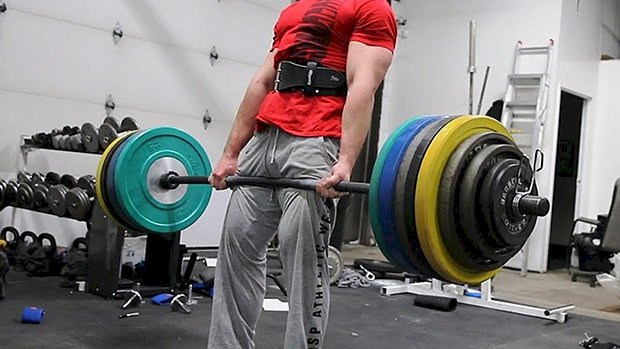 When you hear the term “ego lifting” you probably think of one-fourth squats, curls that use everything but biceps, and bench presses that double as the spotter’s deadlift workout. As a T Nation reader, you know better. However, you can easily fall prey to a more subtle version of ego lifting where you train at or too close to your 1RM. This is especially common with the bench press and deadlift. A lifter trains hard and can eventually hit a plate milestone. It might be a three-plate bench press or a four-plate deadlift with proper form. Now he’s hooked. Each time he trains that lift, he wants that feeling again (and wants everyone in the gym to see him). As a result, his training session consists of working back up to that 1, 2 or 3RM. A typical deadlift workout might look like this: Set 1:5 x 135 Set 2:3 x 225 Set 3:2 x 315 Set 4:1 x 365 Set 5:1-2 x 405 The problem with subtle ego lifting is that the intensity is too high. This can easily lead to burnout, plateaus, and injury. The other problem? The volume is too low to actually build muscle and achieve long-term strength gains. If you’re serious about results, swap subtle ego training for true strength building. True strength building is when you… Check your ego at the door Come to the gym to build strength, not to demonstrate it Lift heavy, but not maximal, weights Train hard, but leave a rep or two in the tank each set Use a moderate, repeatable amount of volume (3×5, 5×5, 4×6, 3×8, 5-8×3) Work on your weaknesses A true strength training deadlift workout might look like this: Warm-up sets Set 1:5 x 135 Set 2:3 x 225 Set 3:2 x 275 Set 4:1 x 315 Set 5:1 x 345 Work sets 2-3 sets of 5 reps with 365 This may not seem as cool at first, but this is a very easy way to add 5-10 pounds per week for quite a while. Before long you’ll be doing a perfect set of 5 with your old
Origin: Tip: You’re Still an Ego Lifter
 All about sport xlsport.club