
 You’ll need a dual-adjustable cable machine like the one in the video. Something like a Cybex Functional Trainer or a Keiser Functional Trainer would work. You’ll also need a bar-style cable attachment. (If you don’t have one of these attachments, you’ll see a workaround below.) The attachment should be set just off the floor. Pick it up and step back a foot or two, which will change the angle of pull from the cable. Engage your lats, push your hips back, and allow the bar to travel in toward the cable machine. Once your hamstrings have gone as far as they can handle, return to the start position. Just think of it as a traditional RDL, but you’ll be forced into a slightly different movement to compensate for the direction of the cable. If you don’t have access to the type of cable attachment shown, here’s an effective way to do it using a barbell. Combo Hamstring RDL Here’s a closer look at how the cable is attached to the barbell using a common handle. (Ankle attachments will also work.) When using the combo (cable and barbell) version you’ll also need to account for the extra weight of the bar. This adds another element to the exercise, where on top of the more horizontal cable load you’ll also be adding to the vertical. You can add weight to the bar here, but keep in mind how this’ll affect the overall profile of the exercise. There are some merits to doing this, but for now let’s stick to the exercise in question where the majority of weight is coming via the cable stack (two cable stacks, technically). Why They Work Due to the cable angle, the exercise is designed so that your hamstrings are likely to give out well before your back does. Your hamstrings are taken into a fully lengthened position under load, while your low back will feel like it’s on vacation. Theoretically, there’s very little sheer or compressive force coming through your lumbar region, while there might even be a little traction of the spine as you reach into the bottom position (depending on the height of the cable). These Romanian deadlifts are anything but an ego lift. They prioritize tension through the targeted muscle. This is good news if size is your priority. When it comes to hypertrophy, your muscles don’t give a damn how much your ego is lifting. Tucked away by layers of connective tissue and skin, they’re blind to what goes on outside. They do recognize tension though – and you’ll get plenty of it with this exercise. You’ll also notice that as your toes get pulled into the floor (resisting dorsiflexion), your calves will become more active. This co-contraction of the gastrocnemius adds to the effect and will make things even harder for your hamstrings. Programming Try these in place of your regular deadlifts as a way to vary the training stimulus or work around a tricky back. They’re also a useful alternative to exercises such as 45-degree back extensions, reverse-hypers, pull-throughs and the like. Sets and reps should be
Origin: Tip: Best Deadlift For Leg Size & Back Health
Tag: Size
Tip: Eccentric-less Training For Size
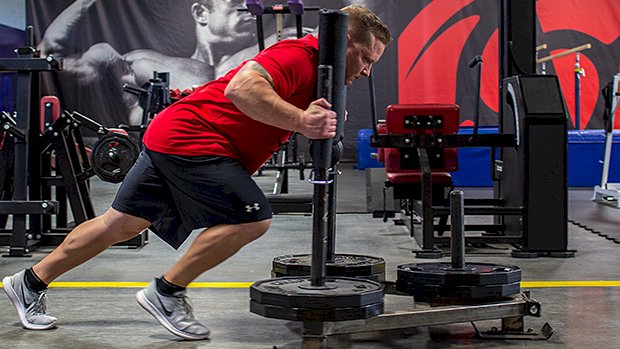 You might remember when I coached Daryl Gee for the Mr. Olympia. One particularity of his routine was daily “eccentric-less” training. It consisted of various forms of Prowler pushing and sled dragging. Remember, the eccentric phase of a lift is usually the lowering or negative portion where the muscles lengthen and stretch. Eccentric-less work removes that portion. If you think about pushing against a sled, each step forward against the weight is concentric. There’s no negative. I also used frequent sled work with a 63-year-old bodybuilder who was making a comeback. He wanted to get back into competing, but his knees were messed up. He couldn’t do any traditional lower-body exercises – no squats, leg presses, lunges, leg extensions, etc. He’d come to see me three days a week and we’d do various types of Prowler pushing and sled drags for his lower body. He ended up winning the overall against guys half his age and his legs were his best body part! He was also able to resume regular lower-body training afterward because his knees were fixed. Two Lessons From This Prowler/sled work is effective at increasing size or strength if you use the right parameters. This type of exercise can be done very often. Sled work is pretty much devoid of an eccentric load. As such, the amount of muscle damage created is very low. That means you can recover quickly. For hypertrophy, since you’re not causing much muscle damage, you must rely on other pathways to stimulate growth: Fiber fatigue Lactate accumulation The release of growth factors. All of these are maximized when the time under load is significant, but not so long that loading has to be light. So 30-45 seconds of work seems to work very well. If strength is your goal, opt for very heavy sets of 10-50 meters with an ideal distance of 30 meters. And, obviously, you can do sled work for conditioning. You can go as high as two minutes per set. I prefer to stay in the 50-70 second zone with either a challenging weight or a challenging speed. When you do frequent (even daily) Prowler/sled work, do one version per day for 3-4 sets. While very little muscle damage is done, you still use a lot of fuel when doing them, so you can end up releasing too much cortisol if you go too heavy on the volume. Note: The 63-year-old bodybuilder used 2-3 variations per workout, but that’s all he did on those workouts. If you add them to your sessions, select one variation per
Origin: Tip: Eccentric-less Training For Size
50 Reps for Size
 Years ago I saw strongman competitor Derek Poundstone doing 100-rep work and asked him why he was doing it. One of his main reasons? Mental toughness. Different kinds of work in the gym require different mindsets. A 20-rep set of squats – with a maximum load for that rep range – is brutally hard. It requires mental and physical toughness. Ultra high-rep work (50 reps and up) is no different. It requires a tremendous amount of intestinal fortitude and mental strength to lock yourself into that set and see the whole thing through. And this type of brutality works great as a finisher. The Main Requirement For Progress Most guys who complain about a lack of progress just don’t train hard enough to make any program work. That’s why they gravitate towards the “volume” approach. They’ll do a whole bunch of sets with a bunch of reps left in reserve. This isn’t hard training; it’s “junk volume” and it sure as hell isn’t going to drive growth or strength gains. At some point you have to train hard enough to force your body to adapt. You have to apply stress to the muscle. There’s literally no way around it. To get past a plateau, you have to train harder than you’ve ever trained before. Ultra high-rep work is one tool to help you do just that. The Benefits It’s not just about the mental toughness. Here’s what else it can do: Metabolic Stress High reps create quite the pump. And bodybuilders have been using the pump for a long time. It’s not just a fleeting cosmetic effect, it’s a tool for muscle growth. Metabolic stress, due to an increase in cellular swelling and potential for additional motor unit recruitment (through metabolic acidosis), can be a driver for muscle growth. Metabolic stress may increase growth hormone as well through the increased lactate response. High-rep work, done properly, is the driver for metabolite accumulation. EPOC This stands for “excess post-exercise oxygen consumption” and has been called the “after burn” effect. If you train really hard, you increase the thermic effect of activity, especially when that activity is more anaerobically driven like sprints or hard lifting. EPOC is referring to the uptake of oxygen above your resting levels after you’ve completed the workout. An increase in oxygen consumption has an energy requirement, so this means you’re still burning calories at an elevated rate after the training session is over. Very high rep work is a great way to induce some EPOC and achieve that energy-burning effect after you leave the gym. While the “after burn” of high intensity interval training (or a really intense lifting session) is a bit overstated in terms of post-training caloric expenditure, it’s still a benefit. Joint Pain Relief While this may not be scientifically proven, over the last several years I’ve had a tremendous amount of people express to me how very high-rep empty barbell curls alleviated their constant and nagging elbow pain when everything else they’d tried had failed. I’ve considered the obvious, like an increase in blood flow moving excess inflammation out of a joint or connective tissue. Or simply strengthening the forearm flexors and extensors in a more balanced way. The point is, if the root of your elbow pain exists between the elbow and wrist, this may alleviate some of that achiness. Now let’s get into the nuts and bolts of ultra high-rep work. 50-Rep Finishers Your goal: Shoot for all 50 reps in one set. Can’t do it? Then break them up into rest/pause sets. In this case, complete the reps using one of these approaches: Do as many reps as possible. Take 10 deep breaths and go again. Repeat this until all 50 reps are done. Break up the 50 reps into 2 sets of 25 reps with 30 seconds rest between. But remember, the goal is to get all 50 in one shot. Now notice that there are loading options for most of these. Why? Because not everyone is at the same strength or strength endurance level. It also allows for a bit of progression and some goal setting. Barbell Curls Some lifters will need to use an empty 45-pound bar for these; others may need to slap on some baby plates and use 50-65 pounds. If your soul is still intact after 50 reps, add weight. Behind the Neck Press Use a 65-95-pound loaded barbell. Seated or standing is fine. We’re working shoulders in metabolic stress fashion – that’s the main point. If you’re truly beastly, you could do the Bradford press, with the bar just barely skimming the top of your head on the crossover. But that would be absolutely torturous. Excellent. I’ll allow it. For those who’ll quip about the behind-the-neck press and shoulder impingement, then do them in front of the neck. Or fix your shoulder mobility. Goblet Squats Find a dumbbell that’s a quarter of your bodyweight. So if you weigh 200 pounds, that’d be a 50-pound dumbbell (or kettlebell). Now do goblet squats for 50 reps. This can be a “broken” set. You can stand and catch your breath as needed, but you can’t put the dumbbell down or sit.
Origin: 50 Reps for Size
 All about sport xlsport.club