
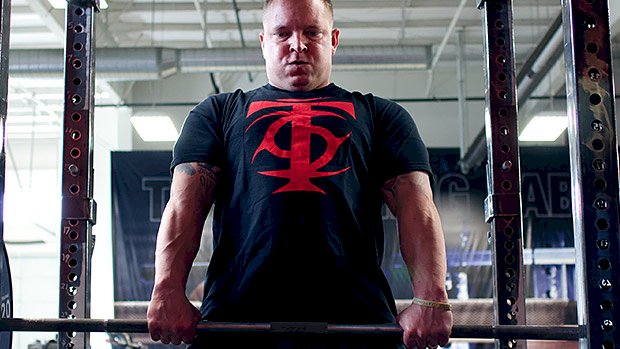
 Following the advice of genetically elite lifters is misleading. Many top competitors have excellent physiques in spite of what they do, not because of what they do. There are other types of genetic freaks as well – those who respond extremely well to PEDs. Their receptors have a great affinity for steroids and they seemingly grow non-stop. Does that translate into the kind of expertise that can help the natural lifter? I’ve been on both sides. For years I coached top-level competitors who wanted to become national champions, but I walked away from that world. In the years that have passed, I realized what it’s like to be on the other side of the fence. I’m now a natural, aging bodybuilder with battle scars and training limitations from those hardcore days. This relatively new-found wisdom has allowed me to compile ten principles for the natural lifter who finds it hard to build muscle. If you apply these principles consistently, you’ll absolutely benefit. 1 – Under-training is more effective than overtraining As cool as some hardcore training tactics look, they can quickly take the natural lifter into the overtraining zone. There’s a difference between optimum work capacity and maximum work capacity. There’s often an overemphasis on methods to stimulate growth, but an under-emphasis on rest and recovery. If you leave the gym and have to sit in your car for 5-10 minutes to gather yourself before you even leave the parking lot, you’ve tapped too deeply into stimulus and you haven’t paid relative attention to recovery. It isn’t very sexy to be talking about rest and recovery, but most of the time the non-sexy details are the most relevant for producing results. Under-training allows you to keep showing up. Consistency is more important than intensity. Furthermore, consistency is the building block of intensity – not the other way around. Does this mean it’s okay to never sweat and to sit on the end of a bench scrolling through your phone between sets? Of course not. But real success is less about “giving it all you got” and more about being able to show up every training day in a performance-readiness state. 2 – Do NOT train to failure After I left the hardcore competition world, I had to revisit dozens of my training programs and write them to include fewer sets, along with removing training tactics that took muscles beyond relative failure – which no natural lifter could realistically recover from. I took out heavy negatives, forced reps, strip sets, drop sets, and extended sets. Not only did I remove these tactics, I instructed all clients to avoid training to failure on any working set. You have to pump iron, but you should always leave a good two reps in the tank on every set. This means picking a weight that challenges your target muscles for the reps indicated, but avoids taking you to failure. 3 – Emphasize both intra-workout and inter-workout recovery You have to balance adequate training stimulus with adequate recovery, both within workouts and between workouts: Not enough workouts per week = not enough stimulus. Not enough recovery within and between workouts = overtraining and not enough time to complete an adaptive response. Intra-workout recovery and inter-workout recovery need to reflect one another. “Inter” workout recovery has a lot to do with proper program design. “Intra” workout recovery has more to do with training within optimal work capacity zones and seldom pushing muscles into maximum work capacity zones. For the natural trainee, establishing a consistent training pace and natural workout flow are important. And this has as much to do with intra-workout recovery as it does with the specified training stimulus of exercise selection, sets, and reps. However, the workout pace should never be forced into specific windows of by-the-clock rest intervals. Obviously, it takes a lot more time to recover from a set of high-rep squats or lunges than it does to recover from a set of concentration curls, but using the clock to gauge intra-workout recovery just makes no sense. And neither does following some written-down instruction to rest for a specified time between sets. No coach can know how close you are in the training zone between optimum and maximum work capacity in a given workout, and neither can a coach assume your current conditioning level. Assigning rest times between sets according to the clock or timer is like throwing darts at a dartboard while blindfolded. That’s not exactly a reliable construct. So how then do you know how long to rest between sets? That’s where the next principle comes in. 4 – Determine how long to rest between sets subjectively Your rest between sets should be self-monitored according to the concept of “subjective determination of performance readiness.” After you’ve completed a working set, ask yourself this question: “Can I do my next set with equal or greater intensity than the previous set?” The answer has very little to do with timers or
Origin: 10 Rules for Steroid-Free Lifters
Tag: Rules
10 Nutrition Rules for Hardgainers
 The Blueprint for Gains When most hardgainers ask for advice, they’re told simply to eat more. Unfortunately, eating more doesn’t address the problems of raging metabolism, high stress hormones, poor digestion, and pathetic appetite that plague most skinny guys. But with the right guidelines and some hard work, you can say goodbye to your former skinny self – forever! Here’s the blueprint I used to pack 50 pounds of lean muscle onto my scrawny frame. Not only did it work for me, but it also worked for my clients and my athletes. It’s time for you to put the “gainer” back in hardgainer. 1 – Boost your appetite with the right amount of training. When it comes to building muscle, the most important thing is training. Even in situations that aren’t ideal, the body can build muscle to survive the threat imposed by training. Research has shown you absolutely can build muscle in a calorie deficit (if protein intake is high) (1). And anecdotal evidence from prisons shows that guys get jacked all the time, despite awful nutrition. This is not in any way suggesting that eating isn’t important. No skinny guy will gain a respectable amount of muscle without proper nutrition. However, you need to have your priorities straight. Muscle building starts with hard training, and perhaps surprisingly, hard training will improve your eating. Consider that one of the biggest obstacles a hardgainer has is a pathetic appetite. Hard training is one of the fastest, easiest ways to increase your appetite. It makes your body demand more food and this makes eating large amounts of food way easier. Oddly enough, your appetite can actually help you find your training sweet spot. Too little training will do nothing to increase your appetite. Too much training will actually decrease your appetite. The right amount of hypertrophy training will leave you ravenous! 2 – Tough out the two-week BMR increase and keep going. Research on lean, healthy subjects shows an increase in BMR (basal metabolic rate) for about the first two weeks with overfeeding (2). That means when you try to eat big, your body’s first response is to increase its metabolic rate. This is precisely why just eating more doesn’t always work for hardgainers. They take the advice, go out and start eating more for a couple weeks, and then find the scale won’t budge. Now the hardgainer thinks he’s a non-gainer. He gives up on nutrition and thinks some magical new biceps curl variation is the real secret to getting jacked. Look, this spike in your already naturally fast metabolism is part of the game. Don’t worry, it won’t keep increasing forever, but you need to be patient. You need time for your body to get used to consuming larger volumes of food. In fact, you may not even be able to eat and properly digest the amount of quality food you need to build muscle… yet. You need time to get used to eating more and following the other new lifestyle habits and strategies in this blueprint. Stay the course, let your body adapt, and the scale will start moving up. If you’re not in this for the long haul, you need a different hobby. 3 – Replace pre-workout stimulants with peri-workout nutrition. Hardgainers already have too many stress hormones pumping through bodies. As a result, losing muscle is fast and easy while gaining it is slow and difficult. Many hardgainers add even more stress to their bodies by abusing pre-workout stimulants. Remember, the only stimulant you “need” for a great training session is a strong mind, and instead of getting all hopped up on stimulants before training, fuel your body with peri-workout nutrition. It’ll give you extra protein, carbs, and calories without taking up room in your stomach or taking up time to prepare more food. Also, the insulin from the carbs has a powerful anti-catabolic effect, which shuffles the hormonal deck in your favor. 4 – Add menu items instead of increasing portion sizes. Think back to your childhood. Remember how you were so full that you couldn’t eat another bite of dinner? But then, when presented with surprise dessert, you regained your appetite. As a kid, I thought I had a separate dessert stomach. I now know it was just a case of palette fatigue. When you eat a lot of one type of food, your palette simply gets bored of that flavor and texture and you stop wanting to eat. When most hardgainers try to eat, they just eat more of what they’re already eating. They try stuffing down more chicken, rice, and broccoli, and it doesn’t work. Their palettes get so tired of the same stuff that they stop eating long before they reach the level of food necessary to build muscle. Instead of eating more, add more items to your meals. Increase the flavors and textures at your meal and watch the scale finally start to climb. For example, let’s say your typical breakfast consists of the following: 3 eggs 2 pieces of toast or oatmeal 1 apple Gradually add items until you get to this breakfast: 1 scoop Metabolic Drive® Protein in
Origin: 10 Nutrition Rules for Hardgainers
 All about sport xlsport.club