
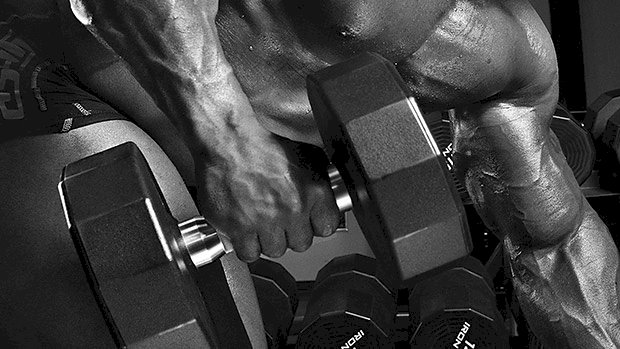
 Are you a powerlifter? Increase your row and you’ll bench more. Do you fight? A stronger row means harder strikes and a tighter defense. Just training for life? A stronger row will improve shoulder health, posture, and general performance. Done correctly, the row variations below are probably all you’ll ever need in this exercise category. So whether you need to build a foundation, work around a low back or shoulder injury, or simply have forgotten the basics, one or all of these exercises will literally get your back on track. 1 – T-Bar Row The T-bar row is a true classic and one of the best overall row exercises. Yes, it’s the one you saw Arnold perform in Pumping Iron. It requires you to use your lower back and hips to stabilize the trunk while you perform rows using your upper back muscles. So, in addition to building pulling strength and your upper back, the T-bar row also develops lower back strength and stability. Start with a light load and place your body in a tight and stable position. Focus on generating force from the ground (by pressing the heels out to the sides to activate the hips) and keeping the abs engaged (pull the ribs down and hold what’s in effect a plank position). That’ll force you to pull with the right muscles instead of just compensating with your lower back. 2 – Chest-Supported Dumbbell Row Besides being more low-back friendly, the chest support makes it hard to cheat and use momentum. This annoying fact will damage a lot of egos and is probably the reason why some lifters often prefer seated cable rows – they make it easy to use a lot of body English. To do the chest-supported row, you need to actually support yourself with your chest and not just lie flat down on the bench. Take a look at how I place my hips in the video and you’ll notice that I adopt a solid stance, thus creating tension from the feet, through the hips, through a stable spine (ribs down, abs engaged to not hyperextend and “leak force”), all the way to the chest. You need a tight body position to get the most out of the exercise and pull with the muscles that are supposed to be doing all the pulling. Too many people mess this up and wobble all around. 3 – One-Arm Dumbbell Row This is probably the best overall barbell/dumbbell row exercise. Sure, it builds your ability to lift things from the ground, but it also improves your defensive abilities against an opponent who’s trying to pull you down or knock you off balance. It does all that by enhancing thoracic spine rotation and extension while building stability in the rest of the body. You really have to use all your core muscles to fight the body’s inclination to rotate and side-shift, meaning you’ll create actual, real-life, functional core strength. Even though this is a classic, many butcher it by failing to achieve full body tension, which leads to energy leaks. Aside from keeping a solid stance, the most important technical aspect is to push the supporting hand hard into the bench while you pull. This “diagonal” tension makes the lift stronger and safer. 4 – Inverted Row Most people struggle to perform this correctly because it requires being able to activate the right muscles. If you can’t pull yourself all the way up to touch the bar, you simply lack upper back strength, period. If this applies to you, no wonder your shoulders hurt when you do bench press, push-ups, or pull-ups. Another great aspect of the inverted row is the need for posterior chain involvement. The entire backside needs to be activated at the same time, which is different from a lot of movements where you just focus on the plank and the “front core.” Getting used to stabilizing your backside in this way will improve your performance in other lifts and activities as well. Oh, and it’s one of the safest pulling exercises you can do when your low back is messed up. 5 – Standing One-Arm Cable Row The ability to perform resisted diagonal and rotational movements is crucial to human functions like walking, running, climbing, and throwing. The trouble is, regular/classical strength training lives primarily in the land of bilateral and symmetrical loaded exercises, with little thought given to rotation. Obviously, some exercises include anti-rotation tendencies, but few traditional exercises involve actual rotation qualities. The standing cable row is a great introduction to rotational training. While the main focus is on the row, it will improve and train thoracic/upper body mobility and core/hip stability. This makes the body more fluid and
Origin: The 5 Greatest Rowing Exercises
Tag: Rowing
Interval Training on the Rowing Ergometer
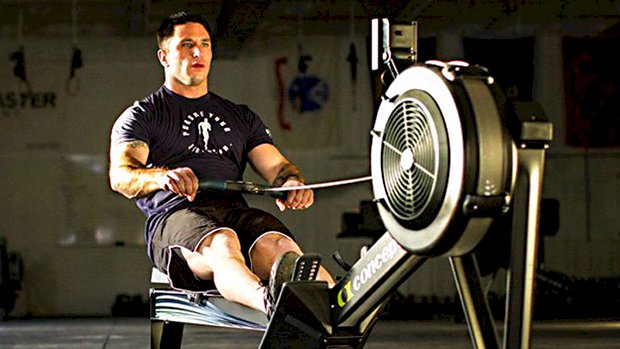 Lead Photo Credit: Again Faster Equipment (Jim Rego at CrossFit Southborough) Here’s what you need to know… The rower is unlike typical cardio machines. It’ll get you gassed immediately with zero impact on the joints. Move through your hips, not your spine. If you have back or hip issues, this may not be for you. There are a variety of workouts. Try intervals of 500-400-300-200-100 meters with 60 rest in between. Test yourself with a 2,000 meter row, or break it up into two sessions of 1,000 meters. Do 5 intervals of 300 meters with little rest in between, or just row as hard as you can for the length of a song. A Different Cardio Machine For the first decade of my career in the strength and conditioning field, I wasn’t too charitable when it came to cardio machines. But I learned the value of the rowing ergometer or “erg.” I learned this by getting my butt handed to me! Gassed, Wheezing, and Red-Faced I bought my wife a rowing machine for her birthday. Believe it or not, at an intimidating 5′ 3″, she was captain of her nationally ranked college crew team. The week we got it, I walked down to the basement to see her get after it on the erg. She was humming along, and making it look easy. I decided to hop on and try it out myself. I cranked out a 500-meter time trial and narrowly edged the 500-meter pace she’d just maintained over 2000-meter. In short, my wife kicked my ass. What’s worse, when I got off the erg I was completely gassed. When I was done wheezing, I joked with her that I couldn’t believe she used to wake up at 5 a.m. to do that in the middle of winter on an icy river. It was awful. Why was it so awful? Well, first, I was wildly inefficient with this cardio approach. Second, the stress was distributed over my entire body, so I felt like I was limited more by my ability to breathe than by local muscular endurance. Third, I’m a competitive bastard, and the thought of being out-rowed by my little wife didn’t sit well with me. So I decided I’d do it once a week as my interval training, and it’s proved to be one of the best training decisions I’ve made. Short Workout, Faster Recovery Why the love for the erg? First, you can get in a lot of work in a short amount of time. And because the stress is distributed over your entire body, rowing won’t gas your lower body like sprinting does. It’s a tough fitness challenge that can actually help you recover from heavy squatting and deadlifting — better than sprinting twice a week. Is Rowing For You? Before we get to the training protocols, note that this absolutely isn’t for everyone, so let’s outline the contraindications. You should not row if: You have symptomatic low back pain, or a history of symptomatic intervertebral disc pathology. Repeated flexion/extension of your spine is an injury mechanism for discs, particularly under compressive loading. You have hip pain of any sort. The full flexion nature of the rowing motion can exacerbate problems in this regard. You have an outrageously aberrant posture. If you’re really kyphotic (rounded shoulder), this approach to rowing will likely make it worse by feeding into your posture. You’re better off doing more controlled, lower-volume rowing variations in your strength training program in a position of thoracic extension. If you have an excessive anterior pelvic tilt and lordosis, it’ll just feed into that as well. You sit all day. If you’re at a desk for 8-10 hours a day, you really should avoid any sitting during your exercise session, and that certainly means avoiding it for 15-20 minutes at a time. You plan to do deadlifts or good mornings the following day. No matter how good your technique is, you’re still going to use your lower back a bit. I’ll typically row a day or two after I do these exercises. You have baggy shorts on. I made this mistake once. Don’t do it. Note on Technique There are coaches who devote their entire career to building elite rowers and optimizing technique. I’m not one of them. However, I do have one bit of advice: Move through your damn hips, not your spine. Got it? Good. That said, most advanced rowers pull a bit higher up, essentially toward their nipples/sternum. Effectively, it looks a bit more like an upright row — or Olympic lift pattern, when you effectively use your legs — than a true “row.” For the general fitness folks just looking for a training benefit as safely as possible, it’s probably more shoulder healthy to pull a bit lower down. The upper abs is a good reference point, even if it means you’ll go a bit slower. Rowing Workouts Use the rower for shorter duration intervals. When people who haven’t been properly educated on rowing technique try to crush 20-30 minute sessions, bad things happen. For that reason, stick to shorter bouts on the erg. Or just get up and walk around between sets, adding in some filler mobility or activation exercises. 1 – 5 x 300-meter with diminishing rest intervals The 300-meter distance is awesome because
Origin: Interval Training on the Rowing Ergometer
Interval Training on the Rowing Ergometer
 Lead Photo Credit: Again Faster Equipment (Jim Rego at CrossFit Southborough) Here’s what you need to know… The rower is unlike typical cardio machines. It’ll get you gassed immediately with zero impact on the joints. Move through your hips, not your spine. If you have back or hip issues, this may not be for you. There are a variety of workouts. Try intervals of 500-400-300-200-100 meters with 60 rest in between. Test yourself with a 2,000 meter row, or break it up into two sessions of 1,000 meters. Do 5 intervals of 300 meters with little rest in between, or just row as hard as you can for the length of a song. A Different Cardio Machine For the first decade of my career in the strength and conditioning field, I wasn’t too charitable when it came to cardio machines. But I learned the value of the rowing ergometer or “erg.” I learned this by getting my butt handed to me! Gassed, Wheezing, and Red-Faced I bought my wife a rowing machine for her birthday. Believe it or not, at an intimidating 5′ 3″, she was captain of her nationally ranked college crew team. The week we got it, I walked down to the basement to see her get after it on the erg. She was humming along, and making it look easy. I decided to hop on and try it out myself. I cranked out a 500-meter time trial and narrowly edged the 500-meter pace she’d just maintained over 2000-meter. In short, my wife kicked my ass. What’s worse, when I got off the erg I was completely gassed. When I was done wheezing, I joked with her that I couldn’t believe she used to wake up at 5 a.m. to do that in the middle of winter on an icy river. It was awful. Why was it so awful? Well, first, I was wildly inefficient with this cardio approach. Second, the stress was distributed over my entire body, so I felt like I was limited more by my ability to breathe than by local muscular endurance. Third, I’m a competitive bastard, and the thought of being out-rowed by my little wife didn’t sit well with me. So I decided I’d do it once a week as my interval training, and it’s proved to be one of the best training decisions I’ve made. Short Workout, Faster Recovery Why the love for the erg? First, you can get in a lot of work in a short amount of time. And because the stress is distributed over your entire body, rowing won’t gas your lower body like sprinting does. It’s a tough fitness challenge that can actually help you recover from heavy squatting and deadlifting — better than sprinting twice a week. Is Rowing For You? Before we get to the training protocols, note that this absolutely isn’t for everyone, so let’s outline the contraindications. You should not row if: You have symptomatic low back pain, or a history of symptomatic intervertebral disc pathology. Repeated flexion/extension of your spine is an injury mechanism for discs, particularly under compressive loading. You have hip pain of any sort. The full flexion nature of the rowing motion can exacerbate problems in this regard. You have an outrageously aberrant posture. If you’re really kyphotic (rounded shoulder), this approach to rowing will likely make it worse by feeding into your posture. You’re better off doing more controlled, lower-volume rowing variations in your strength training program in a position of thoracic extension. If you have an excessive anterior pelvic tilt and lordosis, it’ll just feed into that as well. You sit all day. If you’re at a desk for 8-10 hours a day, you really should avoid any sitting during your exercise session, and that certainly means avoiding it for 15-20 minutes at a time. You plan to do deadlifts or good mornings the following day. No matter how good your technique is, you’re still going to use your lower back a bit. I’ll typically row a day or two after I do these exercises. You have baggy shorts on. I made this mistake once. Don’t do it. Note on Technique There are coaches who devote their entire career to building elite rowers and optimizing technique. I’m not one of them. However, I do have one bit of advice: Move through your damn hips, not your spine. Got it? Good. That said, most advanced rowers pull a bit higher up, essentially toward their nipples/sternum. Effectively, it looks a bit more like an upright row — or Olympic lift pattern, when you effectively use your legs — than a true “row.” For the general fitness folks just looking for a training benefit as safely as possible, it’s probably more shoulder healthy to pull a bit lower down. The upper abs is a good reference point, even if it means you’ll go a bit slower. Rowing Workouts Use the rower for shorter duration intervals. When people who haven’t been properly educated on rowing technique try to crush 20-30 minute sessions, bad things happen. For that reason, stick to shorter bouts on the erg. Or just get up and walk around between sets, adding in some filler mobility or activation exercises. 1 – 5 x 300-meter with diminishing rest intervals The 300-meter distance is awesome because
Origin: Interval Training on the Rowing Ergometer
Interval Training on the Rowing Ergometer
 Lead Photo Credit: Again Faster Equipment (Jim Rego at CrossFit Southborough) Here’s what you need to know… The rower is unlike typical cardio machines. It’ll get you gassed immediately with zero impact on the joints. Move through your hips, not your spine. If you have back or hip issues, this may not be for you. There are a variety of workouts. Try intervals of 500-400-300-200-100 meters with 60 rest in between. Test yourself with a 2,000 meter row, or break it up into two sessions of 1,000 meters. Do 5 intervals of 300 meters with little rest in between, or just row as hard as you can for the length of a song. A Different Cardio Machine For the first decade of my career in the strength and conditioning field, I wasn’t too charitable when it came to cardio machines. But I learned the value of the rowing ergometer or “erg.” I learned this by getting my butt handed to me! Gassed, Wheezing, and Red-Faced I bought my wife a rowing machine for her birthday. Believe it or not, at an intimidating 5′ 3″, she was captain of her nationally ranked college crew team. The week we got it, I walked down to the basement to see her get after it on the erg. She was humming along, and making it look easy. I decided to hop on and try it out myself. I cranked out a 500-meter time trial and narrowly edged the 500-meter pace she’d just maintained over 2000-meter. In short, my wife kicked my ass. What’s worse, when I got off the erg I was completely gassed. When I was done wheezing, I joked with her that I couldn’t believe she used to wake up at 5 a.m. to do that in the middle of winter on an icy river. It was awful. Why was it so awful? Well, first, I was wildly inefficient with this cardio approach. Second, the stress was distributed over my entire body, so I felt like I was limited more by my ability to breathe than by local muscular endurance. Third, I’m a competitive bastard, and the thought of being out-rowed by my little wife didn’t sit well with me. So I decided I’d do it once a week as my interval training, and it’s proved to be one of the best training decisions I’ve made. Short Workout, Faster Recovery Why the love for the erg? First, you can get in a lot of work in a short amount of time. And because the stress is distributed over your entire body, rowing won’t gas your lower body like sprinting does. It’s a tough fitness challenge that can actually help you recover from heavy squatting and deadlifting — better than sprinting twice a week. Is Rowing For You? Before we get to the training protocols, note that this absolutely isn’t for everyone, so let’s outline the contraindications. You should not row if: You have symptomatic low back pain, or a history of symptomatic intervertebral disc pathology. Repeated flexion/extension of your spine is an injury mechanism for discs, particularly under compressive loading. You have hip pain of any sort. The full flexion nature of the rowing motion can exacerbate problems in this regard. You have an outrageously aberrant posture. If you’re really kyphotic (rounded shoulder), this approach to rowing will likely make it worse by feeding into your posture. You’re better off doing more controlled, lower-volume rowing variations in your strength training program in a position of thoracic extension. If you have an excessive anterior pelvic tilt and lordosis, it’ll just feed into that as well. You sit all day. If you’re at a desk for 8-10 hours a day, you really should avoid any sitting during your exercise session, and that certainly means avoiding it for 15-20 minutes at a time. You plan to do deadlifts or good mornings the following day. No matter how good your technique is, you’re still going to use your lower back a bit. I’ll typically row a day or two after I do these exercises. You have baggy shorts on. I made this mistake once. Don’t do it. Note on Technique There are coaches who devote their entire career to building elite rowers and optimizing technique. I’m not one of them. However, I do have one bit of advice: Move through your damn hips, not your spine. Got it? Good. That said, most advanced rowers pull a bit higher up, essentially toward their nipples/sternum. Effectively, it looks a bit more like an upright row — or Olympic lift pattern, when you effectively use your legs — than a true “row.” For the general fitness folks just looking for a training benefit as safely as possible, it’s probably more shoulder healthy to pull a bit lower down. The upper abs is a good reference point, even if it means you’ll go a bit slower. Rowing Workouts Use the rower for shorter duration intervals. When people who haven’t been properly educated on rowing technique try to crush 20-30 minute sessions, bad things happen. For that reason, stick to shorter bouts on the erg. Or just get up and walk around between sets, adding in some filler mobility or activation exercises. 1 – 5 x 300-meter with diminishing rest intervals The 300-meter distance is awesome because
Origin: Interval Training on the Rowing Ergometer
Interval Training on the Rowing Ergometer
 Lead Photo Credit: Again Faster Equipment (Jim Rego at CrossFit Southborough) Here’s what you need to know… The rower is unlike typical cardio machines. It’ll get you gassed immediately with zero impact on the joints. Move through your hips, not your spine. If you have back or hip issues, this may not be for you. There are a variety of workouts. Try intervals of 500-400-300-200-100 meters with 60 rest in between. Test yourself with a 2,000 meter row, or break it up into two sessions of 1,000 meters. Do 5 intervals of 300 meters with little rest in between, or just row as hard as you can for the length of a song. A Different Cardio Machine For the first decade of my career in the strength and conditioning field, I wasn’t too charitable when it came to cardio machines. But I learned the value of the rowing ergometer or “erg.” I learned this by getting my butt handed to me! Gassed, Wheezing, and Red-Faced I bought my wife a rowing machine for her birthday. Believe it or not, at an intimidating 5′ 3″, she was captain of her nationally ranked college crew team. The week we got it, I walked down to the basement to see her get after it on the erg. She was humming along, and making it look easy. I decided to hop on and try it out myself. I cranked out a 500-meter time trial and narrowly edged the 500-meter pace she’d just maintained over 2000-meter. In short, my wife kicked my ass. What’s worse, when I got off the erg I was completely gassed. When I was done wheezing, I joked with her that I couldn’t believe she used to wake up at 5 a.m. to do that in the middle of winter on an icy river. It was awful. Why was it so awful? Well, first, I was wildly inefficient with this cardio approach. Second, the stress was distributed over my entire body, so I felt like I was limited more by my ability to breathe than by local muscular endurance. Third, I’m a competitive bastard, and the thought of being out-rowed by my little wife didn’t sit well with me. So I decided I’d do it once a week as my interval training, and it’s proved to be one of the best training decisions I’ve made. Short Workout, Faster Recovery Why the love for the erg? First, you can get in a lot of work in a short amount of time. And because the stress is distributed over your entire body, rowing won’t gas your lower body like sprinting does. It’s a tough fitness challenge that can actually help you recover from heavy squatting and deadlifting — better than sprinting twice a week. Is Rowing For You? Before we get to the training protocols, note that this absolutely isn’t for everyone, so let’s outline the contraindications. You should not row if: You have symptomatic low back pain, or a history of symptomatic intervertebral disc pathology. Repeated flexion/extension of your spine is an injury mechanism for discs, particularly under compressive loading. You have hip pain of any sort. The full flexion nature of the rowing motion can exacerbate problems in this regard. You have an outrageously aberrant posture. If you’re really kyphotic (rounded shoulder), this approach to rowing will likely make it worse by feeding into your posture. You’re better off doing more controlled, lower-volume rowing variations in your strength training program in a position of thoracic extension. If you have an excessive anterior pelvic tilt and lordosis, it’ll just feed into that as well. You sit all day. If you’re at a desk for 8-10 hours a day, you really should avoid any sitting during your exercise session, and that certainly means avoiding it for 15-20 minutes at a time. You plan to do deadlifts or good mornings the following day. No matter how good your technique is, you’re still going to use your lower back a bit. I’ll typically row a day or two after I do these exercises. You have baggy shorts on. I made this mistake once. Don’t do it. Note on Technique There are coaches who devote their entire career to building elite rowers and optimizing technique. I’m not one of them. However, I do have one bit of advice: Move through your damn hips, not your spine. Got it? Good. That said, most advanced rowers pull a bit higher up, essentially toward their nipples/sternum. Effectively, it looks a bit more like an upright row — or Olympic lift pattern, when you effectively use your legs — than a true “row.” For the general fitness folks just looking for a training benefit as safely as possible, it’s probably more shoulder healthy to pull a bit lower down. The upper abs is a good reference point, even if it means you’ll go a bit slower. Rowing Workouts Use the rower for shorter duration intervals. When people who haven’t been properly educated on rowing technique try to crush 20-30 minute sessions, bad things happen. For that reason, stick to shorter bouts on the erg. Or just get up and walk around between sets, adding in some filler mobility or activation exercises. 1 – 5 x 300-meter with diminishing rest intervals The 300-meter distance is awesome because
Origin: Interval Training on the Rowing Ergometer
 All about sport xlsport.club