
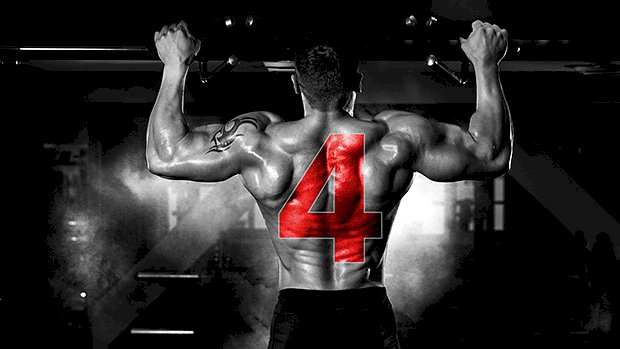
 The 1.5 method is simple: Perform full reps with partial reps between each. Although 1.5 means “one-and-a-half,” quarter reps can also be used. Let’s break down the benefits and look at some different ways to use this proven training method. 1 – This method adds time under tension (TUT) to the portion of an exercise you might otherwise be under-loading. Determine the strongest half or quarter of an exercise, then do an extra half or quarter rep in that portion. It doesn’t matter how big the partial reps are – no one will be measuring with a goniometer. As a general rule, just avoid going through your sticking point. This will vary from exercise to exercise. For example, in a deadlift, if you struggle just below your knees, then stay above them for the extra partial reps. Here are some other examples: Snatch-Grip RDL, Half Rep at Top Lateral Raise, Quarter Rep at Bottom 2 – 1.5s increase TUT in the portion of an exercise that emphasizes a certain muscle. Decide what your target muscle is, then determine what portion of the exercise loads the muscle the most. For example, booty-builders might want to squat deep to get more hip flexion and glute loading. So do an extra partial rep at the bottom to, well, hit your bottom. (See what I did there?) To hit your pecs more in a barbell bench press, do an extra touch-and-go off your chest to really fire up those pecs. The top portion of a squat will emphasize quads more, so spend more time at the top with a partial rep. Bench Press, Quarter Rep at Bottom Safety-Bar Cyclist Squat, Quarter Rep at Top 3 – This method helps you spend more time in the portion of an exercise that better fits your structure. Certain exercises aren’t inherently “bad,” but there are positions and ranges of motion that might cause you a few issues if your structure isn’t suited for them. Determine the most “compromising” position of an exercise based on your structure and injury history, then spend less time in that position while creating more TUT in the safer position. Since you won’t be able to handle your normal weight using the one-and-a-half method, you won’t load your cranky positions as much, while still hammering the rest of the movement. For longevity purposes, this idea just makes sense. Dip, Half Rep at Top 4 – This method can be used to address a technique flaw. Pick the portion of an exercise you suck at, then spend more time there. Do you lose tension at the bottom of a squat? Then add an extra partial rep to work on it. Do you compensate at the top of a chin-up by rounding your shoulders forward? Spend more time at the top and work on it. Stop avoiding it and address the problem head-on! Parallel-Grip Chin-Up, Quarter Rep at Top Don’t sweat too much whether you’re doing an extra half or quarter rep – you can do and call it what you
Origin: Tip: Four Reasons to Use the 1.5 Method
Tag: Reasons
4 Reasons You’ve Got No Rear Delts
 The deltoids are an easy muscle to hit… unless you’re talking about the rear deltoids. Targeting this muscle group takes more than doing standard dumbbell reverse flyes. Here’s what you need to know and do: 1 – You’re Going Too Heavy I cringe when someone does sets of 50-pound dumbbell reverse flyes, or buries their face into a pec dec hybrid machine to perform horribly executed reverse flyes with the stack. There’s a reason your rear delts are underdeveloped and weak – it’s because you’re using too much weight to get the job done and other muscle groups are actually completing the rep. Since the rear delts aren’t easy to hit, we need to respect that it won’t take much weight to hit them hard. It can, of course, be argued that delt-recruiting exercises like high pulls or cleans can be performed with heavy weight, but the amount of work that’s actually done by the upper traps and other back musculature is high. 2 – Your Hand Position is Wrong So much of our rear deltoid training is dedicated to arm abduction, but it neglects rotation. Doing bent-over flyes is all fine and dandy, but it only tackles one function of the rear delts. What you need to do instead is turn your hands so the palms face forward. You get a much fuller, much more targeted contraction. As a bonus, turning the wrists so the palms face forward on the bent-over reverse fly also helps prevent the shoulder glide that can be incurred from using a neutral or internally rotated grip. The same holds true for the face pull. Incorporating an external rotation so the hands finish higher up, over the head, can be a game-changer for just how much you feel it in the target muscles. If you’re big and wide with long arms, then using two ropes is better than one. To take things to the next level, adding a “slide” component to a face pull (like a resisted scapular slide) makes the delts responsible for external rotation from a variety of arm angles through the force curve. This is a great progression to standard wall slides. 3 – You Need to Add Isometrics The good thing about isometrics? You’re able to apply maximal forces in ranges where typical reps of an exercise merely pass through. That means a lifter will typically spend just an instant at full shoulder extension or flexion, with the meat of the rep being felt at basically every other arm angle but those positions. Working the snot out of shoulders at full flexion and extension end ranges with isometrics can not only be the hidden key to creating more available range of motion for immobile, injury-prone shoulders, but also to help develop dormant muscle groups like the rear delts, which otherwise get little to no play in exercises intended for them. Using isometrics as a primer to common exercises – or as their own exercise to be paired or grouped with others – is a great way to get the most out of your muscles through the greatest range possible. This video shows me putting T Nation editor Dani Shugart through a few of these rear deltoid and upper back isometrics. 4 – You’re Doing Same Motion Over and Over Again Every rear delt movement I see has the lifter start with his hands and arms in line with his body, then proceeding to move them outward (think of the rear delt flyes I showed above). There’s nothing wrong with this, other than the fact that solely focusing on this kind of path severely limits how much of your muscle you’re going to hit. To change things up, try setting up on a cable machine for constant tension: This is a very isolated pattern that, when done correctly, absolutely torches the rear delts. It’s important to maintain the same elbow angle throughout the entire range of motion. This isn’t a triceps exercise; the fulcrum is the shoulder. Pull the arm all the way across the body as though you’re trying to cover your mouth with your biceps. Then aim down toward your outside shoe with your fist. It’ll take a few reps to initially feel, but once you’re rolling, you’ll get an insane pump in the target
Origin: 4 Reasons You’ve Got No Rear Delts
Tip: 3 Reasons Trap Bar Deadlifts Are King
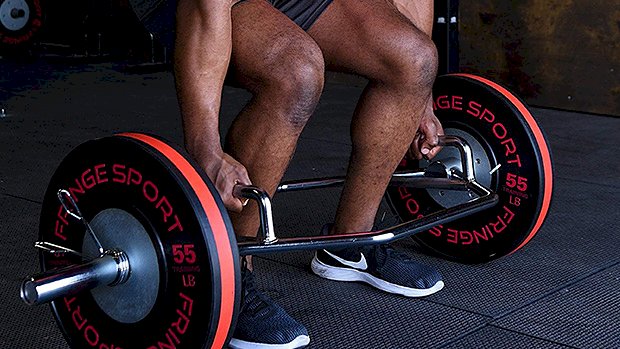 The trap bar deadlift is the king lift for keeping a healthy spine while pulling a stack of weight off the floor in a functional pattern. It checks all the boxes for health, strength training, and maintaining general badassery. There are several reasons why it’s superior to barbell pulls: You have no bar blocking your shins, which is a saving grace for longer-legged lifters, lifters with back problems, or lifters with mobility restrictions. This also allows the shins to migrate forward, allowing the hips to sit lower and the spine to remain more vertical when pulling. It also helps hit the quads harder. You’re using a neutral grip. That means no mixed grip (which has a high risk of biceps tears) and a posture that more easily engages your upper back and keeps you closer to anatomical position. That’s huge. You get to pull from a slightly higher point (at least when you go high-handle). Football and basketball players everywhere are rejoicing in the fact that they don’t have to crumple their bodies into a deep pulling position, like when they use a barbell. But most people already know all this. The true reason they won’t make the switch is bro-based stubbornness, not because a barbell “works better for them.” They think that it’s not a true deadlift if you don’t pull with a straight bar from the floor. Those are the same people who don’t have long-term health, strength, and wellness in mind. Are you sure you want to be one of them? Of course, if it gets too easy, just flip the bar and go low handle. Problem
Origin: Tip: 3 Reasons Trap Bar Deadlifts Are King
 All about sport xlsport.club