
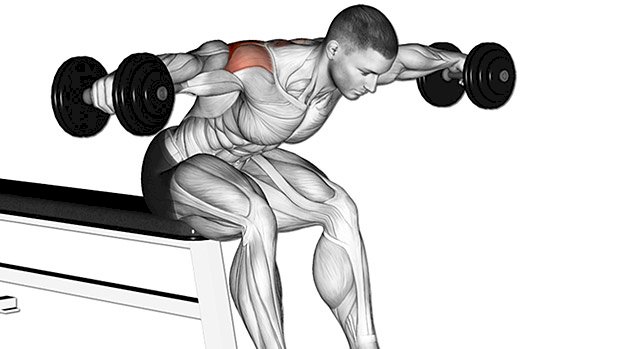
 I’ve done my fair share of bent-over lateral raises (rear delt raises), but the truth is that they fall short. With a bent-over lateral raise, the rear delts never actually get fully shortened. A key component in maximizing an exercise is to get the target muscle fully lengthened and then fully shortened within a movement. But some exercises don’t do that as well as others. Here’s a better option: Rear Delt Row with Supination Row to bring the elbow behind the body as far as possible, which will shorten the rear delt. Add a twist, literally, by supinating as you perform the row. Why the twist? Because it’ll bring about a certain amount of external rotation in the shoulder, which is one of the components of the rear delt. Supination at the forearm is actively linked with external rotation of the shoulder, just like pronation is linked with internal rotation. This isn’t an exercise you’ll go super heavy on, but you won’t need to so long as you’re using the appropriate resistance with it for the mechanics, and making sure to get the rear delt fully
Origin: Tip: Replace the Rear-Delt Raise
Tag: Raise
Tip: The No-Cheat Lateral Raise
 It’s nearly impossible to cheat with these, unlike the standing lateral raise. For lifters having trouble getting a strong mind-muscle connection, the incline version is a better choice. Incline Lateral Raise This exercise will also naturally put the resistance in line with the middle fibers of the delt. When you use a standing lateral raise it’s common (and fairly natural) to work more in the scapular plane, which is slightly safer for the shoulder joint. But it also tends to make it more of an anterior deltoid movement, which we’re trying to avoid since that’s already been covered. Since the resistance is more in line with the middle delt, and you can’t cheat, you’ll naturally bring the dumbbells directly up to your side. This is what makes it a great option for smoking the middle delts. Lastly, if you want to keep tension on the shoulders as much as possible throughout the range of motion, then eliminate the bottom quarter of the movement. The delt itself isn’t very active in the bottom part of the range of motion. It’s the supraspinatus that initiates the abduction of the arm from this position, and then the delt takes over after that. Once you lift the dumbbells to the top on the first rep, lower only about three-fourths of the way down before doing the next rep. Sets & Reps Try these with drop sets or cluster sets. Do 4-6 sets total in the cluster with 10 seconds between each set, going to total muscular failure on the last
Origin: Tip: The No-Cheat Lateral Raise
 All about sport xlsport.club