
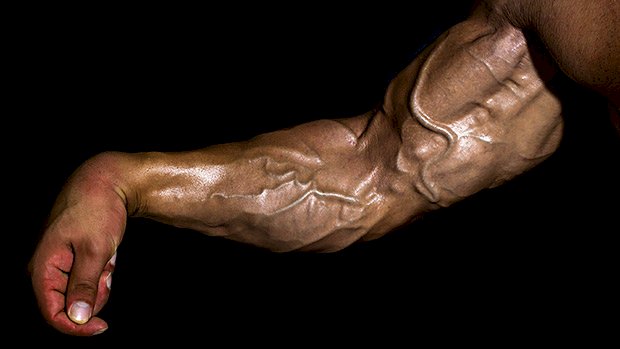
 As anyone who’s lifted weights for longer than a six-month stretch knows, resistance training is plagued by the principle of diminishing returns. The longer you do it, the slower the gains. But rather than accept this fact, a lot of us devote a whole lot of time and mental horsepower into figuring out ways to get around it. Often, the solution is to just eat better (you dope), or to use supplements, drugs, or new training methodologies to get us back into growth gear. Swiss bodybuilder and trainer Patrick Tuor took that last route, designing something called sarcoplasma stimulating training, or SST. It involves a whole lot of time under tension, reps, and sweat, all designed to get an acute muscle pump, which researchers such as Brad Schoenfeld have suggested plays an important role in muscle growth. Of course, any mutt can come up with a training methodology, but Patrick Tuor was lucky enough to have his SST system chosen for laboratory testing by the Catholic University of Brasilia. What They Did The scientists no doubt laid out a generous assortment of churrasco steak with chimichurri to lure 12 Brazilian young men, all of who had been weight training for between 2 and 8 years, to participate in their study. Each participated in three different biceps/triceps training sessions. During the first session, they trained in a “normal” way, doing 8 sets to failure with their 10RM (the most weight they could lift for 10 reps). The other two sessions required the lifters to use Tuor’s SST training methods. The first, as follows, is coined the “contraction type” version of SST: Warm up. Set of 10 using 10RM weight. Rest 20 seconds. Set done to failure with that same 10RM weight. Rest 20 seconds. Set done to failure with that same 10RM weight. Rest 20 seconds. Remove 20% or the load and go to failure, using a 4-second concentric (lifting) phase and a 1-second eccentric (lowering phase). Rest 20 seconds. Remove 20% of the weight and go to failure, using a 4-second eccentric phase and a 1-second concentric phase. Rest 20 seconds. Remove 20% of the weight and perform an isometric (static) hold to failure with your arms bent 90 degrees. The second version of SST they tested is the “rest interval variable” style: Warm up. Set of 10 using 10RM weight. Rest 45 seconds. Set done to failure with that same 10RM weight. Rest 30 seconds. Set done to failure with that same 10RM weight. Rest 15 seconds. Set done to failure with that same 10RM weight. Rest 5 seconds. Set done to failure with that same 10RM weight. Rest 5 seconds. Set done to failure with that same 10RM weight. Rest 15 seconds. Set done to failure with that same 10RM weight. Rest 45 seconds. Eighth set to failure with that same 10RM weight. The goal was to figure out what effect SST had on lactate levels and muscle thickness. What They Found Oddly enough, at least to me, the SST style of exercise didn’t increase lactate concentration any more than regular strength training. However, both styles of SST led to immediate increases in muscular thickness, with the “contraction style” training being slightly more effective than the “rest interval variable” style. The results prompted the scientists to write: “Highly trained subjects may benefit from changing their resistance training routines by using the SST method, as this method may offer a superior muscle training stimulus…” How to Use This Info You may have raised an eyebrow when you read that the SST style resulted in greater muscle thickness in just one training session. Well relax that eyebrow. It wasn’t because of an increase in actual sarcoplasmic hypertrophy; just a bigger pump. But a bigger pump isn’t something to take lightly. For one thing, a pump represents an increase in cellular hydration (the raising of water content in the muscle cells), which in itself appears to be a stimulus for muscle growth. Further, a pump apparently activates a membrane protein named “integrin” that’s responsible for triggering anabolic processes within the cell. (Biotest’s Plazma™ protocol is based almost entirely on this physiological fact. The idea behind the supplement is to “force-feed” key nutrients into the muscle cell during the time the muscle cell is most responsive to nutrient uptake and growth signaling, otherwise known as the pump. Based on the scientists’ findings, Plazma would marry well with the SST style of training.) While the current study involved only biceps and triceps, I experimented with both the contraction style and rest interval variable style of SST training during recent back and chest workouts. While both created a lot of ouch, each led to an extremely satisfying pump, with the contraction style edging out the rest interval variable style in pressure exerted on the seams of my T-shirt. SST is definitely worth trying, particularly if you’re a veteran trainer who’s having trouble urging your muscles into new
Origin: Tip: Do SST for a Mind-Blowing Pump
Tag: Pump
Pump and Grunt – New Biceps Finishers
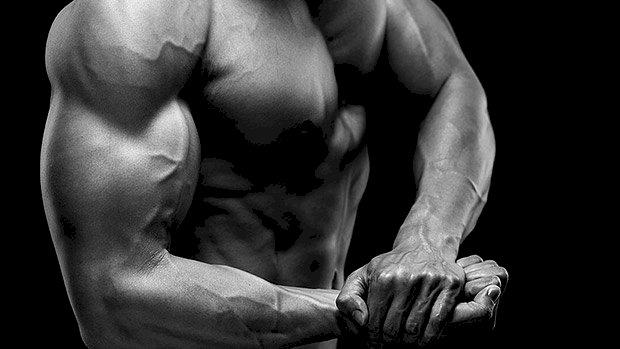 When it comes to biceps training, we all love our 21’s, our drop sets, running the rack, and various other schemes that add metabolic stress or act as time-efficient finishers. They can get stale, though, so let’s breathe a little life into your workouts with these intelligent and basic (yet not boring) biceps protocols. 1 – Biceps Rotisseries Let’s “slow cook” your biceps, as well as the brachioradialis, via a lot of rotation and change in hand position. The protocol: Dumbbell Reverse Curl:6-8 reps with an estimated 12-rep max weight Dumbbell Hammer Curl:6-8 reps (same weight) Dumbbell Curl:6-8 reps (same weight) Dumbbell Cheat Curl:6-8 reps (same weight) 90-Degree Alternating Pronation/Supination:6-8 reps (after last cheat rep) 90-Degree Isometric Hold:Hold for as long as possible (after last supination and pronation) You’ll use the same weight throughout and there’s no rest between the variations. Rest 90-120 seconds and repeat. You’ll likely have to drop down a set of ‘bells to do a second series. You’ll need to leave your ego at the door. This protocol is straight-up metabolic stress, skin-splitting pump work! If you need to use 15-20 pound dumbbells, then so be it. Now isn’t the time to try and impress the Gym Shark girl next to you with huge weights. The weight selection on that first exercise is key. You want to have several reps in reserve. If you go too heavy on the reverse curl and get too close to failure, you won’t last and won’t hit the rep targets on the movements that follow. Trust me, by the third or fourth movement, it’ll get plenty hard. A quick note on the cheat curl – you want to hip hinge just a little and “pop” up powerfully. Pause the contraction and then do a very slow and focused negative. 2 – EZ Does Its This is a straightforward mechanical advantage drop set. We start with the theoretical weakest exercise and then manipulate leverage and strength curve to pour on more volume and extend the set. The protocol: Bent Over EZ-Bar Spider(ish) Curl:8-12 reps (to failure) Strict EZ-Bar Curl with Shoulder Flexion:Max reps (same weight) Strict EZ-Bar Curl:Max reps (same weight) Cheat EZ-Bar Curl:Max reps (same weight) Do the first variation using weight you can lift for 8-12 reps. From there out, go for maximum reps, always using the same weight. Rest 90-120 seconds and repeat. You’ll likely need to reduce the weight a bit to do a second round. Again, this is metabolic stress work – you won’t need a lot of load and you should only do 2 sets, tops. Apply the same guidelines on the cheat curl as laid out above: a little hip hinge and pop up forcefully. Pause the contraction and use a very controlled negative. Here’s an alternative version: This one uses an EZ-bar cable attachment and a low pulley. 3 – Rise Ups This is another straightforward and effective mechanical advantage drop set. With this one, you’ll start face down but spin around on the subsequent set, finally ending up standing, hitting both the long and short heads of the biceps hard in the process: Dumbbell Spider Curl:8-12 reps (to failure) Incline Dumbbell Curl:Max reps (same weight, same incline) Strict Standing Dumbbell Curl:Max reps (same weight) Standing Cheat Dumbbell Curl:Max reps (same weight) 90-Degree Isometric Hold:Max time (after last cheat rep) Do the first variation using a weight you can lift for 8-12 reps. Then go for maximum reps on the exercise variations that follow. The same guidelines apply here in terms of rest periods, sets, and load reduction. How and Where to Use These Regardless of your training split, use these biceps variations mid to late workout – after your heavier, straight-set progressive overload work. There are no hard and fast rules here. Remember, this is metabolic stress and muscle damage work. These aren’t protocols where you’re chasing weight or personal records. It’s all about tension, volume, and mind-muscle connection. Go after mechanical tension, maximizing load, and progression earlier in the workout using other exercises. These are not entrees; they’re side dishes. In Defense of Finishers You can certainly thrive by hammering basic stuff over and over for years, but isn’t training supposed to be fun? And who doesn’t like to pump up their arms? The protocols presented here are a way to make your training “flexibly structured,” quench your bro thirst, and implement some smart variety. There’s nothing wrong with leaving the gym with a pump and a smile and chomping at the bit to come back for
Origin: Pump and Grunt – New Biceps Finishers
 All about sport xlsport.club