
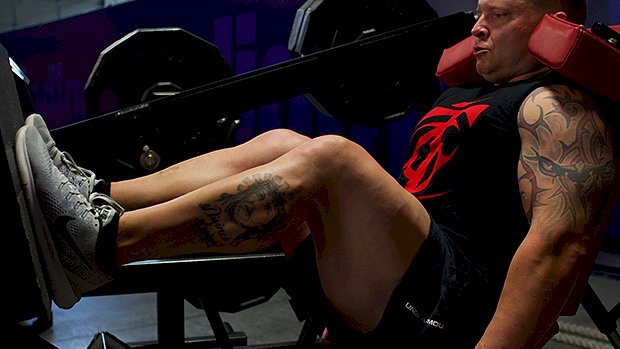
 On leg day, after your squats and lunges, a machine exercise like the leg press can add direct quad training volume without accumulating a lot of systemic fatigue. Foot placement matters for muscle activation but not at the cost of joint pain or lost range of motion. Knee-dominant exercises will always be quad dominant so any foot position used for this will train your quads effectively. Start by placing your feet narrow and lower on the press platform, but work higher and or wider if this allows better range of motion or eliminates joint pain. Maintain a strong foot arch while externally rotating the hips to keep your knees from collapsing inward. Keep your core flexed and rigid. Descend to the fullest range of motion available without allowing your hips to lift from the seat and causing your back to round. Don’t ego-lift and micro-rep like a jackass. Avoid a hard lockout at the top to avoid injury. Use a load which allows 12-15 reps to hit failure. This brings intensity, volume, mechanical tension, and metabolic stress into play. Drop set the last set 1-3 times for added destruction. If your leg press is occupied, swap it out for the hack squat machine. The same principles
Origin: Tip: Master the Leg Press
Tag: Press
Tip: A New Angle on the Shoulder Press
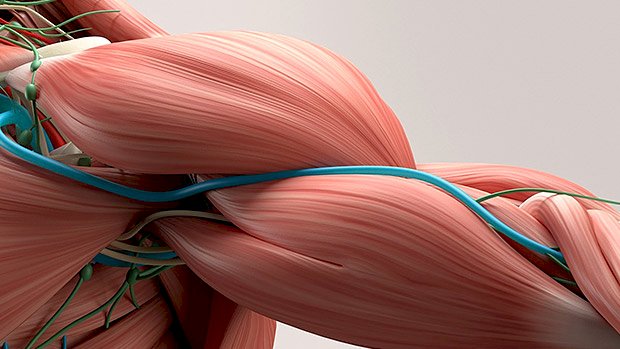 Heavy overhead presses are key for shoulder development. However, the anterior shoulder and triceps do most of the work. If you want your shoulder presses to be more posterior-delt dominant, give this angled shoulder press variation a shot. Set up on the lowest point on the cable machine and use no attachment. Using a staggered stance, position your body at an angle, keep your chest up, and brace your core. This setup will allow you to create enough tension for stability purposes. Position the handle in front of your shoulder. You should be feeling tension in your delt. Keep your elbow close to you. Press up along the same line of your body (at an angle), and reverse the movement to the starting position. This exercise is great if you have limited shoulder mobility or if you’re trying to target more of the posterior delt. It’s a great exercise for keeping constant tension on the muscle with moderate loads. Try this for 3-4 sets of 12-15 reps per
Origin: Tip: A New Angle on the Shoulder Press
Tip: The Athlete’s Floor Press
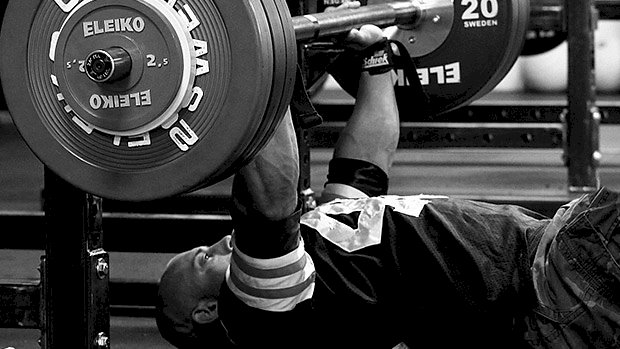 The floor press is a classic bench-building, triceps-focused lift. It’s also a great alternative for people who suffer from low back pain, especially extension-based pain. But for my athletes, I’ve found that the standard floor press doesn’t have the greatest transfer when it comes to sports performance. The good news? One simple adjustment will not only make the exercise more athletic, it’ll make you stronger in this position! Check it out: Floor Press With Glute Bridge Simply perform a glute bridge before you unrack the weight. Really focus on staying tight in the core by using your abs to pin the ribcage down. Contract your glutes hard to hold your hips in position. You’ll notice a couple things: Your core is challenged hard, so you must focus on maintaining the bridge position throughout the lift. You’re actually stronger in this position than a regular floor press. Try a rep without the glute bridge and a rep with it. You can lift slightly more in the bridged position. This probably has to do with energy transfer. A regular floor press doesn’t utilize the lower body or core as much. This variation is much more athletic for a few reasons: Energy transfer from lower to upper body. Pretty much all athletic movements use ground force to initiate a movement. This creates a need to produce energy and transfer it from the ground, through the lower body, and then to the upper body. Challenging static hip stability while dynamically pressing with the upper body. Many sports require joint stability in one area while simultaneously performing a dynamic movement. Direct sport-specific transfer to ground athletes such as MMA fighters and wrestlers. Think of a wrestler pinned on the ground. You’re not just going to use your arms to get a guy off of you; you’re going to use your whole body. Bret Contreras thought of the hip thrust while watching MMA fighters. When they’re on the ground, they thrust to get someone off. This takes that to the next
Origin: Tip: The Athlete’s Floor Press
Tip: How to Diagnose Your Bench Press Problem
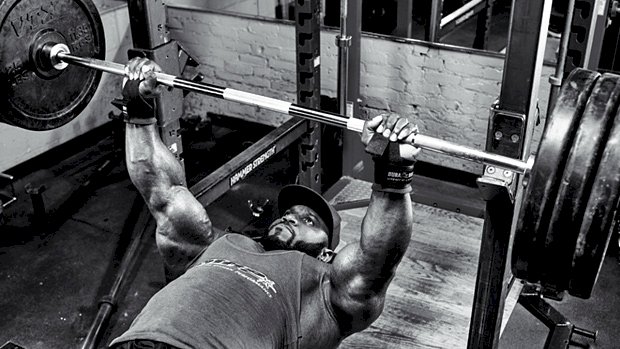 This table lists the most probable issue causing each sticking point on the bench press. Now, there could be something more complex going on, or a technical issue that’s more unique to you. But most of the time, I’ve found that strengthening the sticking point area will solve the problem. So take a look at this table, determine where your sticking point is, take note of the causes, and use the appropriate assistance exercises to strengthen that area. Bench Press Sticking Point Causes Assistance Exercises Breaking off from chest 1. Lats weak or not properly engaged 2. External shoulder rotators 3. Upper traps more dominant than lower traps and rear delts 1. Straight-arms pulldown, Pendlay row, seal row 2. Cuban press, seated dumbbell snatch, external shoulder rotations 3. Trap-3 raise, rear delt machine, Powell raise, victory raise Lower third Pecs Wide-grip bench press, Spotto press, decline bench press, floor press, dumbbell bench press, bench press with Duffalo bar Mid third 1. Anterior delts 2. Rear delts and rhomboids (Shoulder lifts up from bench) 1. Incline bench press, slight incline bench press, lying front raise 2. Bench press with resistance band around wrists, rear delt machine, face pulls Upper third (lockout) Triceps, especially long head Close-grip pin press, lockout bench press, close-grip floor press, close-grip decline bench, overhead triceps extensions If you’re unfamiliar with some of these exercises, use this list: Seal Row A seal row is a chest-supported row (using dumbbells or a bar) using a bench. Elevate the bench on blocks or plates. If you don’t have that setup, a regular chest-supported row will do. Cuban Press Trap-3 Raise Powell Raise Victory Raise Spotto Press Bench Press With Resistance Band Around Wrists Bench Press With Duffalo Bar Once you fix a muscle weakness, it’ll take some time to transfer those strength gains to the bench press. Your body will need to change the intermuscular coordination pattern. Don’t panic if your strength gains in pressing lag a few weeks behind your strength gains in the assistance
Origin: Tip: How to Diagnose Your Bench Press Problem
Tip: The Purpose of the Leg Press
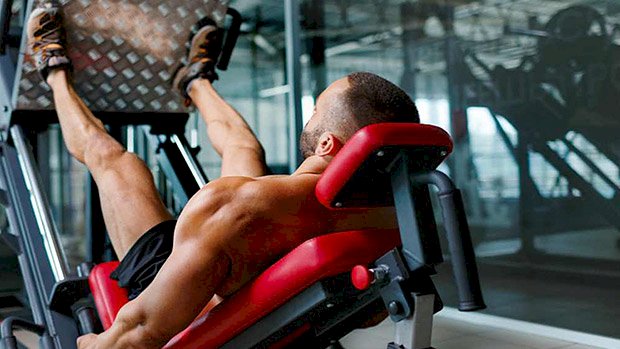 “The Leg Press is Useless!” The coaches and trainers who make that claim remind me of this saying (attributed to Albert Einstein): “If you judge a fish by its ability to climb a tree, it will live its whole life believing it’s stupid.” In the leg-press-is-useless scenario, the coach is probably looking at the leg press’s ability to serve a very specific purpose, like improving the barbell back squat. In other words, he really doesn’t understand how it could be useful in the proper context, like for pure bodybuilding purposes. First, we need to establish some guidelines about proper leg pressing, and then we can talk about the usefulness (or uselessness) of it from there. Proper leg pressing is a thing. There’s a right way and a wrong way to do it. It’s not quite as simple as just lowering the weight and pushing it back up. 1. Establish your active range of motion. This is done by lowering the weight, but not so far down that your butt comes off the seat or your lumbar spine goes into flexion (rounded). This is especially important as loading increases. Your discs don’t approve of your ass coming off the bench and your low back rounding. They end up eating a metric butt-ton of tension and torque. They weren’t made for that. So stop doing it. 2. Choose an appropriately challenging weight. Don’t train with your ego and load the leg press up with eleventy billion pounds, or have other clowns sit on top of the machine to garner more attention as you do two-inch range of motion reps. Or if you do, at least get it on video so we can watch. The interesting point about the excessive loading and partial range of motion is that you actually end up with less internal loading. A full range of motion with less weight will increase the internal loading on the muscle in comparison to a partial movement done with more weight. 3. Don’t fully lock out the knees. I know the knees and joints are actually made to lock out, but not with 1,000 pounds on top of them. The reason a non-lockout is important is because when you lock out, the tension will shift from the quads to the joints and connective tissue. After all, that tension and weight distribution has to go somewhere. Once you lock the knees out fully, then the quads are in a somewhat relaxed state in contrast to if the knees were in a small amount of flexion. You want a soft-knee, slightly bent at the top. Now, intelligent leg pressing involves an active range of motion that’s deep enough to create superior internal loading, but not so deep that you risk injury by invoking lumbar flexion. Then, of course, a soft knee at the top of each rep. So How is the Leg Press Useful? If you’re trying to make the claim that leg pressing is great at building a squat, then you’ll lose that argument. But here’s where it CAN be helpful: Starting Deadlift Strength The leg press helps to improve a deadlift that’s weak off the floor. The key is to make sure you’re using the same foot placement that you use for deadlifts. From there, mimic the start of the deadlift and do paused leg press reps instead of piston-style reps. The Sumo Leg Press This has been a longtime favorite of mine for loading up the glutes and hamstrings. Simply put your feet as high and wide as you can (comfortably of course) on the platform. This is a great movement for the glutes and hams in the lengthened position, but if you add bands and stop quite a bit short of lockout, you’re going to come to a real understanding of what a massive booty pump really feels like. Pour these on for high-rep sets, like 25-30. Quad Development Getting the feet very close together and low on the platform will cause a significant degree of knee flexion, forcing the majority of the tension directly onto the quads. Progress Evaluation John Meadows recently made this point: the leg press is on a fixed plane, so your form is very consistent with it. You can’t get all cheaty outside of reducing the overall ROM. So long as you’re training with some personal integrity on the range of motion, you get consistent feedback of your progress and will be able to track your progressive
Origin: Tip: The Purpose of the Leg Press
Tip: The Weirdest Way to Leg Press
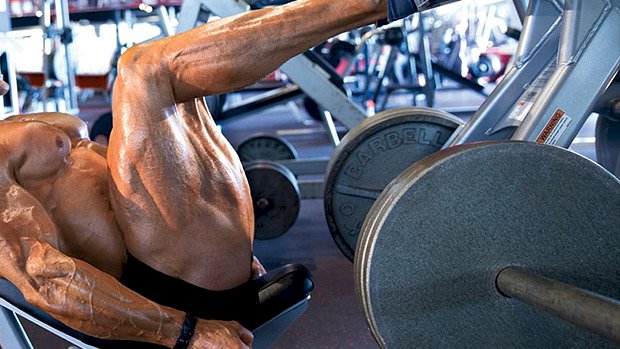 Let’s turn the Smith machine into a lying leg press machine. You’ll need to set the pins or safety catches here so that the bar is resting on them at the bottom. It will need to be high enough for you to wedge yourself underneath the bar, but low enough so that you’re getting a decent range of motion. No three-inch rep stuff. Smith Machine Leg Press Try this: Start with a hard set of 10, take some weight off, and immediately do another hard set of 10. Repeat that one more time and find your safe
Origin: Tip: The Weirdest Way to Leg Press
Tip: Build Pecs with the Hex Press
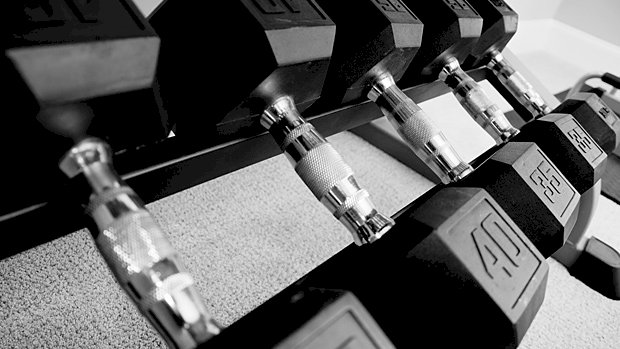 Pain-Free Pressing Lifters suffer from a lot of anteriorly directed shoulder pain. It happens when the head of the humerus is pushed too far forward in the glenoid fossa. It feels awful. This position is exacerbated at terminal horizontal abduction, elevation, and external rotation, which are all components of traditional bench press variations. But this can be avoided by using a squeeze press, even when you’re managing some nagging shoulder pain. The Hex or Squeeze Press Use dumbbells and squeeze them together as hard as you can throughout the concentric (lifting) and eccentric (lowering) portions of the lift. You’ll get a legit training effect without flaring up your shoulders. By forcing your shoulders and deep humeral and scapular stabilizers to initiate tension into internal rotation and depression, the head of the humerus will translate more posteriorly and will be more centrated in the shoulder socket. This positioning allows you to use internal tension and torque production through the shoulders and still train
Origin: Tip: Build Pecs with the Hex Press
 All about sport xlsport.club