
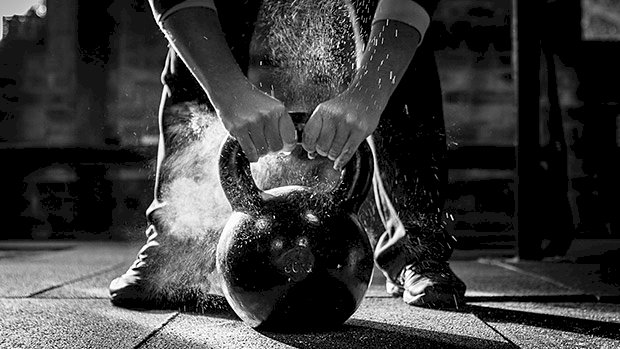
 Although you’re probably tired of hearing about “secret” Soviet training programs, the Soviet track and field teams really were dominant in the Olympics. One reason is the work of obsessive sport scientist Yuri Verkhoshansky who created a hugely successful training protocol based on jumping drills. He’d have athletes drop from 60-inch boxes in what he called “depth jumps.” Specifically, an athlete drops off a box, lands briefly to absorb the shock, and then immediately jumps as high as possible, which led to a 14% increase in maximal strength among highly-trained volleyball players. Even so, I wouldn’t recommend them for most athletes unless they’ve got great squat form and strength. There are, however, safer alternatives. Lower Body Shock Training – Kettlebell Over-Speed Eccentrics We can activate the same beneficial mechanisms found in the depth jump with Russian kettlebell swings. How? By placing an emphasis on the downward (eccentric) portion of the swing. Instead of absorbing the weight of our own body, as we do in depth jumps, we absorb the shock of the kettlebell when it switches directions. The more we force the kettlebell down, the greater the plyometric effect. In the lab, Brandon Hetzler found that experienced kettlebell instructors could swing a 32-kilogram kettlebell back down with a force equivalent to three times their bodyweight. Most of the beneficial effects of kettlebell swings come from when we reverse force, so the more force there is to reverse, the more strength (and explosiveness) we’ll gain. Kettlebell swing over-speed eccentrics can be done in three ways. Accentuate the Eccentric:Normally, we let the kettlebell float into position and let gravity take it back down into our next swing. However, we can actively accelerate it downward by forcefully “throwing it” between our legs. Partner Assisted Downward Throw:In this scenario, we have a person stand on the side and push down on the kettlebell when it reaches the top. Band Assisted Eccentric:This version involves wrapping a band around the kettlebell and standing on the band. Once the kettlebell hits the top of the swing, the band accelerates the kettlebell back down. Don’t do these over-speed eccentrics with higher reps. You’re taxing the nervous system a lot more than you would with regular swings. Ten or fewer reps is a good rule of thumb. Upper Body Shock Training – Drop Push-Ups Verkhoshansky also created multiple apparatuses to create a similar “depth jump” effect with the upper body. Picture a bench-press type device that drops the weight down on top of you and then allows you to explode it up. (Please don’t try creating this type of gizmo at home as Verhoshansky’s device had built in safety features.) However, we can mimic this effect with drop push-ups. To do these, create a stable base of about 12 inches high, just outside your normal push-up stance. Position yourself atop the stable base. Drop off the base. Catch yourself (and simultaneously absorb some plyometric force) before you do a face plant. Explosively push up as quickly as possible (similar to the depth jump). Once the rep is finished, place both hands back on the base and start the next rep. An Explosive Program Doing this type of “depth jump” training can build enormous amounts of explosiveness. It can also serve as a nice adjunct to your traditional training by providing a bit more explosive power. For most people, I’d suggest doing the following program to break out of your plateaus. It takes about 6-10 minutes and should be done three times a week. A note of caution, though – this program is only for trained athletes who exhibit good control of their movements: On odd minutes, do 10 kettlebell swing over-speed eccentrics. On even minutes, do 10 drop push-ups. Continue back and forth for the prescribed number of rounds. On Mondays:6 rounds On Wednesdays:10 rounds On Fridays:8 rounds Why This Works There are three main reasons why kettlebell swing over-speed eccentrics and drop push-ups (and depth jumps, of course) build explosiveness and strength: Greater CNS Stimulation:The shock of the sudden reversal of force leads to greater muscular excitation. The more frequent the muscle nerves fire, the more strength you build. Myotatic Reflex:As the muscle lengthens, the muscle spindle is stretched and its nerve activity increases. Powerlifter Andy Bolton utilizes this reflex. He performs three hamstring stretches immediately prior to executing the lift, performing the lift on the execution of the third stretch. Neurogenic Effects:These occur when the time between stretching the muscle and the subsequent shortening decreases as the pre-motor cortex anticipates the shock. This means our reflexes get faster. In general, the more we do these plyometric-type movements, the more our body builds explosive power. This explosive power can help our absolute strength (deadlift), speed strength (clean), and pure speed (sprinting). Basically, we’re
Origin: Shock Training for Superhuman Power
Tag: Power
Question of Power 5
 Complete Pec Development Q: My pecs won’t grow no matter how strong I get on the bench press. What gives? A: I know the feeling. I naturally had great shoulder strength and development early on, and that tended to translate over into virtually all of my pressing (flat, incline, overhead, etc). The drawback? Because I was delt-dominant, my chest lagged behind. There’s always going to be some muscle groups that will be subpar compared to others, no matter how much specialization you do for them. But I do believe in giving everything the ol’ college try. So let’s talk about some principles you should be adding to go from being bird-chested to pectacular. (Totally cheesy, but I’m rolling with it.) 1. Train chest early in the week or whenever you’re fresh. This shouldn’t be an issue with most gym bros. Monday is International Chest Day, after all. 2. Get the chest out in front. With all pressing and flye movements you need to set the scapula deep into retraction and depression. Think about getting the shoulders down into your back pockets, and keeping the sternum high. When you look at this from the side, you’ll see that the pecs get into a deeper stretch, which will increase their activation, and you’ll reduce the involvement of the anterior delts. A little “hack” here is to use a foam roller or rolled up towel in the middle of your back in order to facilitate a deeper setting of retraction. The towel is a pretty strong reminder to hold it there as well. 3. Push to the centerline of the body. This can be an internal cue to help establish better mind-muscle connection for the pecs as well. In all of your pressing, think about moving the arms to the centerline of the body to maximize pec activation and shortening. For a lot of guys who press in order to “train the movement” for strength, they simply press straight up. But if you want to get the pecs to contract as hard as possible during a press – and you do for hypertrophy purposes – then think about driving the hands towards the center of your torso. The external cue for this, if you’re pressing with a bar, is to think about bending the bar in half so that it would end up in a “U” shape. Just make sure you hold that deep scapula retraction and depression to bias the pecs in the pressing. Don’t let the shoulders roll forward at any time. 4. Know that leanness matters. There’s no “inner pecs” really. That’d be the sternal area of the pecs. And here’s the real reason why a lot of guys think they need more mass in there: they carry too much body fat to see the separation between the pec muscles. If you want that bad-ass pectoral “split” that runs down the middle, then don’t be fat. 5. Understand arm angles for complete pec development. The pecs have three different areas: the clavicular pec or upper chest where the fibers are attached to the clavicle; the sternal or middle portion of the pecs that attach to the sternum; the abdominal head of the pectorals which originates from the external oblique, often called the lower chest. If you want to bias a certain area of the pecs, you need to be aware of the angle of the humerus to the pecs themselves. This, and not the angle of the bench, will dictate what area of the pecs is the most activated and doing the brunt of the work. Sternal Pecs You hit this area more when the arms drive from the side of the body to the centerline of the torso. Upper Pecs You hit this area more when the arms drive at a 45-degree angle upwards, towards the centerline, in relation to the torso. Lower Pecs You hit this area more when the arms drive towards the hips and the centerline in relation to the torso. Prioritize movements based on what area of the pecs you’re trying to bias over the others. 6. Stress the pecs at different lengths. Not all movements stress the pecs equally in the range of motion. An incline press or flat press stresses the pecs maximally at the mid-point in the range of motion. A dumbbell flye places the greatest amount of torque on them in the bottom position where they’re maximally lengthened. And a pec-deck or cable crossover tends to stress them more in the fully shortened position. It’s a good idea to stress the pecs through all of these different ranges so that no fiber is left behind. So how would this look in program design? Day 1 Hit the sternal pec area: Do the dumbbell bench press for two drop sets of 8/8/8. Take the first 8 reps to failure Reduce the weight Take another 8 reps to failure Reduce the weight Take another 8 reps to failure Repeat one more time Hit the upper and lower pecs: Superset the low-to-high cable crossover with dips. Do 8-10 reps on cable crossovers to failure Do as many reps as you can on dips with bodyweight Repeat one more time Day 2 Hit the upper pecs: Use an incline dumbbell press, barbell press, or Hammer Strength incline press (shown in video). Do 10-12 reps to failure Rest 60 seconds Then try to get half the number of reps you
Origin: Question of Power 5
Tip: The Best Power and Conditioning Test
 The Test Hop on a stationary bicycle, like an Assault or Airdyne bike, and go hard for 1.5 miles. To pass the test, you need to finish in 3:30 or less. The Reasoning If your anaerobic power is lacking, you’re going to have a tough time pushing through multiple hard sets of a lift, let alone an entire training session. If your aerobic capacity is non-existent, you’re going to have a hard time recovering in both the short-term (between sets/exercises) and the long-term (between training days). Since the test is short, yet long enough to tap into the aerobic system, you’re simultaneously testing both qualities. As a refresher, anaerobic power is the ability to exert maximal power in the presence of fatigue while sustaining high levels of metabolic stress. Aerobic capacity is the ability to be maximally efficient with the entire body while feeling like you have a flamethrower going off inside your lungs. If you lack either quality, the 1.5-mile bike test will humble you in a matter of minutes. The positive is, you’ll find out which area you need to focus on: If you were able to maintain a solid pace but still didn’t beat 3 minutes and 30 seconds, your anaerobic power needs work. If you shot out of the gates but burned out within the first minute, you need to build up your aerobic
Origin: Tip: The Best Power and Conditioning Test
Tip: Simple Power Training for Muscle
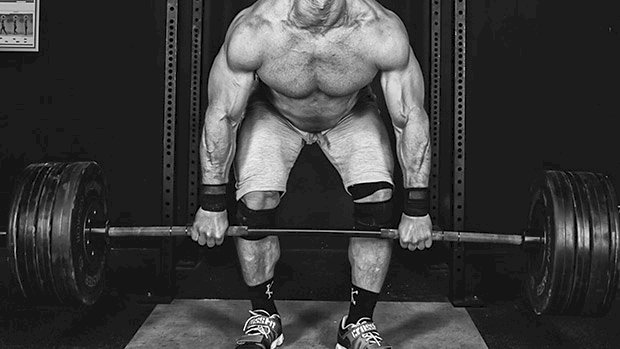 How many lifters train to become more powerful? Do YOU make power training part of your program? Well, you should consider it. You’ll unlock more strength, more athleticism, and more muscle. How’s That Work? Power is the ability to produce force quickly. And remember, as you age you lose power twice as fast as strength. But a recent study by Franchi et al. showed that plyometric training is an effective intervention. It produces a rapid increase in muscle mass and power, no matter your age. Jumping, throwing, sprinting, and the Olympic lifts will heavily recruit fast twitch muscle fibers (which have the highest propensity for growth) as well as help improve your athleticism and prime your nervous system for the heavier strength training that follows. Luckily, this doesn’t require a complete program overhaul, just a few extra minutes and a bit of planning. Looking at the force velocity curve, the far left is max strength. This is the heavy stuff, and of course the loads don’t move very fast. This is where most lifters spend the majority of their time, and rightfully so. However, if you never venture outside of that, you’re leaving a lot of progress on the table. As you slide down the curve, the loads will lighten up and the speed of movement will increase. Knowing what you’re trying to accomplish will help you pick the right tools at the right loads for the task at hand. For example, if you’re performing 10 reps of hang cleans, you’re not really training strength-speed like you might think. The speed of the reps isn’t fast enough to be improving speed-strength either. You end up in a middle ground: doing things that make you tired, but don’t make you more powerful. Or maybe you’re using a medicine ball that’s far too heavy to throw fast enough to make any improvement in the speed-strength area, or “sprinting” for a minute or so. Again, the tools aren’t the issue, but the application of them needs to be better. How To Do It Better Before your strength training sessions, pick one or two movements from various sections on the force velocity curve that match up with the main movement pattern you’ll be tackling in your lifting. Here are some ideas: Squat Olympic lifts Box jumps Loaded squat jumps Heavy sled marches (10 yards) Sled sprints (10-20 yards) Single-leg hurdles Short sprints Deadlift Olympic lifts Heavy sled marches (10 yards) Sled sprints (10-20 yards) Loaded trap bar jumps Broad jumps Kettlebell swings Short sprints Upper Body Days Medicine ball throws: chest passes, lateral throws, overhead soccer throws, slams Keep your reps on the low end. Make sure the last rep of each set is just as explosive as the first. As a rule of thumb, do 2-4 sets of 3-10 reps. The lighter the implement, generally the higher the rep range (8 medicine ball throws isn’t the same as 8 dumbbell snatches). The trickiest part of training for power is figuring out how much weight to use on things like sled sprints and loaded jumps. Remember, moving with speed is the goal, not loading the movements up so heavy that you hardly leave the ground or are moving at the speed of smell. And don’t get caught up in the “more is better” game. More just means slower, and slower doesn’t equate to more
Origin: Tip: Simple Power Training for Muscle
Tip: Vitamin D for Strength and Power
 Vitamin D deficiency is common. Fewer people are getting outdoors, and those who are vitamin D deficient will get even less during winter months. As you know by now, this has numerous health implications. But new research by Jung et al. found that vitamin D status can influence performance as well. The Study The researchers used 35 collegiate Taekwondo athletes with a low serum vitamin D concentration and randomly assigned them to two groups: One group of 20 people received 5000 IU of vitamin D per day for four weeks. The other group of 15 people received a placebo for four weeks. After four winter weeks, serum vitamin D concentrations increased significantly in the vitamin D group with no change in the placebo group. The results? The vitamin D group produced greater power and muscular strength. The placebo group saw no change. How to Use This Research First, get a blood test to see if you’re vitamin D deficient. Some health professionals even encourage people take it year round… without any testing beforehand. But if it’s winter or you live in an area that stays overcast and rainy most of the year, or you spend most of your time indoors, there’s a higher likelihood you’re deficient. Then find a dose that will raise your blood concentration levels. In the current study, 5,000 IU did the trick. We already knew getting sufficient vitamin-D could make you healthier and less susceptible to illness. And now there’s evidence it can make you stronger and more powerful
Origin: Tip: Vitamin D for Strength and Power
Tip: Increase Pull-Up Power With This Simple Plan
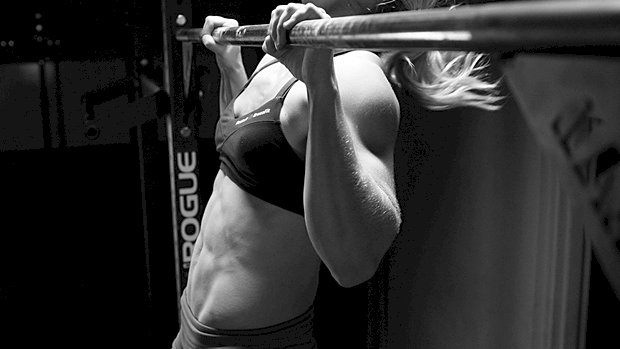 Mini-Sets for Maximum Gains Suck at pull-ups? You need to work them with frequent training. Start every workout with a total of 20 pull-ups done in as little time as possible using “mini-sets” of half your current max effort. Use a clock to track how long it takes and try to beat that time each session. The best strategy is to NOT hit failure on any of the mini-sets since it would require too much rest between sets and thus would take longer to complete. Here’s How It Looks Let’s say your current max is 4 or 5 pull-ups. Start with mini-sets of 2, resting as little as possible between each set – about 20 seconds rest is plenty. When doing the second rep becomes a grind, extend the rest to 30 seconds. When the second rep becomes tough again even with the longer rest, move down to doing sets of 1 with 15-20 seconds of rest until you hit your total (20 reps) for the day. As you get stronger, you’ll be able to use more than two reps for your mini-sets, but be very gradual about increasing them. Monitor the time it takes you to complete 20 reps to gauge if your strategy is adequate. When you increase the reps per set, your total time should continue decreasing. Ideally, in 8 to 10 weeks you’d end up hitting the 20 reps in just two sets of 10 with about 20 seconds of rest. When that happens, you’ll likely be able to hit 15 good pull-ups in a row. Progression Method: 30 Total Reps, Then Add Weight Once you can complete 20 total reps in just two mini-sets with no more than 30 seconds rest, increase the target total to 30 reps and resume the progression. Eventually, when you can hit the 30 reps in just two sets with less than 20 seconds of rest, go back down to 20 total reps, but here’s the killer… add 15 pounds to your waist and resume the progression all over
Origin: Tip: Increase Pull-Up Power With This Simple Plan
 All about sport xlsport.club