
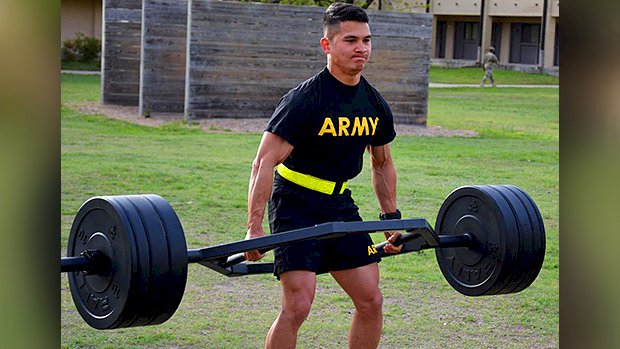
 APFT vs. ACFT Since the early 1980s, the United States Army has been measuring the American soldier’s physical readiness with the Army Physical Fitness Test (APFT). This test consists of a two-mile run for time, maximum number of push-ups completed in two minutes, and maximum number of sit-ups completed in two minutes. The APFT is conducted during the soldier’s initial entry/basic training and then at their unit every six months. The soldiers do this test collectively, usually at the platoon level (that’s a team of about 30-50 soldiers). Diagnostic testing may also occur during deployments to combat zones and other countries, but these don’t involve testing “for record.” The trouble is, the modern soldier needs to train and develop multiple aspects of fitness and performance, and the APFT doesn’t reflect that. To be frank, the APFT doesn’t reflect much of anything, but beginning in October, 2020, soldiers will instead be required to take the new Army Combat Fitness Test (ACFT). This new test is a huge step in the right direction. The old APFT may have been logistically simpler to implement, but it lacked the testing of critical physical skills that the new ACFT measures: power, absolute strength, and anaerobic conditioning. Also, unlike the old APFT, the ACFT is gender neutral – there won’t be different minimum standards for females or males. Understanding specifically what the ACFT is testing will help soldiers understand how to train for it. And if you’re not planning on enlisting, it would still be a “fun” way to test your readiness. The New Test The ACFT has six events. The ACFT has six events. Let’s use the requirements for soldiers in “heavy” physically demanding units or jobs, which may be more interesting to T Nation readers and lifters. To max the test, you have to score 100. To minimally pass the test, you have to score 70. Here’s how to train for them: 1 – Three-Rep Maximum Trap-Bar Deadlift: 2 attempts to establish a 3RM To score 100:340 pounds x 3 To score 70:180 pounds x 3 This test is a display of your absolute strength. Bodyweight circuit training isn’t going to cut it for this one! Being absolutely strong is a practical thing – picking up heavy artillery shells, throwing an M2 .50 caliber machine gun over your shoulder, or climbing over a wall while wearing 100 pounds of kit and body armor isn’t going to happen without some raw strength. You’re going to need to spend time in the gym lifting weights… heavy weights. 2 – Standing Power Throw: 10-pound medicine ball thrown over and behind the head To score 100:13.5 meters To score 70:8.5 meters Throwing a grenade, jumping over a ditch, tossing an ammo can to the gunner, kicking down a door – all of this requires the ability to generate force with high velocities. You need to be explosive and violent. Sharpening your reflexes and focusing on plyometrics and a few weighted movements are going to be your best bet – things like different varieties of jumps, throws, slams, swings, and Olympic lifts. 3 – Hand-Release Push-Ups: as many as possible in two minutes To score 100:70 To score 70:30 If the soldier already has a level of general, absolute strength, then this event will be a test of muscular endurance. However, when a soldier is extremely weak, this becomes a test of their strength, and soldiers need to train accordingly. 4 – Sprint, Drag, Carry: Sprint 25 meters, drag a 90-pound sled 25 meters, side shuffle 50 meters, and carry two 40-pound kettlebells 25 meters, all for time To score 100:1:40 min. To score 70:2:09 min. This is a new form of conditioning for the Army, yet it’s the most representative of what soldiers might see on a battlefield: sprinting to cover, dragging your buddy to safety, carrying ammunition 50 meters to the front. This test requires anaerobic conditioning, so being a good distance runner isn’t going to cut it. You need lots of muscle and lots of stored glycogen. Development of this type of conditioning requires a combination of “resisted” training like farmers walks, yoke carries, sled drags/pushes, and buddy/log carries, along with “unresisted” training like various sprints and bear crawls. 5 – Leg Tuck: Hanging From Pull-Up Bar (knees to elbows) To score 100:20 reps To score 70:5 reps Like the hand-release push-up, the leg tuck is going to be an endurance test for some and a strength test for others. Generally speaking, the smaller guys are going to see this as endurance training whereas the big boys will have to look at this as part of their strength training. 6 – Two-Mile Run for Time To score 100:12:45 min. To score 70:18:00 min. Everyone who hates to run pulls the old “I’ll never need to run for two miles in combat” card, but they’re missing the point. This test evaluates aerobic capacity: overheat and seize up, or run cool and efficient under high stress and nasty hot weather. I’ve seen plenty of big boys drop out as heat casualties while their weaker, yet
Origin: Can YOU Pass the New Army Fitness Test?
Tag: Pass
Tip: The Strength Test Real Lifters Can Pass
 Lead Photo Credit: Daniel Bernhardt The 1RM Trap-Bar Deadlift Test As a serious lifter, you should be able to pass this test: Set up a trap bar with 2.5 times your bodyweight. Now, get one good rep. That’s it. So, a 200 pound man should try to hit a 500 pound trap-bar deadlift. Trap-bar deadlifts aren’t inherently “better” for testing strength than traditional squats or deadlifts, but they have a number of unique benefits. Squats are mostly knee-dominant, with some help from the posterior chain. Deadlifts are mostly hip-dominant, with some help from the anterior chain. There’s definitely overlap between the two, but it’s hard to determine who’s stronger: a guy with a 500 pound squat and a 400 pound deadlift, or a guy with a 400 pound squat and a 500 pound deadlift. A trap-bar deadlift can settle the debate. It’s a hybrid movement that combines the best of the squat pattern with the best of the hinge pattern. Rather than focusing on one side of the body, it requires a great deal of strength from both the posterior and anterior chain. On top of recruiting the entire musculature of the lower half, trap-bar deadlifts require significant upper back and grip strength. Plus, no lift translates more directly to overall athleticism and performance like the trap-bar deadlift. For example, a vertical jump requires exerting maximum force into the ground, which is exactly what it takes to lift a maximally loaded trap bar off the floor. Can’t Do It? Make trap-bar deadlifts your primary strength focus on lower-body days. Squats and conventional deadlifts obviously help, but nothing boosts your trap-bar deadlift more than the lift itself. Heavy singles, sets of 3-5 reps, and dynamic effort sets with bands or chains will go a long
Origin: Tip: The Strength Test Real Lifters Can Pass
 All about sport xlsport.club