
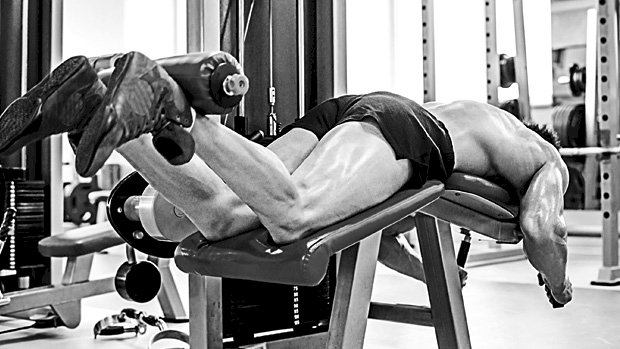
 Contractile failure is the main trigger to stimulate muscle growth. That means you go until can’t get another full rep with good form. The key in this variation of rest-pause training is hitting failure at several points in the same set. Basically, one “set” may be two minutes long with little 10-second breaks taken within the set. “Death by” means that you continue until you can’t do any more. Here’s an example. Hamstring Curl, Death-By Rest-Pause Start with a weight you can do for 6-8 reps. The number you get isn’t important, this is just to help you pick the best weight to start with. Go to failure. The last rep should be tough, but you should be able to do the full rep in good form. Don’t try to do half of a ninth rep and then fail. Remember, contractile failure means completing a FULL rep and not being able to do another full rep. Rest for 10 seconds. Using the same weight resume the set and once again go to failure. Continue the pattern: reps to failure, 10 second pause, reps to failure, 10 second pause… until you reach a point where you know you can’t possibly get one more full rep. Continue doing the same process until you can only perform a single complete rep in a mini-set, where you know that getting a second one would be impossible. Since these sets are amazingly powerful but also traumatic on the body, only do one or maybe two sets per exercise. This method is ideal for isolation
Origin: Tip: Build Muscle With “Death By” Sets
Tag: Muscle
Tip: Eat Oatmeal Cookies, Build Muscle
 People are strange, especially bodybuilders and gym rats. Tell them to have some oatmeal with protein powder, a handful of nuts, and a little fruit for breakfast and they’ll do it. After all, that’s about the best breakfast you could eat if you like muscle. But tell them to have cookies and they’ll freak out. Like eating cookies for breakfast is bad or something… Okay, I get it. Most cookies are tasty little disks of Type-2 diabetes. But not these. In fact, these contain pretty much the same foods as the above muscle-building breakfast, with the added bonus of being portable. High-Protein Vanilla Oatmeal Cookies Ingredients 2 Cups old-fashioned oats 1 Cup unsweetened apple sauce 1 Soft banana 4 Scoops (120g) vanilla Metabolic Drive® Protein 2 Teaspoons vanilla extract 1/4 Cup Splenda (or equivalent sweetener of choice) 1 Teaspoon baking powder Cinnamon and powdered ginger, as much as you’d like Pinch of salt Optional: 1 Cup walnut halves Directions Preheat oven to 325 degrees. Line a baking sheet with parchment paper for easy cleanup. Mix all the ingredients together in a bowl. Using a cookie scooper, medium ice cream scoop, or a spoon, place 8-12 mounds of dough onto the sheet pan. Bake for around 20 minutes, depending on your oven, elevation, and size of your cookies. Larger cookies will require an extra minute or so, smaller cookies a minute or two less.
Origin: Tip: Eat Oatmeal Cookies, Build Muscle
How to Keep Muscle During a Layoff
 Here’s what you need to know… Don’t panic. You won’t lose muscle if you take a week off from training. After a three-week break, you might lose 5-10% of your strength mostly due to lost neural adaptations. After three weeks, it’s possible to lose muscle mass, but there are ways to mitigate the loss. You don’t gain strength by deloading. You reveal the strength you gained during your hard training cycle. Fatigue masks fitness. Deloads reveal it. People notice overtraining when they start to lose strength and body weight, so their normal reaction is to train more, making things worse. Time Off: Planned and Unplanned There are three situations where a serious lifter would take time off from training: A planned deload to help reach peak performance or to recover from overtraining. A short planned break (vacation or trip). An unplanned layoff (sickness or injury). Deloading and hiatuses from training are part of everybody’s life. While it’s my job to help people get the most out of their training, it’s also part of my job to help them retain most of their gains when they’re forced out of the gym. Here’s my take on all three: 1 – A Planned Deload Deloading prior to a competition or before trying to hit a new PR It’s a common approach to include a deloading period prior to a competition or “gym test.” The theory is that you impose a large stress on your body with 2-3 weeks of hard training, then you include 4-10 days of reduced training or active rest. This is called a taper. During the taper, several markers of performance go up: Testosterone peaks (it’s normal for it to get low during high-stress training). The nervous system gets back to optimal function (as evidenced by a marked increase in grip strength tests 3-4 days into the taper). Super-compensation of glycogen stores occur and the body stores more water inside muscles and less subcutaneously (possibly indicative of lower cortisol). You’re left with a body that’s primed to function at its best. You don’t gain extra strength by tapering/deloading for a peak. You’re simply revealing the strength you gained during your hard training cycle. Fatigue masks fitness. When you accumulate a certain degree of systemic fatigue, you might only be able to function at 90 or even 80% of what you’re capable of. The thing is, once you’re past the beginner stage, you must train at a level that will cause some accumulated fatigue to stimulate further gains in strength and size, and the harder you train to make gains, the more fatigue you build up. So, during a hard cycle you might be able to gradually add some weight to the bar (making you believe that you aren’t plagued by fatigue), but the results you see in the gym and in your body are inferior to the real gains you’re making, because fatigue masks your true level of fitness. So, why not avoid accumulated fatigue altogether? If you’re training hard enough to get optimal gains it will lead to a certain level of accumulated fatigue. If you aren’t building up a certain level of fatigue, then you aren’t imposing a stimulus strong enough to force the body to adapt. Important: Don’t stop lifting during a taper. Sure, not training at all will help you recover faster, but it would be at the expense of timing and neural activation. When I competed in Olympic lifting, I performed the most poorly when my coach had me do a taper where I wouldn’t train at all 4-5 days prior to the competition. I lacked timing and felt out of the groove and not fully focused. Don’t spend more than one day without touching a bar when trying to maximize performance, even if it’s only light training to stay in the groove. Application: During the taper we do the following: Drop all assistance work, only doing the 3 main lifts. Drop training frequency to 3 times during the week: Monday, Tuesday, Thursday, and test on Saturday. Perform the 3 lifts at each session, using submaximal weights. Monday: 70% for 3 sets of 3 Tuesday: 90% for 3 sets of 1 Thursday: 80% for 3 sets of 2 Saturday: Test Increase Plazma™ intake during the taper to promote a maximum anabolic rebound, despite a lower volume of training: 2 servings pre-training, 1 serving during training, 1 serving 30 minutes post-training, and 1 serving 60 minutes post-training. One serving of Mag-10® 15 minutes before every meal. Increase caloric intake by about 25%. Most people make the mistake of decreasing calories when they taper. They think that since they’re training less, they need less fuel. They’re also afraid of gaining some fat if they eat more while training less. This is the best way to miss your peak! The goal of the taper is to get rid of any fatigue you might have that could mask your fitness. By eating less you risk slowing down your recovery. Deloading to recover from overtraining A certain amount of accumulated fatigue is normal when training hard toward a goal, but we don’t want this to turn into an overtraining situation. When it happens you need to get out of that
Origin: How to Keep Muscle During a Layoff
 All about sport xlsport.club