
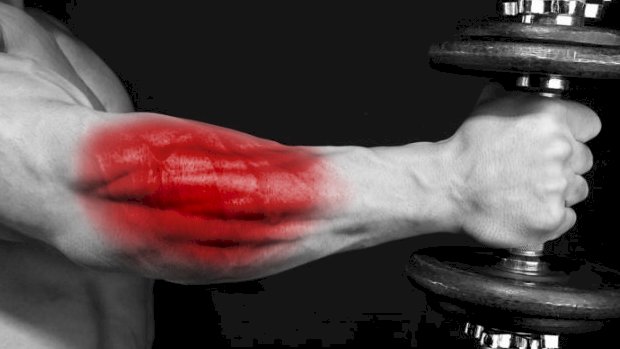
 Forearm pain from bench pressing is common… and it’s misunderstood. The culprit is generally the brachoradialis, a muscle normally associated with hammer curls. The reason it can get upset is because the fixed hand position on the bar forces your forearm through a pronation and supination cycle as the elbow bends and straightens. That means you’re effectively being forced to turn your hand over towards an end-range “palms down” position in the bottom of a bench press. Then, as you press up towards lockout, the forearm supinates into a more neutral position. This happens without us really thinking about it. However, while the forearm pronates and supinates, the brachoradialis is loaded to stabilize the movement occurring between the two long bones of the forearm. It’s a little complicated, because the muscle changes functions through the movement, doing different things at different points. Small stabilizer muscles under big loads often leads to overload and pain. Yes, you can back off bench pressing for a while, or you can rub or needle the muscle. All that might make it feel better in some way, but none of it will resolve the problem. Solving the issue requires you to condition the problem range of movement, making that range more easily available and stronger so it has the capacity to deal with the demands of benching. That means specifically conditioning loaded forearm pronation through a horizontal pressing cycle. Sounds complex, but the hammer press is the simple answer: Hold a hammer out at arm’s length and pronate the forearm until the hammer is parallel to the ground. Start with a very short lever. That means holding close to the top of the handle, near the head of the hammer. Holding the hammer parallel to the floor, try to mimic the bench press movement. You’ll feel the forearm fire up and work, and you’ll feel the problem muscle in the relevant way. Some discomfort, up to around 4-5 out of 10 on the pain scale, is acceptable and therapeutic throughout the movement. Do slow and controlled presses. If you need to make it more challenging, work your way down the hammer shaft to make the lever longer. Because the movement goes through the same range of motion as your bench press, it’s the only way to ensure you’re conditioning the relevant parts of the relevant muscles/tendons so they can adapt and actually solve your problem. Since this is a therapeutic exercise, it should be done daily and only to moderate discomfort. You’re actually adding work to tissues that are failing to cope with their current workload, so go steady. It may take a week or two to adapt and improve. It’s worth the time investment though. You’re really solving the problem, not just masking
Origin: Tip: No More Forearm Pain From Benching
Tag: More
More Gains in Less Time: 5 Pro Tips
 Building muscle and strength is closely tied to work output per unit of time – the more work you do in a week/month/year, the better results you’ll get. So, let’s review some proven time management and productivity strategies and apply them to weight training. Here are five methods, along with practical suggestions about how to apply them to your training routine. 1 – You Can’t Have Everything on the Menu Whenever I’m asked why I never use a certain exercise or training method, it’s rarely because that exercise or method doesn’t have value. Instead, it’s because I only have so much time and energy, so I’ve got to pick my battles. Pro Tip Although it’s not possible to utilize all beneficial methods simultaneously, you can incorporate a lot more of them by performing them sequentially. Here are a few quick examples: Let’s say you train legs twice per week and you’ve identified 16 exercises that work really well for you. If you wanted to run all 16 exercises within a weekly split, you’d need to do 8 exercises per session. Obviously, this isn’t practical. The solution is to run exercises 1-8 during one 6-week training block, followed by exercises 9-16 on the second 6-week cycle. Although it might seem like you’ll lose ground on an exercise that you haven’t done for 6 weeks, the exercise-specific strength you gain on one cycle will typically be enough to maintain or even improve your strength on the exercises that were put on the back burner. Rather than trying to improve strength and muscle mass simultaneously (within the same training cycle), train these adaptations sequentially, again using 6-week cycles: For 6 weeks use sets of between 6-12 reps, followed by a 6-week cycle where you train in the 3-5 rep bracket. This way, the muscle you gain on the first cycle will support and potentiate greater strength when you return to low-rep sets. Rather than trying to build muscle and lose body fat simultaneously – a physiological stunt that tends to work only for fat beginners taking PEDs – focus on these contradictory goals sequentially. First, you’ll do a “building” cycle where you slowly gain weight (mostly muscle) by lifting hard and elevating your calories. Later, you slowly lose body weight (mostly fat) by lifting hard and reducing your calories. Rinse and repeat. 2 – Do the Important Stuff First If you run your own business and today’s agenda includes a potentially lucrative new client consult and refilling the stapler, you’d tackle that first item when your energy is highest. The stapler could be refilled any time, regardless of your energy levels. Similarly, if your top training goal is bigger arms, you’d ideally train biceps and triceps first in the week or first in a workout. You might even train them by themselves as a separate workout. Additionally, you might consider putting your best muscle groups on maintenance mode by using the minimum amount of training volume required to maintain, but not advance, their current development. Pro Tip Do your most injury-prone exercises last in the workout, rather than first. Here’s why: When you do your most “iffy” exercises last, you’ll have less energy, and therefore you’re less likely to harm yourself further by doing them. Second, your most bitchy joints are usually related to your most well-developed body parts. Let’s say that you’ve got great pecs, but also painful shoulders, from benching. Given that your pecs are now your best-developed muscle, you can afford to back-burner that exercise, allowing your shoulders to heal up. 3 – Batching: Don’t Wash Just One Pair of Socks Batching is a very effective productivity tool that involves completing all similar tasks in a single block of time rather than performing different types of tasks in the same sitting. As Tim Ferris explains, “You wouldn’t do your laundry every time you have a new pair of dirty socks… you wait for a certain critical mass of dirty laundry to accumulate and then you do your laundry.” This is because the time and labor required to do a full load of laundry is the same as you’d need to wash a single pair of socks. Also, switching back and forth between similar tasks requires more time and focus than focusing on a single task. As you consider the best type of training split, think in terms of batching. Although I explained my love of whole-body training splits in The Single Most Effective Workout Split, I can’t dismiss one powerful benefit of bro splits, upper-lower splits, and push-pull-legs splits: they allow you to focus on related tasks during each workout. This type of focus allows you to minimize warm-up time since the warm-up sets you do for your first exercise tends to keep you warm for later exercises as well. You’re also likely to work with greater intensity since you won’t need to “save yourself’ for other body parts later in the workout. Pro Tip Busy trainers often use a related tactic known as “training in the margins.” Rather than completing traditional 60-90 minute
Origin: More Gains in Less Time: 5 Pro Tips
Tip: Eat More, Train More – The Anabolic Toggle
 How Do You Eat for Muscle Gains Without Getting Fat? First, you have understand that the metabolism is not a great multitasker. It likes to be building up fat and muscle (anabolism) or tearing them both down (catabolism). Trying to do both at once is the metabolic equivalent of patting your head and rubbing your belly. You can do it, it’s just not that easy… unless you’re a beginner or using anabolics. The trick here is to understand you have four different metabolic toggles to pull: 1 – Eat less, exercise more. This will burn fat and muscle because it creates a pretty intense and wide calorie gap through both exercise and food. Think marathon runner or skinny fat. 2 – Eat more, exercise less. This will put on both muscle and fat through creating a calorie gap in the other direction. Think powerlifter or muscle-fat. That latter scenario is what most people try to do when they want to gain muscle. It works, but it often makes you look like you just put a jacket on top of two sweaters. It’s not the best approach or the best look. This is usually creating a 500-calorie surplus or more, and that may be too much if the training isn’t right. 3 – Eat less, exercise less. Think the little old lady in Paris who climbs four flights of stairs six times a day, but eats only half a baguette, a cup each of coffee and wine, a radish, and some cheese. She stays lean because she drives the calorie deficit through diet and moves enough to not become a skeleton. 4 – Eat more, exercise more. That’s the toggle you want. It’s the athlete toggle. Ramp up your food intake to a slight surplus so you can gain some muscle. I suggest somewhere between 15 and 20 times body weight in pounds depending on whether or not you’re a hard gainer. If you tend to get “muscle-fat” easily (like me), stay near 15 to start. Now set your macronutrients to 40-30-30 (carbs, protein, and fat). You’ll need the extra carbs. Insulin is, after all, the most powerful anabolic hormone in the body. If you can’t get that fuel in the cell, you’re not going to grow no matter how much testosterone you have. Now turn on the training intensity like you’re a banshee in a bench, squat, and deadlift competition to the death. Doing things this way will amplify energy flux, reduce fat (or at least minimize its accumulation) and put mechanical pressure on the muscle to grow. If it’s not working, SLOWLY ramp up the calories until it does. My guess is you’ll end up in a slight surplus of 200-400 calories. This is the best way to
Origin: Tip: Eat More, Train More – The Anabolic Toggle
Tip: 40-Plus? Do More Work
 Extend Your Sets For Better Results If you’re over 40, doing 3 sets of 8 and going home is no longer going to suffice. It may have worked when you were younger and had testosteroned-up tiger blood flowing through your veins, but not so much when you’ve got a 50/50 blend of tiger blood and prune juice squirting through your plaque-riddled vessels. That’s why damn near every workout should contain an extended set, drop set, or finisher of some kind and if you’re not making an ugly, just-got-burned-by-dragon-fire face at the end of it, you didn’t work hard enough. Do strip sets on leg press or Smith machine squats. Rep out. Pull a plate. Rep out. Pull a plate. Rep out. Pull a plate. Rep out. Collapse into a fetal position. Try Paul Carter’s 10-6-10 method on an exercise or two. That’s a 10-second isometric followed immediately (using the same weight) by 6 full-range-of-motion reps done with a 3-5 second eccentric, followed immediately (again with the same weight) by 10 partial range, little grunt reps. Here’s what it looks like: Or pick a weight that you can do about 10 reps with. Look at the wall clock and note the time. Give yourself 5 minutes to do 50 reps with the same weight, taking little bitty chunks of rest in-between sets to failure. If you actually hit 50, the weight was too light. Mechanical advantage barbell curls like this work well too: A1. Reverse barbell curls for 6 to 8 reps. A2. Drag curls for as many reps as you can. A3. Standing barbell curls for as many reps as you can. You get the idea. It sounds counterintuitive and it smacks of weightlifting heresy, but you’ve got to train harder than when you were younger if you want to stay in the
Origin: Tip: 40-Plus? Do More Work
Lifters Need to Lift More Often
 Here’s what you need to know… Experts used to think that once-a-week, high-volume training for individual body parts was best. Science now shows that a higher frequency of training works better. In newbies, post-workout muscle protein synthesis (MPS) continues for upwards of 48 hours. But in experienced lifters, MPS only continues for about 16 hours, proving that training frequency needs to be increased. When you work a body part once a week, you spend almost 5 or 6 days not growing. Increasing training frequency to two times a week essentially doubles the amount of time you spend growing. When you increase frequency, you reduce the amount of work you do in a workout. In return, you get better recovery and an opportunity to use more exercise variety. Manipulate Frequency and Volume for Growth Strength How often you train and the total amount of work you do in the gym, otherwise known as frequency and volume, are two of the most important variables you can manipulate for improving muscle growth, strength, and performance. In the past, most experts thought that having once-per week, high-volume training workouts for a particular body part was optimal for growth. Now, science is beginning to reveal that spreading that volume over multiple workouts may be more advantageous for building muscle and improving strength. In fact, new research shows that increased training frequency is almost an imperative for anyone who’s not a rank newbie. Why? It starts with protein synthesis. Protein Synthesis and Muscle Growth In order to fully understand how training frequency influences muscle growth, you need to understand what drives muscle growth and how it changes over time. Currently, the leading theory behind how muscle actually grows is because of something called muscle protein synthesis. (1) When you work out and stress your muscles sufficiently, you up-regulate the process of protein synthesis, which allows the body to combine amino acids into new proteins, i.e., new muscle tissue. However, it’s important to recognize that the process is a rate that diminishes when you become experienced. As a beginner, the amount of time that protein synthesis is elevated in response to exercise is quite long, with some studies showing upwards of 48 hours. That means that as a beginner, your ability to grow new muscle from a single workout can last a few days. (2) New research, however, tells us that as you become more experienced and more resilient to stress, the amount of time the body spends growing muscle from a single workout decreases significantly. In fact, some research shows that for experienced lifters, this rate of muscle building can actually return to baseline within 16 measly hours. (3) This is one of the biggest reasons why it becomes increasingly more difficult to grow as you become more experienced, and all the more reason experienced lifters need to start training more frequently. Bottom Line: The body responds to exercise by increasing protein synthesis. As a beginner, this response is intense and lasts a long time. As you become more experienced, though, this growth response diminishes, making once-a-week single-body part workouts less and less effective. Start Increasing Training Frequency Increasing how often you train certain muscle groups means you’ll have less volume per workout, but you’ll also have the opportunity to incorporate greater volume overall. For example, let’s say you’re a newbie and you train legs once per week and do 8 sets of squats. That’s a lot of sets and chances are you’re exhausted and will remain sore for days afterwards. But if you’re experienced, the actual growth response to that session might be over with by the next day. This means that despite the difficulty of your workout, an experienced lifter might only be growing for a day or so in response. That leaves the rest of the week when those muscles aren’t growing. But let’s say you split the amount of work you did during that single workout over two training sessions. Now you’re doing 4 sets of squats, twice per week. When you make this change, a few things happen. First, you’re reducing the amount of work you’re doing per workout, but what you get in return is a better ability to recover and the opportunity to use more exercises. Consider that in the example you completed 8 sets of squats. By working legs twice a week, you have the opportunity to do 4 sets of squats and maybe 4 sets of leg press, for example. Second, you’re increasing the amount of time you spend growing. If you’re experienced and you hit a certain muscle group only once per week, it’s likely that you’re spending almost 5-6 days without growth. When you increase the frequency that you train certain muscle groups, you’re now essentially doubling the amount of time you spend growing. All together, the benefits of increased frequency means that you can do more work over time, while also spending significantly more time each week growing. Bottom Line:
Origin: Lifters Need to Lift More Often
Tip: Pull Before You Push and Pull More Often
 You need to keep a balance between pulling exercises (rows, pull-ups etc.) and pushing exercises (bench press etc.) If you don’t pay attention to that balance, you’re setting yourself up for bad posture, muscle tightness, and even joint pain. Train Your Back More People usually remember to get their back workout in to counter their chest or shoulder workout they did earlier in the week. But it doesn’t end there. Not even close. Due to our lifestyles, a 1:1 ratio isn’t enough when it comes to creating and promoting – and in many cases, restoring – balance among the muscles. It means training the back more frequently, with more volume, and for higher rep ranges than we generally do with our anterior muscles. Pull Before You Push There’s more. When you do an upper body workout that contains both front and back side muscle groups, program the pull exercises first, before doing the push exercises. Why? Scapular stability. Doing your pull-ups before doing your overhead presses, or your rows before bench presses, will create a much more stable shoulder environment for the second of the two exercises. Your rotator cuff muscles attach to your scapulae, and increasing blood flow and tightness to that region will do plenty to give the shoulder joint enough support to steer clear of unwanted injuries or general instability. It also means pain-free pressing. Even if you’re doing a straight pressing workout, prime the shoulders to bear load by stabilizing them with a couple of high-rep sets of rows of any variation, using any means of resistance – dumbbells, cables, or even bands. The goal is just to get the upper back to start feeling a mild pump and get activated. Pull Day Before Push Day Program a pull day before a push day in your weekly program cycle. If you’re already training back (or pull exercises) more than once weekly, just make sure at least ONE of those pull workouts is programmed before your major pressing workout. Tough workouts can produce DOMS (delayed onset muscle soreness), which can decrease range of motion or flexibility of the muscles. Take advantage of that restriction by getting the upper back muscles mildly sore before a chest workout. This won’t affect your chest or pushing work. The ROM inhibition can have the same effect on shoulder stability specific to heavy
Origin: Tip: Pull Before You Push and Pull More Often
 All about sport xlsport.club