
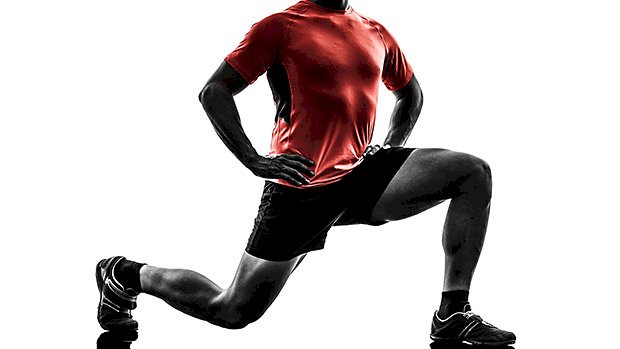
 There are three things you need to know: Most lifters skip crucial developmental exercises. Having range of motion doesn’t matter if you can’t control it. Chasing numbers before stability is a fast track to injury. I’ve lost count of the number of lifters I’ve met over the years with back and knee problems. Why so many? Because people can’t control themselves without using weight. Wait, what does that even mean? It means that most lifters get so caught up with increasing their numbers and getting stronger on paper, that they completely neglect the strength it takes to control their own body weight. This takes stability, and they have no idea they lack it because they never test it, which isn’t that hard to do. The Lunge Test Now, I’m not inventing some new-fangled “one exercise to fix all” here. This is a lunge, done slowly. So what’s the significance? All the lifters that come to me with long-term back or knee issues can’t do it. Even with impressive totals on their main lifts, they struggle to do one controlled rep on each leg. Can you do it? The Steps Set up by doing a lunge first so you know where to comfortably keep your feet. Extend both your knees so your legs are straight. Over 30 seconds, lower yourself down to the bottom of the lunge, keeping a consistent speed. Tap your knee gently to the ground while maintaining tension. Rise up slowly, taking another 30 seconds until your legs are straight again. Repeat on the other side. Tips and Reminders If it’s not challenging, increase the range of motion required by elevating both feet on plates or boxes. Remember, the purpose of this exercise is to have full control through complete range of motion. If you suddenly speed up a bit to avoid a certain position then that’s where your weakness lies. You may not completely lose balance or drop all the way to the floor, but if at any point you lose the consistent slow speed you can’t count that as a completed rep. Now take it a step further. Aim for 5 reps minimum on each side with no problems. If you can’t complete them, you’ve got your work cut out for you. Just add it to your warm-ups for a while and you’ll master it. Advanced Version The elevated version isn’t essential but it’s a nice way to improve your overall hip mobility and push that stability further. Don’t be afraid to push your body with more stability exercises. You’ll get that same satisfaction of being able to do something a lot of others
Origin: Tip: Test Your Stability in One Minute
Tag: Minute
The 12 Minute Fix for Abs and Glutes
 Here’s what you need to know… Too many people waste time working the abs and glutes separately when they could be training them simultaneously. To understand that you can work the abs/glutes/core together, you need to think of the core as a cylinder that wraps around the middle of the body. Joining and working these body parts increases efficiency, along with improving effectiveness and metabolic enhancement. The most effective and efficient way to train abs/glutes/core together is from the plank position. Since much of the core/glutes/shoulder metabolic blast is done from the plank position, there’s also a huge spillover effect to shoulder stabilization as well. Better Abs, Tighter Glutes Most women want nicer abs and round, lifted glutes. Men want one of those things more than the other (so they say), but both men and women want to work the core quickly and effectively. And if they can get some metabolic conditioning in at the same time, it’s a good day. Too bad I see them wasting gym time by training these areas as separate entities when they could instead be capitalizing on how the glutes and core often work in concert. That’s just what the this ab/glutes/core metabolic exercise sequence does. Change the Way You Think About the Core When targeting the core and glutes together for a single training effect and for metabolic optimization, it’s best to think “form follows function.” To really “get” that you can effectively target abs/glutes/core at the same time, you need to think of the core more as a cylinder that wraps around the middle of the body, engaged in the anterior chain, but supported all around the cylinder, from front to back and back to front, and top to bottom. Joining and working them together increases training efficiency not only in terms of saving time, but in terms of targeted effects and metabolic enhancement as well. The Power of the Plank Position The most effective and efficient way to train abs/glutes/core together is from the plank position. No exceptions. That’s what makes this monster metabolic sequence so effective. Additionally, there are huge spillover effects to shoulders as well, as the shoulder muscles go back and forth from unilateral and bilateral stabilization support. The abs/glutes/core sequence was conceived by considering a gymnast on the pommel horse and then tweaking the exercise sequences for overall fitness and body sculpting needs. The Workout Below is the sequence as demonstrated by Kevin Weiss, a two-time World Champion in raw powerlifting. As he says, “Even when training for size, strength, or development, there’s no downside to just ‘a little’ athleticism!” Perform 3-4 rounds. (Four is the max and only for super-beasts). Rest 15 seconds or so between each exercise in the sequence. Here are the exercises in the sequence, broken down: A.Full Sit Outs8-15 reps B.Alternating Contralateral Hand to Toe Touch8-15 reps C.Alternating Contralateral Elbow to Knee Touch8-15 reps D.Alternating Swiss Ball Step Offs8-15 reps E.Dumbbell Overhead Lockoutslow 30 count Exercise Breakdown Full Sit-Outs These engage the muscles and demand recruitment through the speed of execution and kinesthetic awareness of muscles in space. Alternating Hand to Toe Touch The relatively straight leg alters the movement pattern from the full sit outs and adds rotation and keeps muscle recruitment not only engaged, but for lack of a better term, “thinking” about that movement pattern change. This enhances the kinesthetic awareness demands, much as it would for a gymnast on the pommel horse. Furthermore, by keeping the leg relatively straight just like in the full sit outs, we’re still emphasizing longer lever arms, which demand more muscle recruitment and neural activity. Alternating Contralateral Elbow to Knee Touch What we do here is continue the movement pattern in the core cylinder, but we shorten the lever arms (meaning bent knee and touching to elbows, instead of hand to toe). This change still engages substantial effective rotational elements, but now involves the intercostals as well because of the shorter lever arms. Alternating Swiss Ball Step Offs Now the real fun begins. Because of the previous sequences and this change in movement patterns, we see tremendous lower abs and direct glute involvement, too. The nature of this movement is about stabilizing and counteracting the movement of the leg, while the other leg takes on a more kinesthetic demand by contributing to stabilization and balance as well. At this point, the abs and glutes are burning. Dumbbell Lockout Holds This movement completely alters the effects and demands of abs/glutes/core stabilization through an overhead hold. The weight has to be heavy enough to create that demand. This movement acts as a finisher as the shoulders, serratus, paraspinals, glutes, and abs are all contracting hard in order to support the overhead hold. Furthermore, because you’re using the plank position in the first four
Origin: The 12 Minute Fix for Abs and Glutes
 All about sport xlsport.club