
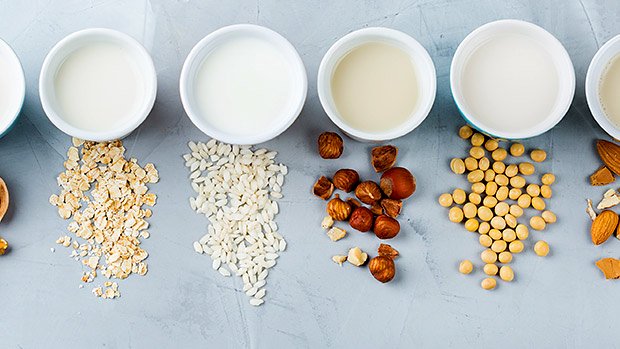
 Let’s First Get One Thing Straight… Milk is what female mammals secrete to nourish their young, so calling the liquid you get by pulverizing any of various seeds, nuts, or fruits “milk” is hugely inaccurate. There are, after all, no soybeans, almonds, oats, or coconuts that lactate, even though the last one kind of looks like a hairy hooter. Regardless of what you call them, these plant-based juices are hugely popular. Just stand in line at your local Starbucks and see how many hamsters signal their nutritional virtue by ordering their lattes with one of these milk alternatives (as if replacing milk with a dollop of one of these sugar-saturated Frankenjuices is going to make a difference in their health). Any way you look at it, though, regular, whole-fat milk is nutritionally superior to all of the plant-based alternatives. There are, however, two completely valid reasons not to make milk your choice of liquid to pour on your cereal, mix in your protein drink, or whiten up your coffee – one, you’re vegan, which by definition rules out cow’s milk, or two, you’re lactose intolerant, in which case cow’s milk is your digestive enemy. I should also accept that many of you, because of pasteurization, the China Study, or maybe because it comes out of a cow’s lady parts, think that cow’s milk is what the devil dips his raspberry scones into and thus won’t touch it. Fine. Those delusions are, as they say, beyond the scope of this article. Regardless of your reasons, there’s one, possibly two, milk substitutes that make for a valid alternative to milk. They’re oat milk and cashew milk. A Bunch of Players But None of Them Starters The idea behind most plant-based milks sounds great. Sure, mash up some plant matter. Strain out the crap, add water, and fill up on pure plant nutrients, proteins, and fatty acids. Too bad it doesn’t really pan out that way. Take almond milk, for instance. It gives you none (or very little) of the benefits of almonds, which include proteins and good fats, and neither does it give you the benefits of regular milk since it lacks calcium. For one thing, each carton only contains a handful of almonds, and the handful in question is a wee, gnarled, arthritic thing that can only scoop up a couple of almonds without spilling them onto her orthopedic shoes. Not only that, but when you strain out the insoluble stuff from the “milk,” you lose most of the stuff you’d eat almonds for in the first place. Of course, manufacturers usually add calcium and vitamins A, D, and B-12 (along with a bunch of sugar, unless you get unsweetened variety), but you’re still getting very little protein – about 1 gram per cup, compared to about 8 grams for milk. It’s true, though, that almond milk is generally 50% lower in calories than cow’s milk since it lacks any significant amounts of fat and, since it’s not an animal product, it contains no saturated fat or cholesterol… if any of that matters to you. (Unsweetened almond milk is also virtually carb-free if that’s something you’re looking out for.) Few of the other milk substitutes fare much better as they each have their individual drawbacks. Pea protein milk is higher in protein than almost all of the others, but it’s not made with the whole pea and, as such, lacks the polyphenols that would make it a truly healthy drink. Plus, its second major ingredient is sunflower oil, which is rich in the omega 6 fatty acids that most of us already sop up too much of every day. Coconut milk tastes great as it’s just watered down coconut fat. It’s probably similar in nutritional value to some of the nut drinks, but it’s really calorie dense, especially if you choose a sweetened variety. Of course, if you want to cash in on MCT oils (of which all four varieties are present in coconut milk), drinking it is an okay strategy since approximately 60% of its fatty acid content is made up of MCTs. Soymilk, one of the pioneers of the genre, is higher in protein than some of the nut based milks, but it’s basically intolerable, taste-wise (unless you choose one that’s been sweetened up the wazoo), and it’s so pale and watery that I’m surprised they haven’t slapped a Coors label on it to expand their market. Another strike against soymilk is the possible presence of certain plant isoflavones that mimic estrogen and can, in the long run, create hormonal havoc in both men and women. That pretty much leaves us with oat milk and cashew nut milk. So Why Do Oat Milk and Cashew Nut Get a Pass? Most oat milks are made of nothing but oats, water (in the ratio of 1 cup of oats to three-fourths cup of water), sea salt, and a bit of rapeseed oil. Nutritionally, each cup has about 120 calories, 5 grams of fat, 16 grams of carbs (of which 7 are from naturally occurring sugars), 2 grams of fiber, and about 3 grams of protein. Compared to milk, that’s a little more sugar, a little less fat, and a lot less protein, but drinking milk alternatives for their protein is like eating rum
Origin: Tip: Which Type of Milk Should You Drink?
Tag: Milk
Tip: Another Reason to Avoid Low-Fat Milk
 First off, let me dispel some of the usual crap you hear about milk in general: The China Study This milk-shaking and oft-referred to study reported that casein, the primary protein in milk, causes cancer, but that doesn’t hold up when you look closely at epidemiological studies. Besides, there’s a lot of casein in mother’s milk. That would be a pretty silly idea on nature’s part if it were to cause cancer. That would be a biological error on par with nature placing a rhino’s genitals on his horn. Every time he butted another rhino, wham! Another generation would go down the tubes. Growth Hormone Yeah, maybe milk contains a little bit of GH, but cows produce it naturally and the levels found in the milk of cows treated with it hasn’t been found to be any higher than cows not treated with it. Besides, GH is a protein. It doesn’t get absorbed in its entirety. Do you think if you eat an egg, it gets absorbed intact, eventually ending up in your liver next to some bacon at Bob’s 24-Hour Bacteria Breakfast Bistro? No, it gets broken down into its constituent amino acids when it hits your digestive system, just like GH does. Whole Milk vs. Low-Fat or Fat-Free Milk Take away all the nutritional mythology and milk is a fairly decent drink, filled with protein, minerals, and, in the right circumstances, nutrients. It’s important to drink whole milk, though. Whole milk drinkers have been shown to have fewer incidences of cancer, diabetes, and heart disease than drinkers of skim milk, and whole milk has also been shown to grow more muscle than skim milk, possibly because of the CLA (conjugated linoleic acid) it contains. Skim milk is also less functionally nutritious and it has to do with how they make it. They remove all the fat, thereby removing all the fat-soluble vitamins like A and D. They then have to fortify the milk by adding those vitamins back in, but unless you’re drinking the milk with some fatty food, those vitamins won’t get absorbed. All that being said, a new study reveals a surprising and compelling new reason to choose whole over skim or low fat and it has to do with estrogen. What They Did Scientists herded up 109 postmenopausal women to see what drinking milk would do to their endocrine levels. (They chose postmenopausal women because they wouldn’t be susceptible to the daily and hourly fluctuations in natural estrogen levels seen in premenopausal women). Each test subject drank 1 liter of semi-skimmed milk (1.5% milk fat) per day for four days, and 1 liter of whole milk (3.5% milk fat) per day for four days, interspersed with a four-day washout period. The scientists measured sex hormone levels in 24-hour urine samples collected after each 4-day period. What They Found The lower-fat milk ended up causing much higher estrogen levels than the whole milk did. That’s not to say the lower-fat milk had more estrogen in it than the whole milk. Instead, it had to do with the way the body handled the estrogen in the milk after drinking it. “Milk consumption resulted in a significant increase in urinary estrone (E1) excretion, whereas estradiol (E2), estriol (E3), and 16ketoE2 excretion only increased after semi-skimmed milk consumption.” Moreover, the semi-skimmed milk led to a higher percentage of conjugated estrogens, which are the most bioavailable form of estrogen and have a longer half-life. They’re also the type found in birth control pills. The scientists theorized that maybe the fat in the whole milk inhibited the enzymes needed to deconjugate the estrogen. What This Means to You Drinking skim milk can contribute to having higher-than-desirable estrogen levels, making it harder to put on muscle and easier to gain fat. It can also lead to heart problems. Granted, the women in this study were drinking a lot of milk – a liter, or a little more than 4 cups a day. Most of us don’t drink that much unless you’re one of those GOMAD (gallon of milk a day) bodybuilders who, after they’re curdled and aged, turn into giant blocks of cheese. Still, even if you’re only drinking average amounts of milk – either for the protein it contains, its nutrients, or as a tasty topping for your oatmeal or cereal – you’re better off drinking whole
Origin: Tip: Another Reason to Avoid Low-Fat Milk
 All about sport xlsport.club