
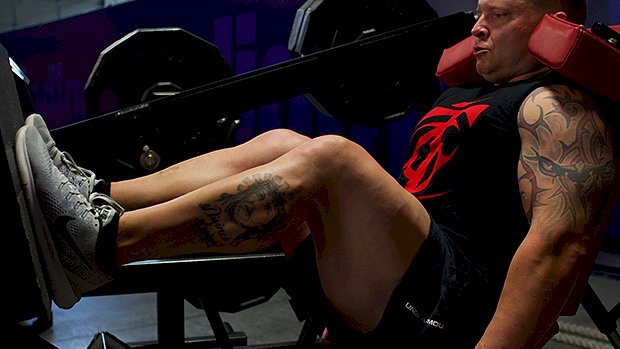
 On leg day, after your squats and lunges, a machine exercise like the leg press can add direct quad training volume without accumulating a lot of systemic fatigue. Foot placement matters for muscle activation but not at the cost of joint pain or lost range of motion. Knee-dominant exercises will always be quad dominant so any foot position used for this will train your quads effectively. Start by placing your feet narrow and lower on the press platform, but work higher and or wider if this allows better range of motion or eliminates joint pain. Maintain a strong foot arch while externally rotating the hips to keep your knees from collapsing inward. Keep your core flexed and rigid. Descend to the fullest range of motion available without allowing your hips to lift from the seat and causing your back to round. Don’t ego-lift and micro-rep like a jackass. Avoid a hard lockout at the top to avoid injury. Use a load which allows 12-15 reps to hit failure. This brings intensity, volume, mechanical tension, and metabolic stress into play. Drop set the last set 1-3 times for added destruction. If your leg press is occupied, swap it out for the hack squat machine. The same principles
Origin: Tip: Master the Leg Press
Tag: Master
Tip: Master the J-Row
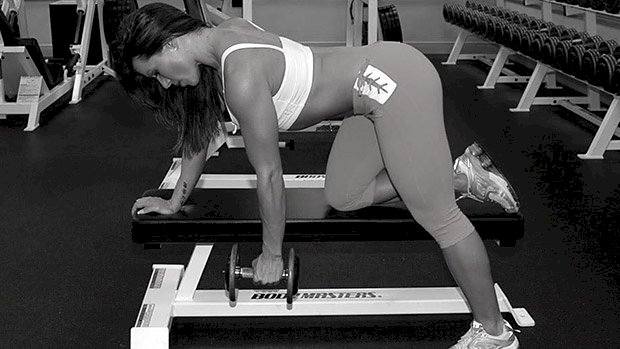 The one-arm row is a classic exercise, but it can usually be performed better by pulling with a J-shaped trajectory. One concept in muscular anatomy that’s often overlooked is the direction that fibers run. Muscles contract along the lines of fibers within them. So, muscles only contract in the direction those fibers run. In the case of the lats, the fibers run a bit diagonally from the shoulder joint down towards the lumbar spine. So it’s important to use those fibers that are high up in the back (and diving into the shoulder joint) by letting a weight travel in front of us during rows. How to Do It Get one knee on a bench with the same-side arm directly underneath the shoulder joint. Your off-bench leg should shoot out wide to “get out of the way” and create a pocket for the elbow. Engage your core and brace to keep your spine level (tabletop back). Let the dumbbell begin underneath your forehead/eye region and pull it towards your hip. Move it back towards the hips, up towards the ceiling, and then in towards the spine. Slowly control the weight back into that stretched lat position.
Origin: Tip: Master the J-Row
Tip: Master the Pendulum Pull-Up
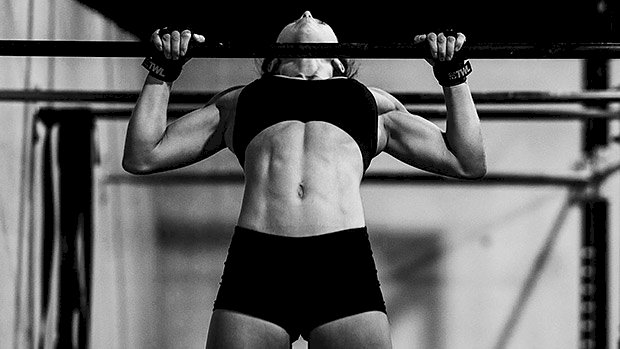 Pull-ups are great, but many people feel the tension in their arms more than their upper backs. This is suboptimal for back strength and hypertrophy… especially since the pull-up is primarily supposed to be a back exercise. To fix this, just take it through a full range of motion. “But wait, isn’t the pull-up already a full-ROM exercise?” Unfortunately, it’s not. In a typical pull-up, your spine remains relatively neutral. This doesn’t allow the muscles of the upper back to go through their full contractile range of motion. The Solution That’s where the pendulum pull-up comes in. With this variation, you’ll extend and flex your spine at different portions of the rep. Take a look: At the top of the rep, extend your spine and curl your legs up. This allows your shoulders to externally rotate and your shoulder blades to pull tightly down while your chest sticks up. This will fully shorten your upper back musculature. Then, as you lower your body, unbend your legs, round your spine, and hang in a hollow body position at the bottom of the rep. This allows your shoulder blades to fully rotate upwards and lengthen the lats, giving them a nice loaded stretch, which has been shown to increase hypertrophy (1). The flexing and extending of the spine will take the key muscles through their true contractile range of motion. You can do it this way with any grip you like. Don’t Cheat, Bro Be careful though. The line of pull is still very strict. The leg curling is only to maximize muscle contraction. It’s not supposed to help you swing for momentum. If you struggle with staying strict on normal pull-ups, these are probably too advanced for you. If you’re a pull-up stud, give these a
Origin: Tip: Master the Pendulum Pull-Up
 All about sport xlsport.club