
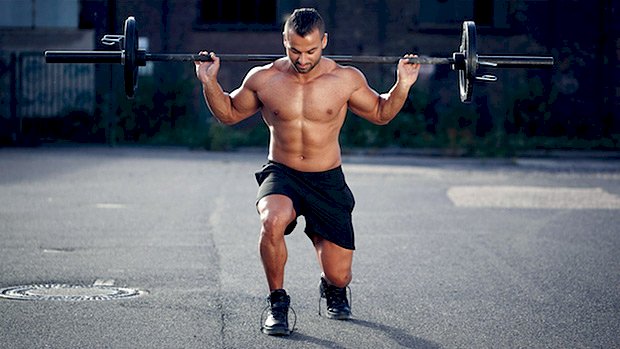
 Finished with your squats? Good. Now do some lunges… and use a barbell. Why? Lunges add total quad demolition and single-leg work. Grabbing a couple dumbbells will work, but barbell lunges avoid grip and posture fatigue while allowing greater loading. You don’t have to have an upright torso for these despite what many personal trainers still say. Instead, use a torso angle that best allows you to keep a neutral spine and engaged core while maximizing range of motion and avoiding knee discomfort. Too often, staying upright can only be done at the expense of an aggressive lumbar arch. Lunges can be done with a vertical shin for more glute emphasis or with a forward knee for more quad focus, though all forms of lunges hammer quads. Emphasize the quad-dominant version by allowing your knee to travel as far past the toe as your ankle mobility will allow and your knee will tolerate (free of discomfort). Maintain firm heel contact with the ground on each stride. Pissing off your knees will shut down your quad training, so use the form combining the best quad emphasis with knee happiness. Stop touching your back knee to the ground. The extra little range of motion isn’t worth the impact on your kneecap. Alternate forward strides across a room or lunge in place if you don’t have the space to lunge across a floor. Do 3-4 sets to failure at about 10-15 reps per leg. Take each stride forward instead of crossing your feet over as if walking a tightrope. This only makes balance harder with no training benefit. Don’t have the space to do these at your gym? Swap them for Bulgarian split
Origin: Tip: Nail the Walking Lunge
Tag: Lunge
Tip: The Full-Body Lunge
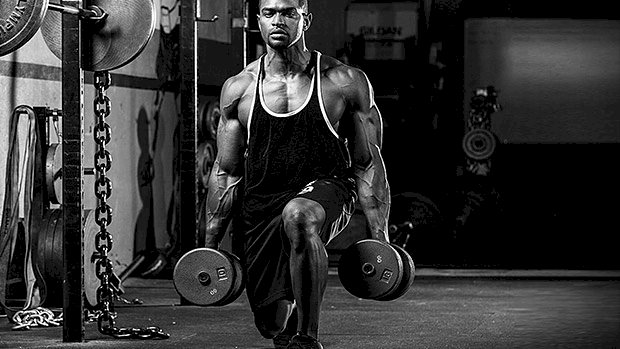 Doing exercises using the Zercher position has been trending lately and for good reason. When you place a barbell in the crook of your elbows and perform traditional compound movements, some cool shit happens. Using this variation for a squat, lunge, or carry is an incredibly effective way to hammer the upper back, traps, biceps, and abs. Getting comfortable with big barbells in the Zercher position will not only build the “yoke,” it develops a bulletproof midsection that can stand up to large loads for standard lifts. The problem with Zercher position exercises is that most lifters are limited by how much they can hold, at least until the upper body muscles catch up to the strength of the lower body. Either the torso or biceps will fail first. This leaves the legs without a great stimulus for strength or hypertrophy. Enter the Zercher Dumbbell Lunge Drop Set A great way around this issue is to use a mechanical drop set of sorts. A typical mechanical drop set involves modifying an exercise after the failure point to make it easier and allow for additional reps. In this case, after you reach failure at the torso/biceps in the Zercher position, you drop the bar, switch dumbbells, and finish off the legs with traditional dumbbell lunges. This allows you to reap all the benefits of using a Zercher position and smash the legs in the same set. How to Do It Do 2 sets of Zercher lunges in your preferred rep range, but leave 1-2 reps in the tank on each set. Place dumbbells that add up to 75% of the total load used for the Zercher lunge close to where you ended the first 2 sets. On the third and final set, take the Zercher lunge to failure, ditch the barbell, grab the dumbbells, and do lunges until form breaks
Origin: Tip: The Full-Body Lunge
 All about sport xlsport.club