
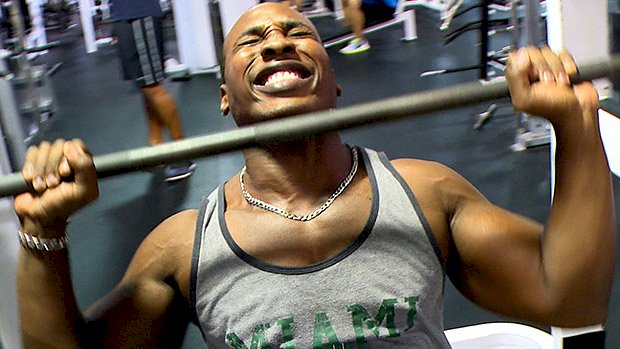
 Lift hard for long enough and you’ll eventually have some joint pain. Whether it’s the knee, shoulder, lower back, or wrist, something will probably flare up. Now, you could pop some pain killers and grind through it until your flare-up becomes a real injury… or you could do the smart thing and manage your injury. If you’re ready to check your ego, use some of these strategies. Increase Your Volume and Decrease Weight Your muscles may be able to take heavy daily lifting, but that doesn’t mean your joints can. Dropping the heavy lifting and increasing your reps will not only give your joints a break, it’ll allow your nervous system to recover while you shift focus towards muscle growth. The amount of effort you put into your workouts doesn’t need to change just because you’re going lighter. Taking shorter rests and increasing your reps will create more metabolic stress which will lead to greater hypertrophy. Also, higher reps will get the heart pumping hard which provides extra blood flow and circulation to your cranky joints. Partial Reps Partial reps create more time under tension and emphasize the “pump” when lifting. Limiting your range of motion to the middle two-thirds of your lift and avoiding the lockout will relieve excess strain on your joints. As an example, here’s the neutral, close-grip incline press: Use Bands as Upper-Body Assistance This can prevent excessive stress at the end range of motion on your pull-ups and push-ups. They’re a great way to add both higher volume and partial reps while allowing your body to be in constant motion for your calisthenics exercises. Banded Partial Push-Up Banded Partial Pull-Up Even if you’re capable of repping out 50 push-ups or 20 pull-ups, bands push your volume even higher and keep a smooth muscular contraction throughout your sets. Deload Your Spine for Lower-Body Work If you feel like you’ve shrunk a couple inches after compressing your spine with heavy squats, it may be time to deload. You can still work the squat movement without all the spinal compression. One of the best ways is with the belt squat. The belt squat takes the spine out of the equation because a belt is placed around the hips and the weight is applied from the waist down. No belt squat machine? Rig together your own variation. One way to do it is to use a couple straps, a hook, some boxes, a weight belt, and a heavy kettlebell or two. Kettlebell Belt Squat Ideally, keep your butt pushed against a wall. This will provide extra stability and allow you to use your glutes and hamstrings to a greater
Origin: Tip: How to Lift with Angry Joints
Tag: Lift
Lifters Need to Lift More Often
 Here’s what you need to know… Experts used to think that once-a-week, high-volume training for individual body parts was best. Science now shows that a higher frequency of training works better. In newbies, post-workout muscle protein synthesis (MPS) continues for upwards of 48 hours. But in experienced lifters, MPS only continues for about 16 hours, proving that training frequency needs to be increased. When you work a body part once a week, you spend almost 5 or 6 days not growing. Increasing training frequency to two times a week essentially doubles the amount of time you spend growing. When you increase frequency, you reduce the amount of work you do in a workout. In return, you get better recovery and an opportunity to use more exercise variety. Manipulate Frequency and Volume for Growth Strength How often you train and the total amount of work you do in the gym, otherwise known as frequency and volume, are two of the most important variables you can manipulate for improving muscle growth, strength, and performance. In the past, most experts thought that having once-per week, high-volume training workouts for a particular body part was optimal for growth. Now, science is beginning to reveal that spreading that volume over multiple workouts may be more advantageous for building muscle and improving strength. In fact, new research shows that increased training frequency is almost an imperative for anyone who’s not a rank newbie. Why? It starts with protein synthesis. Protein Synthesis and Muscle Growth In order to fully understand how training frequency influences muscle growth, you need to understand what drives muscle growth and how it changes over time. Currently, the leading theory behind how muscle actually grows is because of something called muscle protein synthesis. (1) When you work out and stress your muscles sufficiently, you up-regulate the process of protein synthesis, which allows the body to combine amino acids into new proteins, i.e., new muscle tissue. However, it’s important to recognize that the process is a rate that diminishes when you become experienced. As a beginner, the amount of time that protein synthesis is elevated in response to exercise is quite long, with some studies showing upwards of 48 hours. That means that as a beginner, your ability to grow new muscle from a single workout can last a few days. (2) New research, however, tells us that as you become more experienced and more resilient to stress, the amount of time the body spends growing muscle from a single workout decreases significantly. In fact, some research shows that for experienced lifters, this rate of muscle building can actually return to baseline within 16 measly hours. (3) This is one of the biggest reasons why it becomes increasingly more difficult to grow as you become more experienced, and all the more reason experienced lifters need to start training more frequently. Bottom Line: The body responds to exercise by increasing protein synthesis. As a beginner, this response is intense and lasts a long time. As you become more experienced, though, this growth response diminishes, making once-a-week single-body part workouts less and less effective. Start Increasing Training Frequency Increasing how often you train certain muscle groups means you’ll have less volume per workout, but you’ll also have the opportunity to incorporate greater volume overall. For example, let’s say you’re a newbie and you train legs once per week and do 8 sets of squats. That’s a lot of sets and chances are you’re exhausted and will remain sore for days afterwards. But if you’re experienced, the actual growth response to that session might be over with by the next day. This means that despite the difficulty of your workout, an experienced lifter might only be growing for a day or so in response. That leaves the rest of the week when those muscles aren’t growing. But let’s say you split the amount of work you did during that single workout over two training sessions. Now you’re doing 4 sets of squats, twice per week. When you make this change, a few things happen. First, you’re reducing the amount of work you’re doing per workout, but what you get in return is a better ability to recover and the opportunity to use more exercises. Consider that in the example you completed 8 sets of squats. By working legs twice a week, you have the opportunity to do 4 sets of squats and maybe 4 sets of leg press, for example. Second, you’re increasing the amount of time you spend growing. If you’re experienced and you hit a certain muscle group only once per week, it’s likely that you’re spending almost 5-6 days without growth. When you increase the frequency that you train certain muscle groups, you’re now essentially doubling the amount of time you spend growing. All together, the benefits of increased frequency means that you can do more work over time, while also spending significantly more time each week growing. Bottom Line:
Origin: Lifters Need to Lift More Often
 All about sport xlsport.club