
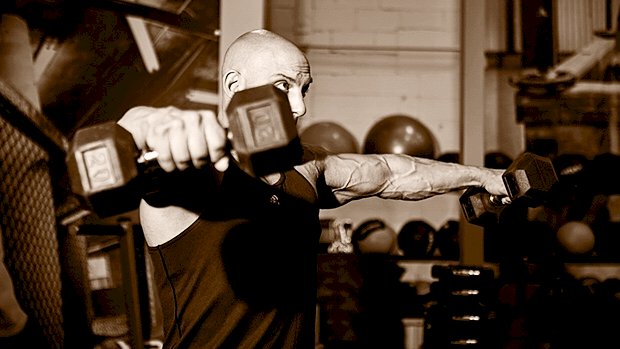
 While becoming stronger for sets of 5-8 reps on the basic pressing movements is the key to great delts, there’s no doubt that properly executed lateral raises can help you get there faster. How? Both by directly developing the delts and by improving your capacity to recruit them so they’re better stimulated when you do heavy pressing work. When used to develop a solid mind-muscle connection, lateral raises can be done pretty much every day. Here’s why: First, they cause very little muscle damage. Muscle damage is created when you’re stretching the muscle fibers under load and tension. That occurs during the eccentric phase of the movement. In lateral raises, only the top quarter of the range of motion is under significant loading. Let’s say that in the finish position your arms form a 90-degree angle with your torso. Your delts are only under significant loading when the arms reach about 70-75 degrees. Before that you aren’t moving opposite the source of resistance (which is directly down). You’re moving more sideways than up. It’s the same thing when you’re going down – the deltoid (especially the medial head) will be under load only for the first quarter of the eccentric range of motion, which is when the muscle is shortened. When the muscle is stretched, there’s literally zero tension on the delts. On top of that, if you do the lateral raise properly (no swinging at the bottom where there’s no resistance and you can easily speed up), you won’t be using a lot of weight, which also decreases the amount of muscle damage. Since the movement isn’t neurologically demanding, it likely won’t hurt neurological recovery either. How to Make the Most of Lateral Raises Initiate the movement by trying to push away, not lift up. This will put more focus on the medial head of the delt and less on traps. Getting tension in the traps instead of the shoulders causes frustration for a lot of lifters. If you’re one of them, see my tip on this. This also works with the incline variation: Use zero momentum in the first half of the movement. From the bottom to a bit higher than the mid-range, the resistance is very low. You could easily do half of the lateral raise with 60-pound dumbbells even if you can only use 20 pounds for the full range. Since there’s very little resistance, creating acceleration in the bottom is super easy. The problem is, if you create enough momentum, it’ll take away from the muscle contraction work that occurs in the final portion of the range of motion. So do the first half of the movement under control; focus hard on not accelerating. At the top of the range of motion, hold for two seconds per rep. This is helpful for two reasons. First, the active range of motion is short; the delts only contract maximally for the last 15-20 degrees. That’s not a lot of time under tension to create muscle fiber fatigue and force adaptation. By holding at the top, you increase muscle fiber fatigue. And second, the hold helps develop mind-muscle connection. While holding the top position, also try to push out. This will switch even more of the stress on the medial head of the delt, which is the part that we really want to develop. Shoot for a set duration of at least 40 seconds. Since we aren’t causing muscle damage, we must rely on muscle fiber fatigue as well as lactate and growth factor accumulation to stimulate growth. This requires a bit more time under tension. With the two-second hold at the top, that comes down to around 12 reps per set. You can easily do 3-4 sets of 12 in this fashion every day to improve mind-muscle connection and stimulate
Origin: Tip: Everyday Lateral Raises
Tag: Lateral
Tip: The No-Cheat Lateral Raise
 It’s nearly impossible to cheat with these, unlike the standing lateral raise. For lifters having trouble getting a strong mind-muscle connection, the incline version is a better choice. Incline Lateral Raise This exercise will also naturally put the resistance in line with the middle fibers of the delt. When you use a standing lateral raise it’s common (and fairly natural) to work more in the scapular plane, which is slightly safer for the shoulder joint. But it also tends to make it more of an anterior deltoid movement, which we’re trying to avoid since that’s already been covered. Since the resistance is more in line with the middle delt, and you can’t cheat, you’ll naturally bring the dumbbells directly up to your side. This is what makes it a great option for smoking the middle delts. Lastly, if you want to keep tension on the shoulders as much as possible throughout the range of motion, then eliminate the bottom quarter of the movement. The delt itself isn’t very active in the bottom part of the range of motion. It’s the supraspinatus that initiates the abduction of the arm from this position, and then the delt takes over after that. Once you lift the dumbbells to the top on the first rep, lower only about three-fourths of the way down before doing the next rep. Sets & Reps Try these with drop sets or cluster sets. Do 4-6 sets total in the cluster with 10 seconds between each set, going to total muscular failure on the last
Origin: Tip: The No-Cheat Lateral Raise
Tip: Your Lateral Raises Aren’t Working
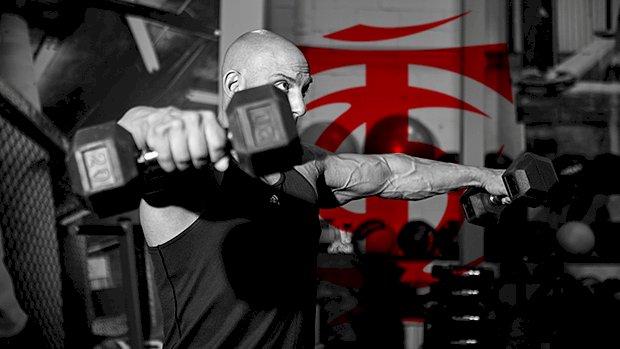 To make the lateral raise effective at recruiting the delts (and not just the traps) first focus on pushing the dumbbells AWAY, not on lifting them up. Try to bring the dumbbells as far to your sides as possible. They should only go up as a result of you pushing sideways. This minimizes trap recruitment. Here are three alternative exercises to try: 1. The Backpack Raise No, you won’t be doing lateral raises while wearing a backpack (although that would likely work too) but with resistance bands looped around your shoulders to keep them down. The traps get involved when the shoulders raise up instead of just rotate. The bands, by keeping the shoulders down, help you focus on the delts better. To set up, you step on the inside of the band and hook the other end around the shoulder. Then do that on the other side with a second band. The bands’ position on the shoulder is important. You want to place it on the AC joint, not on the trap. If the band is on the trap it will actually increase the recruitment of the trap by creating a greater mind-muscle connection with that muscle and a reactive contraction because of the pressure. You’ll still need to focus on pushing the dumbbells away instead of lifting them up, but the bands will make that a lot easier. 2. The Handcuff Raise with a Mechanical Drop Set For this one you’ll use a short resistance band looped around your wrists, like handcuffs. Use a band with only a small amount of resistance; no need to go crazy here since you’re only using it to shift the tension to the medial delts. Choose dumbbells that are a bit lighter than what you’d normally use for 10 strict reps. Let’s say a weight you could do 12-15 quality lateral raises with. The first step of the mechanical drop set is to do partial lateral raises with the band and dumbbells. Go as high as the band will allow, which should be around a third to a half of the way up. Do as many good reps as you can. Then immediately drop the band and do regular lateral raises with dumbbells only. Shoot for 8-10 reps. Then, drop the dumbbells and put the band back on and do partial reps (like in step one) with only the band. Don’t rest between each step of the mechanical drop set. If you want to set your medial delts on fire, this is the exercise for you! 3. The Incline Lateral Raise This is the “less cool” option but one that I’ve been using for at least 15 years successfully with people who have dominant traps. Sit down on an adjustable bench angled at around 30 degrees and do lateral raises from that position. Still focus on pushing the dumbbells out, not lifting them up. This greatly decreases trap activation, but you still have to focus on pushing the dumbbells far away from your side instead of
Origin: Tip: Your Lateral Raises Aren’t Working
 All about sport xlsport.club