
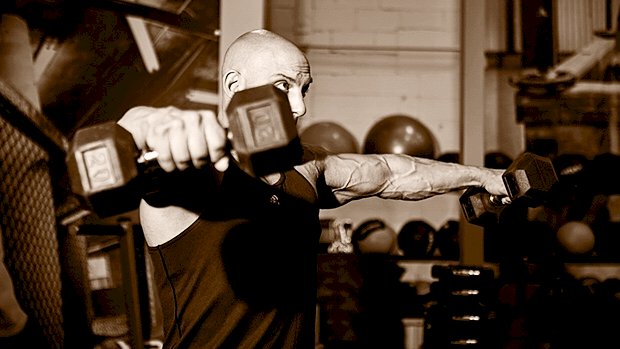
 While becoming stronger for sets of 5-8 reps on the basic pressing movements is the key to great delts, there’s no doubt that properly executed lateral raises can help you get there faster. How? Both by directly developing the delts and by improving your capacity to recruit them so they’re better stimulated when you do heavy pressing work. When used to develop a solid mind-muscle connection, lateral raises can be done pretty much every day. Here’s why: First, they cause very little muscle damage. Muscle damage is created when you’re stretching the muscle fibers under load and tension. That occurs during the eccentric phase of the movement. In lateral raises, only the top quarter of the range of motion is under significant loading. Let’s say that in the finish position your arms form a 90-degree angle with your torso. Your delts are only under significant loading when the arms reach about 70-75 degrees. Before that you aren’t moving opposite the source of resistance (which is directly down). You’re moving more sideways than up. It’s the same thing when you’re going down – the deltoid (especially the medial head) will be under load only for the first quarter of the eccentric range of motion, which is when the muscle is shortened. When the muscle is stretched, there’s literally zero tension on the delts. On top of that, if you do the lateral raise properly (no swinging at the bottom where there’s no resistance and you can easily speed up), you won’t be using a lot of weight, which also decreases the amount of muscle damage. Since the movement isn’t neurologically demanding, it likely won’t hurt neurological recovery either. How to Make the Most of Lateral Raises Initiate the movement by trying to push away, not lift up. This will put more focus on the medial head of the delt and less on traps. Getting tension in the traps instead of the shoulders causes frustration for a lot of lifters. If you’re one of them, see my tip on this. This also works with the incline variation: Use zero momentum in the first half of the movement. From the bottom to a bit higher than the mid-range, the resistance is very low. You could easily do half of the lateral raise with 60-pound dumbbells even if you can only use 20 pounds for the full range. Since there’s very little resistance, creating acceleration in the bottom is super easy. The problem is, if you create enough momentum, it’ll take away from the muscle contraction work that occurs in the final portion of the range of motion. So do the first half of the movement under control; focus hard on not accelerating. At the top of the range of motion, hold for two seconds per rep. This is helpful for two reasons. First, the active range of motion is short; the delts only contract maximally for the last 15-20 degrees. That’s not a lot of time under tension to create muscle fiber fatigue and force adaptation. By holding at the top, you increase muscle fiber fatigue. And second, the hold helps develop mind-muscle connection. While holding the top position, also try to push out. This will switch even more of the stress on the medial head of the delt, which is the part that we really want to develop. Shoot for a set duration of at least 40 seconds. Since we aren’t causing muscle damage, we must rely on muscle fiber fatigue as well as lactate and growth factor accumulation to stimulate growth. This requires a bit more time under tension. With the two-second hold at the top, that comes down to around 12 reps per set. You can easily do 3-4 sets of 12 in this fashion every day to improve mind-muscle connection and stimulate
Origin: Tip: Everyday Lateral Raises
Tag: Everyday
5 Things You Can Train Everyday
 I’m a firm believer in frequency when it comes to strength and size gains. It’s not surprising when you look at my personal training background. I started out training for football and our strength coach was a big believer in hitting the big basics three days a week. Our program was essentially the power clean, squat, bench, and pull-up three days a week. After football I transitioned to Olympic lifting where I’d squat, clean, and snatch pretty much every day. The higher frequency regimen worked for those exercises too. The truth is, you can train pretty much everything with a high frequency once technical mastery is accomplished. Of course, you need to plan volume and intensity properly, but it’s possible. Not sold on the idea of squatting every day or snatching every workout? No worries. There are a few things that are less complicated than others to train every day. And they’ll make it pretty easy to fix some of your weak links too. Here are five of them. 1 – Forearms Forearm exercises don’t cause much, if any, muscle damage, especially for exercises with less eccentric loading like the wrist roller or Thor’s hammer (see video). But even wrist flexion and wrist extension will cause little damage. Furthermore, these exercises have a very small impact on the nervous system because they’re very simple and done with light weights. Energy expenditure is low too since it’s a short range of motion and smaller muscles are involved. None of the factors requiring more recovery time are present with forearm training. Unless you go absolutely crazy with the volume there’s no reason you can’t train forearms every day. Why would you want to do that? Because big forearms look cool. Hey, they’re the only thing that’s 100-percent showing in a T-shirt! But having well-developed forearms will do more for you than simply attracting admiration. Bigger and stronger forearms make it easier to build bigger biceps. Coach Charles Poliquin wrote about this phenomenon 20 years ago. The body hasn’t changed since that was written. By building bigger, stronger forearms you’ll be able to handle more weight in both curling and pulling exercises, which will increase the stimulation on the biceps and back muscles. Bigger forearms and a stronger grip also help the bench press. Look at the top bench pressers in the world; they all have thick forearms. To bench heavy weight you need a strong grip. The harder you can squeeze the bar, the less the wrist will tend to cock and get the bar misaligned. (The bar should be directly above the wrist joint. If the wrist is cocked, the bar moves away from that alignment.) On top of that, big forearms create a bigger “body” on which to spread the load of the bar. This can decrease stress on the shoulder joint. There is one caveat: You shouldn’t overdevelop one part of the forearms. For example, the wrist flexors tend to be trained a lot more than the wrist extensors (the flexors are involved a lot when curling and pulling) and the forearms supinators are often dominant over the pronators. Just like any other muscle imbalances in the body, this can lead to problems like tendonitis. So if you want to jack up your forearms and train them every workout (or every day) then work on flexion/extension one workout, do supination/pronation on the next, and do grip work on the third. Then just rotate through that. Since forearm exercises have a short range of motion, you’ll need to do either higher reps or use a slower tempo to create enough fatigue and trigger growth. Sets lasting 30-60 seconds should be your target. I actually don’t count reps when doing forearm work. I put a timer on and keep working until I’ve achieved failure or close to it in the 30-60 second range. But I’ll prescribe a number of reps in a couple of the examples below for the sake of simplicity. Workout A – Flexion/Extension Exercise Sets Reps Rest A1 Wrist Roller 3-4 30-60 sec. 1 min. A2 Wrist Curl 3-4 10-12 90 sec. Workout B – Supination/Pronation Exercise Sets Reps Rest A1 Thor’s Hammer Pronation (4 second negative) 3-4 10-12 1 min. A2 Thor’s Hammer Supination (4 second negative) 3-4 10-12 1 min. Workout C – Grip Exercise Sets Reps Rest A Pinch-Grip Deadlift (Hold 30-60 sec.) 3 90-120 sec. B Fat-Grip Hold (Hold 30-60 sec.) 3 90-120 sec. You can use other exercises if you prefer, but you get the idea. 2 – Abs My strategy for ab training? Using blocks of intense abdominal training where I hit them every day for 4-6 weeks. You can recover rapidly from pretty much any abdominal exercises except those full range GHD sit-ups you see in CrossFit. (This movement creates a powerful stretch of the rectus abdominis – especially when done with the speed they use – which will cause a lot of muscle damage, and require more recovery time.) Daily ab training at an adequate level of intensity is one of the fastest ways of improving abdominal aesthetics, provided you’re lean enough to show them. The “abs
Origin: 5 Things You Can Train Everyday
 All about sport xlsport.club