
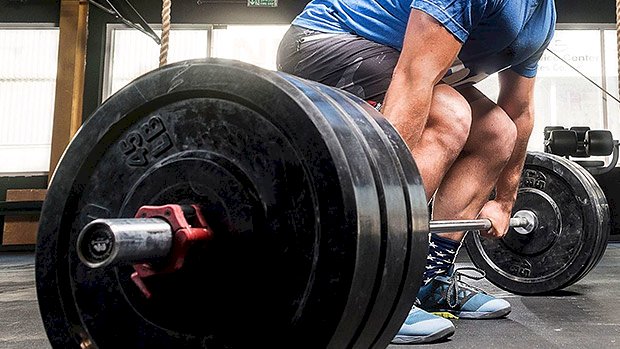
 The deadlift plays a massive role in developing strength, power, and – when done correctly – injury prevention and overall resilience. While there’s no denying that the deadlift is a powerful strength builder, the waters become a tad murkier when talking about deadlifts in the context of high-rep sets. Relatively heavy sets done within the 1-5 rep range can create powerful adaptations, but going beyond that threshold is, at best, questionable. The supposed point of high-rep sets is stimulating hypertrophy, improving muscular endurance, and building up work capacity. That means chasing metabolic stress, increasing time under tension, finding ways to extend sets, and imposing maximal muscle damage. But do high-rep deadlifts accomplish any of these noble goals? The answers point in the opposite direction – that performing high-rep deadlifts is playing with fire. Why High-Rep Deads Are a Bad Idea 1 – Who are you kidding? Your technique isn’t good enough. In theory, you can get away with high-rep deadlifts if you can maintain good technique throughout the duration of the set. Unless you were mistaken for the Hulk out of the womb, though, you probably can’t. As Tony Gentilcore says, “The ideal rep scheme to teach deadlifts is in the 3-5 rep range. Anything more and technique goes into the crapper.” When pulling from the floor, it’s hard enough to maintain optimal technique, full-body tension, and a strong brace for 1-3 reps, let alone 10, 12, or 20. Add in the laundry list of cues that accompany the deadlift – chest up, back flat, armpits over bar, neutral neck, vertical shins, etc. – and things get more complicated. So there’s a lot that needs to be dialed in and hardly any room for error. Combine all of that with a couple sets of, say, 12 reps, and things can get ugly quickly. 2 – High-rep sets aren’t that great for building muscle. Assuming you’re past the newbie stage, the deadlift doesn’t do much in the way of hypertrophy in the first place. The downside of the deadlift is that most of the musculature performing the work is in an isometric/static position. There’s minimal time under tension and hardly any eccentric (negative) loading, both paramount for building muscle. Consider that there’s no other exercise (outside of Olympic lifting) where you just drop the weight. As Paul Carter wrote in The Big 3 Suck for Size Gains, no eccentric means no growth. Putting on muscle with the deadlift gets even more unlikely when you go high-rep. 3 – Deadlifts tax the nervous system, especially with high-reps. There’s no other lift that’s as devastating on the nervous system as the deadlift. Deadlifts involve more axial/spinal loading than any other lift, which is arguably the most potent stressor on the CNS. There’s no stretch reflex. Since deadlifts start from a dead stop, the nervous system is forced to fire on all cylinders at the beginning of each and every rep. Unlike most lifts where a breakdown in form means a failed rep, it’s easier to grind out a “successful” deadlift with sloppy technique. On top of hammering the entire posterior chain, deadlifts challenge grip strength more than any other lift. A drop in grip strength is an indicator of CNS fatigue, which makes near-maximal grip requirements an additional contributor to the deadlift’s neural demands. If frequency and volume are kept in check, the systemic fatigue that occurs after deadlifting is a normal (and necessary) part of the adaptation process. In the context of high-rep sets, though, the deadlift takes a lot more than it gives back. If volume skyrockets, the factors above that contribute to a fried nervous system are amplified. Pair some deadlifts with a couple of AMRAP sets and the inevitable sloppy technique, and you’ll wake up the next day feeling as worthless as a pool noodle in a gun fight. 4 – High reps or not, conventional deadlifts aren’t for everyone. When manufacturers began producing standard 45-pound plates, they mapped out the design so that the barbell would sit 8.75 inches off the ground. The rationale? If a lifter missed an overhead lift and got pinned under the bar, 8.75 inches would provide ample room to prevent his skull from being crushed. The problem is, unlike squatting and benching – where range of motion is dictated by an individual’s anthropometrics and movement capabilities – the deadlift’s range of motion is based on an arbitrary manufacturing design. The bench press’s range of motion depends on the length of an individual’s arms and the size of his chest, while squat depth is determined by height, leg length, and an individual’s mobility (or lack thereof). As it applies to deadlifts, though, it doesn’t matter if you’re a hobbit, Sasquatch, or anything in between. You’re pulling from the same 8.75″ as the next guy. The reality is that some people simply lack the ability to pull from the floor with a neutral spine. A lot of lifters can reap ALL the benefits of the deadlift by using a setup like this: More info on
Origin: High-Rep Deadlifts Are Dead
Tag: Deadlifts
Tip: 3 Reasons Trap Bar Deadlifts Are King
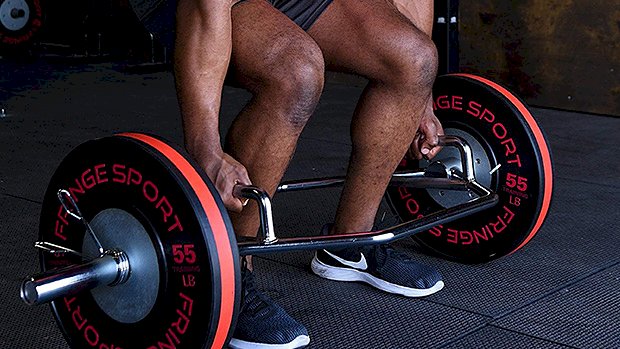 The trap bar deadlift is the king lift for keeping a healthy spine while pulling a stack of weight off the floor in a functional pattern. It checks all the boxes for health, strength training, and maintaining general badassery. There are several reasons why it’s superior to barbell pulls: You have no bar blocking your shins, which is a saving grace for longer-legged lifters, lifters with back problems, or lifters with mobility restrictions. This also allows the shins to migrate forward, allowing the hips to sit lower and the spine to remain more vertical when pulling. It also helps hit the quads harder. You’re using a neutral grip. That means no mixed grip (which has a high risk of biceps tears) and a posture that more easily engages your upper back and keeps you closer to anatomical position. That’s huge. You get to pull from a slightly higher point (at least when you go high-handle). Football and basketball players everywhere are rejoicing in the fact that they don’t have to crumple their bodies into a deep pulling position, like when they use a barbell. But most people already know all this. The true reason they won’t make the switch is bro-based stubbornness, not because a barbell “works better for them.” They think that it’s not a true deadlift if you don’t pull with a straight bar from the floor. Those are the same people who don’t have long-term health, strength, and wellness in mind. Are you sure you want to be one of them? Of course, if it gets too easy, just flip the bar and go low handle. Problem
Origin: Tip: 3 Reasons Trap Bar Deadlifts Are King
 All about sport xlsport.club