
 Metabolic conditioning, cardio, aerobics, HIIT, or whatever you want to call it, is to weightlifting what flossing is to dental health. You know, good for us. Still, it’s a grim, joyless, kind of disgusting semi-compulsory act. Granted, we’re not getting drool and masticated burrito bits all over our fingers when we do cardio, but none of us started lifting weights so we could spend hours running or peddling to nowhere on machines, or flogging Mother Earth with old ropes your gym manager stole from the USS Ronald Reagan. Still, we have to do conditioning work, both for health and to improve work capacity. There may, however, be a way to make it more palatable. Scientists have found that doing short sprint “snacks” separated by an hour or more worked just as well as doing them together in one session. In other words, you could do short bouts of peddling or running or presumably any HIIT-type training modality throughout the day when you had a minute to spare and you’d accrue the same benefits as if you’d done them all at once in one tedious, mind-numbing session. What They Did Scientists at the University of British Columbia recruited 28 healthy, young, inactive adults and randomly assigned them to one of two groups that performed 18 training sessions over 6 weeks. One group did traditional sprint interval training (SIT) that involved doing three 20-second bouts of full-out cycling, each 20-second bout interspersed by 3-minute rest periods. The other group did sprint “snacks” (SS) consisting of three, separate 20-second full-out bouts each interspersed by 1 to 4 hours of rest. What They Found As far as cardiorespiratory fitness, both the SIT group and the SS group increased their absolute VO2 peak with no difference between groups. Both groups also showed similar improvement in their 150 kilojoule (kj) cycling time trial. How to Use This Info If you’re somebody who hates doing cardio, you can use the results of this study to make it more palatable. Say for instance you’ve got a stationary bike at home. You can hop on the thing any old time when you’ve got a few seconds to spare, like when you’re waiting for your toast to pop up. Simply get on the bike (or treadmill, or whatever apparatus you use), go balls out for 20 seconds, and then resume whatever you were doing. Then, when similar opportunities present themselves throughout the day, whip out another couple of 20-second high-intensity efforts. Similarly, you could do a single 20-second burst as part of your warm up for your workout and then do another an hour later when you’re finishing up, then doing a third bout later on at home. If we believe the results of this current study, the effects on cardiorespiratory fitness would be the same as if you’d done all three bouts at the same time. It Controls Appetite, Too This type of exercise may also suppress appetite. In a separate study, sport scientists at the University of Birmingham found that high-intensity cycling protocols (4 x 30 seconds) also reduced levels of the hunger hormone ghrelin while increasing levels of the satiety hormone GLP-1. Of course, unlike the “sprint snacks” described in the British Columbia study, the appetite-suppressed subjects did their high-intensity bouts all at once, but it’s likely that even one high-intensity bout would have similar effects on hunger hormones, albeit to a lesser
Origin: Tip: Do Sprint Snacks to Build Conditioning
Tag: Conditioning
Tip: The Best Power and Conditioning Test
 The Test Hop on a stationary bicycle, like an Assault or Airdyne bike, and go hard for 1.5 miles. To pass the test, you need to finish in 3:30 or less. The Reasoning If your anaerobic power is lacking, you’re going to have a tough time pushing through multiple hard sets of a lift, let alone an entire training session. If your aerobic capacity is non-existent, you’re going to have a hard time recovering in both the short-term (between sets/exercises) and the long-term (between training days). Since the test is short, yet long enough to tap into the aerobic system, you’re simultaneously testing both qualities. As a refresher, anaerobic power is the ability to exert maximal power in the presence of fatigue while sustaining high levels of metabolic stress. Aerobic capacity is the ability to be maximally efficient with the entire body while feeling like you have a flamethrower going off inside your lungs. If you lack either quality, the 1.5-mile bike test will humble you in a matter of minutes. The positive is, you’ll find out which area you need to focus on: If you were able to maintain a solid pace but still didn’t beat 3 minutes and 30 seconds, your anaerobic power needs work. If you shot out of the gates but burned out within the first minute, you need to build up your aerobic
Origin: Tip: The Best Power and Conditioning Test
Tip: The Triple Pyramid Conditioning Challenge
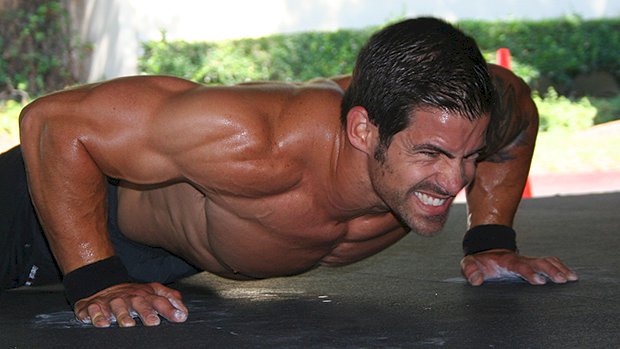 Try something a little different to measure your progress and to test yourself. This challenge will do just that. All you need is a power rack (or Smith machine) and a bench. And, well, maybe a mop. The Challenge This challenge consists of horizontal rows, push-ups, and rear-foot elevated split squats. Set up your space so you can use the bench for all three exercises and go at it. Do one horizontal row, one push-up and one split squat per leg. That’s the first round. Without rest, do another round, only this time you’ll do 2 reps of each (4 for the split squat, 2 each leg). So in round two your reps will be 2-2-2-2, then 3-3-3-3, 4-4-4-4… up to 10 of each exercise as you go up the pyramid. Then make your way back down the pyramid with 9-9-9-9, 8-8-8-8… to one of each at the end. Try to move immediately from one exercise to the next without any rest at all for the duration of the challenge. (Good luck with that.) You may think the challenge is too easy for most of your trip up the pyramid, but at some point after 6 reps, you’ll discover the joy of suffering. Modifications The great thing about the Triple Pyramid is that it’s infinitely adaptable. Each exercise can be modified to make it harder or easier. For the horizontal rows, you can bend your knees to get your feet under you and make it easier. To up the intensity, you can stretch your legs out, place your feet up on the bench and/or add a weight vest. Modify the push-ups with different hand placements (wide vs. narrow; on the floor or on the bench), foot placement (on the floor or elevated on the bench) or with extra load (weight vest). You can make the split squats easier by switching to body weight squats or you can make them harder with added load like kettlebells, dumbbells, or by using the Smith machine. 20 Minutes of Suffering This challenge should take about 20-25 minutes, but it shouldn’t be a race against the clock. Keep your form strict and controlled along the way to maximize time under tension. If it takes you less than 20 minutes with good form, you’ll want to move to a more challenging version of the exercises. Throw the Triple Pyramid in at the end of a regular workout for some extra metabolic conditioning or make it a stand-alone workout during an (almost) off-day, a metcon day, or a
Origin: Tip: The Triple Pyramid Conditioning Challenge
 All about sport xlsport.club