
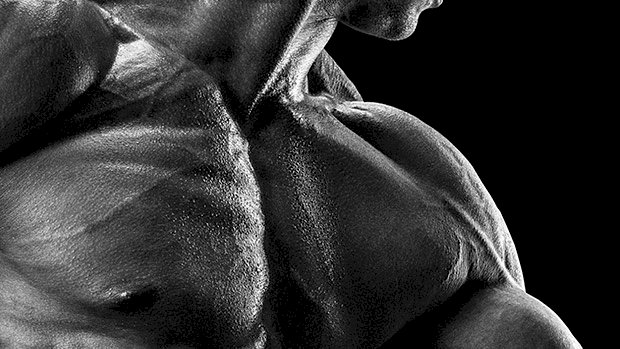
 While many lifters get decent mid and low-pec development, it’s rare to see a truly filled-in upper chest. When it comes to aesthetics, the upper pecs are a game changer. Here are eight things you need to know (and do) to build yours. 1 – Check Your Ego at the Door The biggest reason guys lack upper pec development? They turn chest day into ego day. Flat bench pressing gets all the love because they can use more weight. But if you’re serious about reaching your pec potential, you need to put your ego aside and focus on incline movements – even if you train in a public gym and you currently suck at inclines. Upper pecs are a tricky area. Unless you won the genetic lottery, just emphasizing incline pressing may not be enough. 2 – Hit BOTH Parts of Your Upper Pecs When people think about the upper pecs, they only think about the clavicular portion of the pectoralis major. But there are TWO major portions. The clavicular part originates on your clavicles and run almost parallel to your anterior deltoids. When doing incline presses, many lifters mistakenly use the same grip and style they use for flat bench presses. However, research shows that one great way to emphasize the clavicular portion of your pecs is to use a narrower grip when doing inclines (1). This brings your elbows in and gets your shoulders moving in the direction of your clavicular fibers. Note: Don’t bring your elbows in all the way; this will place stress on the anterior delts. If you use a barbell, use a shoulder-width grip and focus on squeezing your hands together as you press the weight to increase the recruitment of your pecs. You can also do this with dumbbells and your arms at a 45-degree angle: This elbow tuck position is so powerful that you may not even need to use an incline. Research shows that simply doing flat bench press with a reverse grip lights up your clavicular fibers (2). The downside of the reverse-grip bench press? You move your arms into external rotation. While it works, it may not be optimal because the pecs assist in internal rotation. As a result, a better approach is to press with dumbbells (off floor or bench). With dumbbells you get the same elbow position at the bottom as a reverse-grip bench press, but you can internally rotate your arms as you press up for max pec recruitment. The other part of your pecs that’s often forgotten is the upper sternal portion. If you look at the pec anatomy, you’ll see sternal fibers running all the way up to the top of your sternum. If you look at the line of pull of these fibers, you’ll see they’re still pulling your arm across your body. If you only press with your elbows tucked, or a steep incline, you might miss this part. To develop the upper sternal fibers, you need a low incline and a wider elbow position. Note: If you have shoulder problems, or experience pain pressing this way, don’t do it! However, if you want to give it a go, here are some tips that’ll help hammer your pecs while sparing your shoulders: Don’t force the elbow flare – maintain a slight elbow tuck. Remember, you’re on a slight incline. Flat bench pressing with wider elbows is riskier for your shoulders because your shoulders are abducted (out to the side) and internally rotated. This puts you in a position of shoulder impingement. But when you use a slight incline, you externally rotate your arms which moves you out of that shoulder impingement position. Stop when your elbows are in line with your shoulders. This is where most people naturally stop anyway. Also note that the distance between the dumbbells and your shoulders will vary depending on your arm length, so stop looking at the dumbbells and start looking at your elbows. 3 – Find YOUR Optimal Bench Angle If you’re trying to build your upper chest, the angle matters. If your bench angle is too high, your upper pecs will drop out and your anterior delts will take over. What’s your optimal angle? Research shows that a bench angle of about 30-45 degrees may be best for hitting your upper pecs (3). However, before you pull out your protractor, you should know that this study was done with only 14 subjects. That leaves us with the question, “What about individual variation?” If you look carefully at a bunch of different people, you’ll notice significant variance in chest cavities (sunken, flat, barrel, etc.). How can people with different chest structures press on the same bench angle and expect the same muscle activation? The optimal angle for you might be higher or lower than the next bro at your gym. To find your best angle, try this test: Attach a light band to a rack or post at about eye level. Keep the band tension very light. Grab the band and raise your hand overhead. Place your opposite hand on your upper pec of the raised arm. Draw your hand in until it’s at or just past the midline of your body. Slowly lower your hand. Stop the movement when you feel your upper pec light up. Turn to a side mirror and
Origin: 8 Secrets For Building Your Best Upper Chest
Tag: Building
6 Hard Truths About Building Muscle
 There are a few hard and fast rules about building muscle that everybody knows: You need to be in a calorie surplus. You have to train hard. You need to recover from your training. Yeah, yeah, but beyond those three simple truths are plenty of other lesser-known muscle building truths. Here are six of them that you need to know to maximize muscle growth. 1 – Stop searching for the perfect body part split. One of the most common questions people ask is: What’s the best muscle building split? The answer? There isn’t one. Muscle growth comes down to training frequency and volume, so the more often you can train a muscle with higher volume then, theoretically, the more growth you can achieve. So training a muscle group twice a week should provide more growth than once a week. And three times a week should provide even more growth than twice, right? Sounds like a decent idea in theory, but then again so did communism, and we all know how well that’s worked out. When looking at specific training splits, the number of times you can train a muscle in a given week comes down to the volume you’re using, the load you’re lifting, your training history, sleep, recovery, and nutrition. In other words, it’s complicated. Let’s say your workout split calls for training legs on Monday and Thursday. Sounds great, until Thursday comes around and your legs are still so trashed from Monday’s session that you can barely peel your tender glutes off the toilet seat. The ideal training split comes down to how well you can recover. The better you can recover, the more often you can train a muscle group per week. And the more often you can train a muscle, the higher your weekly volume and the more muscle growth you can induce. Recovery comes down to a few different factors. Calories and food quality are important ones. The more energy you take in, the better your body can repair tissues and manage inflammation (up to a certain point). But calories are only one side of the recovery equation. Sleep also plays a huge role in the recovery process. You can eat all the calories you want, but if you’re not sleeping enough, your body can’t effectively utilize those calories to help you recover. The bottom line? Pick a training split you can stick with consistently and train hard. To become self-sufficient, take notes on the process and observe how you feel. As you educate yourself on what’s best for your body, you’ll be better equipped to optimize your workout split going forward. 2 – Get more sleep. No really. Muscles are broken down when you train. They’re built when you sleep. Sleep is the reset button on our body. When we sleep, our bodies increase the production of hormones like testosterone and growth hormone. Testosterone is obviously important for the growth and repair, as well as staying lean, but growth hormone is also extremely important. Growth hormone stimulates the release of IGF-1 or insulin-like growth factor-1. IGF-1 stimulates systemic growth and has an impact on every single cell in the body – muscle cells included. Sleep also has a big impact on two other important hormones: insulin and cortisol. Insulin gets a lot of hate when it comes to body fat storage, but it’s actually an extremely powerful anabolic hormone due to its nutrient partitioning abilities. And nowhere does this play more of an important role than in and around training. The more sensitive you are to insulin, the more receptive your muscle cells are going to be to carb intake. This means harder, more intense training sessions and better recovery, all of which culminates in more muscle growth. But a lack of sleep decreases your sensitivity to insulin, which means a poorer response to carbohydrates, poorer training sessions, and crappy recovery. (1) A lack of sleep also increases the production of cortisol (as a stress response). Not only does cortisol inhibit testosterone production, but it’s also catabolic – it promotes the burning of muscle tissue. Sleep is also the best stress management tool our body has to combat elevated activity of the sympathetic nervous system (which controls the body’s fight, flight, or freeze response). The more this sympathetic nervous system remains elevated (as opposed to being in a parasympathetic state, which is where we should be a majority of the time), the more cortisol it produces, and the more difficult it is to gain muscle. Make sleep a priority and you’ll notice a significant improvement in body composition. 3 – If you’re not growing, you’re not eating enough. Are you eating enough? Well, if you’re not adding weight to the scale, the answer is no. If you’re gaining muscle, scale weight is going to go up. That’s true of almost every situation. And if it’s not, you’re not eating enough, despite what your nutrition tracker is telling you. If you’re hitting the gym hard but not seeing the gains you think you should, follow this: Multiply your bodyweight x 16. This gives you your daily calorie target. Eat
Origin: 6 Hard Truths About Building Muscle
 All about sport xlsport.club