
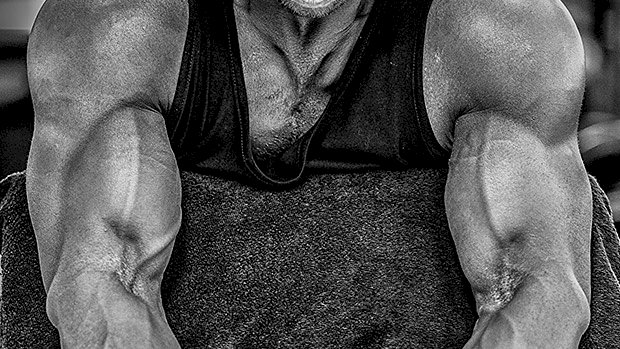
 Reality Check Here’s a question we received recently: “How often do you have to train each week to get 19-inch arms?” Let me offer some hard-earned perspective. I’ve been lifting for a long time. I was always cursed with crappy arms. The late Charles Poliquin used to call me some German term that translated to “Asparagus Tarzan.” Whether he meant I was a half-naked savage raised in the jungle by a tribe of asparagus or that I had arms like spears of asparagus, I’m not sure, but I think it was the latter. Anyhow, I’ve tried every program, every training style, every trick known to bodybuilding, but my arms are still my worst body part. Part of it’s because my arms are long. Want that box of cereal on the high shelf? No problemo. But filling in that long vista of space between my shoulders and elbows with muscle? Sigh. The only thing that ever worked, remotely, was a piece of advice from again, Charles Poliquin. In his experience, he said that you had to gain roughly 15 pounds of bodyweight for every extra inch you added to your arms. True enough, when I went from my usual fighting weight of 215 to 220 pounds to 235 pounds, my “biceps” (more accurately, my arms) grew about an inch. Still, by his reasoning, I would have had to gain another 15 to 25 pounds to get even close to 19 inches. Wasn’t gonna’ happen. Wasn’t the look I wanted, anyhow. And when I went back to my fighting weight, I wasn’t able to sustain the added size for long, which probably means that some of the added arm size was blubber. What I’m trying to say is that the size of your arms is largely genetically determined. I fully realize that right now there are a bunch of genetically gifted guys reading this that are hollering all kinds of synonyms for bullshit, but these guys know nothing about being a hardgainer. They might suggest that someone like me needs to train more, and if that didn’t work, I need to train less. They might say to lift heavier, lift lighter, do drop sets, work them once a week, work them twice a week, eat more, sacrifice a heifer to the biceps god, and so on. Eff ’em. I’ve tried it all. Most of these guys, however, could fold laundry and still grow giant arms. What I’m saying is that if you’re regular folk and want big(ger) biceps, follow the regular rules of bodybuilding: Train the whole body. Get good at the big lifts. Consistently eat more calories than baseline. Do lots of pull-ups and close-bench bench presses. After all that, if it’s in your genetic cards, you’ll get your 19-inch biceps. If not, focus on less stubborn body parts. But if having huge guns means that much to you, there are always steroids, in which case the old “gain 15 pounds rule” goes out the
Origin: Tip: Can Anyone Build 19-Inch Arms?
Tag: Build
Tip: Build Your Back With Bodyweight
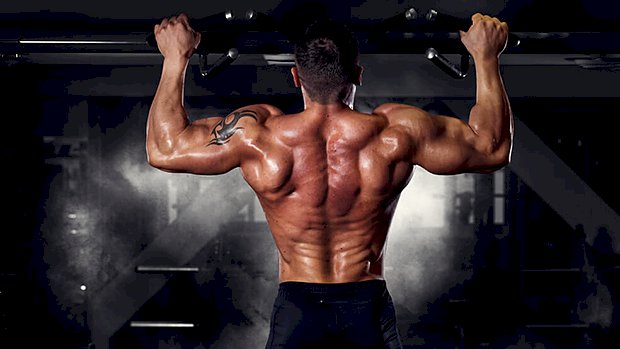 Mechanical drop sets (unlike regular ones where you just reduce the weight as you fatigue) allow you to switch to an easier modification of the movement, usually with the same weight. This helps you to increase metabolic stress and time under tension, both of which will stimulate hypertrophy. If you use this during the main part of the workout, shoot for 3-4 mechanical drop sets. If you use this as a finisher, then one set is more than enough. Do as many standard wide-grip pull-ups as you can. Use a weight vest or hang additional weight from a belt if you can do more than 15. Next, go to volitional failure on eccentric (negative) pull-ups. Jump up to the top position, then lower yourself as slowly as possible. Drop down under a suspension trainer or a bar and perform as many horizontal rows as you can (feet on the ground or elevated, depending on your level of fatigue). The suspension trainer is preferable as it allows your hands to rotate to maintain optimal shoulder position and to better engage the back muscles.
Origin: Tip: Build Your Back With Bodyweight
Tip: Build Muscle With “Death By” Sets
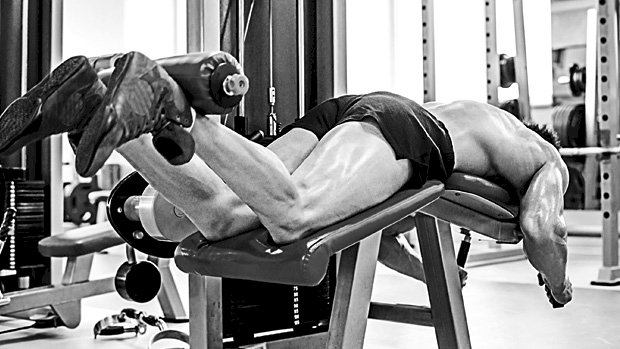 Contractile failure is the main trigger to stimulate muscle growth. That means you go until can’t get another full rep with good form. The key in this variation of rest-pause training is hitting failure at several points in the same set. Basically, one “set” may be two minutes long with little 10-second breaks taken within the set. “Death by” means that you continue until you can’t do any more. Here’s an example. Hamstring Curl, Death-By Rest-Pause Start with a weight you can do for 6-8 reps. The number you get isn’t important, this is just to help you pick the best weight to start with. Go to failure. The last rep should be tough, but you should be able to do the full rep in good form. Don’t try to do half of a ninth rep and then fail. Remember, contractile failure means completing a FULL rep and not being able to do another full rep. Rest for 10 seconds. Using the same weight resume the set and once again go to failure. Continue the pattern: reps to failure, 10 second pause, reps to failure, 10 second pause… until you reach a point where you know you can’t possibly get one more full rep. Continue doing the same process until you can only perform a single complete rep in a mini-set, where you know that getting a second one would be impossible. Since these sets are amazingly powerful but also traumatic on the body, only do one or maybe two sets per exercise. This method is ideal for isolation
Origin: Tip: Build Muscle With “Death By” Sets
Tip: Eat Oatmeal Cookies, Build Muscle
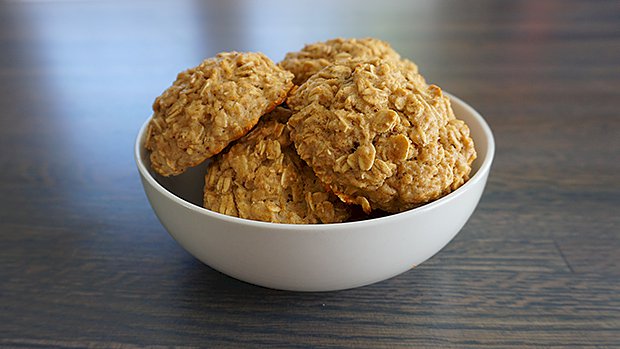 People are strange, especially bodybuilders and gym rats. Tell them to have some oatmeal with protein powder, a handful of nuts, and a little fruit for breakfast and they’ll do it. After all, that’s about the best breakfast you could eat if you like muscle. But tell them to have cookies and they’ll freak out. Like eating cookies for breakfast is bad or something… Okay, I get it. Most cookies are tasty little disks of Type-2 diabetes. But not these. In fact, these contain pretty much the same foods as the above muscle-building breakfast, with the added bonus of being portable. High-Protein Vanilla Oatmeal Cookies Ingredients 2 Cups old-fashioned oats 1 Cup unsweetened apple sauce 1 Soft banana 4 Scoops (120g) vanilla Metabolic Drive® Protein 2 Teaspoons vanilla extract 1/4 Cup Splenda (or equivalent sweetener of choice) 1 Teaspoon baking powder Cinnamon and powdered ginger, as much as you’d like Pinch of salt Optional: 1 Cup walnut halves Directions Preheat oven to 325 degrees. Line a baking sheet with parchment paper for easy cleanup. Mix all the ingredients together in a bowl. Using a cookie scooper, medium ice cream scoop, or a spoon, place 8-12 mounds of dough onto the sheet pan. Bake for around 20 minutes, depending on your oven, elevation, and size of your cookies. Larger cookies will require an extra minute or so, smaller cookies a minute or two less.
Origin: Tip: Eat Oatmeal Cookies, Build Muscle
Tip: Build Pecs with the Hex Press
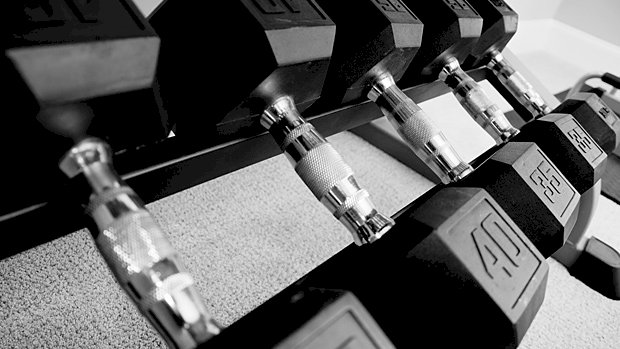 Pain-Free Pressing Lifters suffer from a lot of anteriorly directed shoulder pain. It happens when the head of the humerus is pushed too far forward in the glenoid fossa. It feels awful. This position is exacerbated at terminal horizontal abduction, elevation, and external rotation, which are all components of traditional bench press variations. But this can be avoided by using a squeeze press, even when you’re managing some nagging shoulder pain. The Hex or Squeeze Press Use dumbbells and squeeze them together as hard as you can throughout the concentric (lifting) and eccentric (lowering) portions of the lift. You’ll get a legit training effect without flaring up your shoulders. By forcing your shoulders and deep humeral and scapular stabilizers to initiate tension into internal rotation and depression, the head of the humerus will translate more posteriorly and will be more centrated in the shoulder socket. This positioning allows you to use internal tension and torque production through the shoulders and still train
Origin: Tip: Build Pecs with the Hex Press
 All about sport xlsport.club