
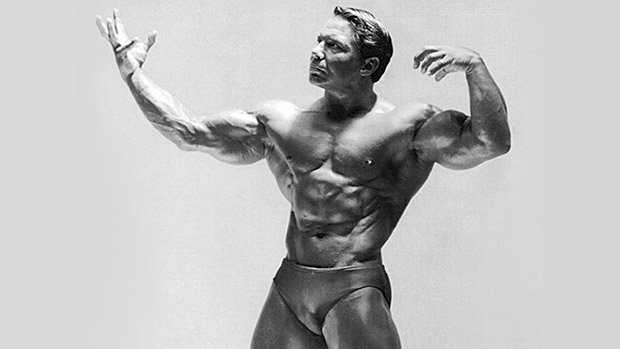
 Who Is Bill Pearl? You may not know who Bill Pearl is, or realize his impact on the whole industry. I like to explain it this way: Bill Pearl was Arnold, before there was Arnold. Bill Pearl was bodybuilding’s first true crossover superstar. And his early books should be considered required reading even today, especially “Keys to the Inner Universe.” I met Bill in the summer of 1989 while I was working at the prestigious Muscle Camp in Los Angeles. My job was to open up the one-of-a-kind gym every morning. I’d get there at 4:30 AM and I can still remember how it took the floodlights about 15 minutes to fully kick on. Half the time I’d be warming up in darkness. I pretty much had the place to myself… until Bill Pearl started coming in right about the same time. When I introduced myself, he shook my hand and said, “It’s been a pleasure watching you work out.” That was something that stood out about Bill Pearl. Even with the enormity of the shadow he cast, he always made you feel like YOU were the most important person in every conversation. I told Bill that if he had any advice for me I’d love to hear it. Luckily, he had plenty. He imparted the following lessons to me over 30 years ago, but they’re lessons you can and should put to use today. 1 – Stop training like you have something to prove.Instead, train like you have something to accomplish. The next morning Bill pulled me aside and asked me, “Scott, what are you trying to accomplish in your workout?” To this day I remember not being able to give Bill a reasonable answer beyond some sheepish, kindergarten-level reference to what body part I was training. He told me I looked like I was working out like I had something to prove, but each workout should instead be about accomplishing something specific, beyond numbers and beyond efforts expended. He was right. I did train like I had something to prove. Since I wasn’t as strong as other bodybuilders of my size and caliber, I always aimed to out-train them. It was something Bill spotted right away. Rather than working out to build my pecs, for example, I acted like I was working to increase my max bench. It was a lot like the guys you see in the gym every week who start with bench press with the same weight, same reps, and same bad form – one guy holding the bar pretty much doing upright rows while the bencher does a hip bridge with every rep. And all their follow-up exercises are chest exercises. Ask them what the hell they’re trying to accomplish and they can’t tell you. And we’ve all seen the guy with pipe cleaners for legs load up the leg press with 10 plates per side and move the sled an inch or two. That’s training with something to prove (exactly what, I’m not sure) instead of wanting to accomplish a specific goal. I can’t tell you how many career-ending torn biceps, torn pecs, torn ACL’s, blown quad tendons, and herniated discs I’ve seen, all because lifters were training with something to prove rather than training with something to accomplish. It might have been because of training partners encouraging them to get more reps, even though their form was breaking down; or lifters adding more weight to the bench or squat or other risky exercises just to keep up with a training partner or a bad personal trainer’s expectations. All of that stuff led to bad outcomes. Training with something to accomplish instead of training with something to prove puts you in a much more mature headspace. Start by thinking about your workout and what you aim to accomplish within it, beyond a numbers game. Leave your ego at the door. 2 – Learn by doing, but also by observing. At that time, the Mr. Olympia contest was right around the corner and top pros were coming into Muscle Camp to work out. One morning Bill asked me to meet him at the gym when it was the busiest. Puzzled, I agreed. I met Bill and the gym was packed with people and some top pros, including the reigning Mr. Olympia, Lee Haney. I remember wondering what kind of workout Bill was going to put me through, but when I got there he told me that we were just going to watch – watch everyone – from the regular gym goers to the top-tier pros and amateurs. At first, this was a disappointment, but I gradually saw his intent. Bill would point out someone training and ask me to explain what I saw. At one end of the gym was a top wannabe Olympia competitor bench pressing with a training partner. He was struggling, like really struggling, to get up a couple of reps of 305 pounds. His form was horrible and his training partner helped him eke out a couple of forced reps. This already had me shaking my head because just a couple months earlier, one of the top magazines had shown this same guy benching four plates per side – obviously some fake weights were involved there. In another corner of the gym, Lee Haney was training back and shoulders, and I’ll never forget the image. I hadn’t really ever seen anything quite like that before. With Haney, there seemed
Origin: 3 Lessons From Bodybuilding Legend Bill Pearl
Tag: Bodybuilding
Tip: Keto and Bodybuilding Don’t Mix
 I’ve often written about how hard it is to really be in ketosis. It’s not a problem if you’re an epileptic in a hospital being fed a controlled diet by a team of white-gowned specialists who weigh all your food, along with all your doodie. But if you’re a regular Joe who isn’t in total command of his food chain – who doesn’t live on a farm and grow all his own food and make all his high fat, unsweetened, almond flour peach cobbler with no peaches – you’re liable to slip up sooner or later. All it takes is eating an apple that’s too big, a spoonful of hidden sugar in a sauce, or a morsel of matzo in a meat loaf. Beyond all that is a problem that’s probably unique to lifters: They eat an f-ton of protein. Every day. People who are truly in ketosis need to get 80 to 90 percent of their calories from fat, and that doesn’t leave much space for protein, which is the lifeblood of a lifter. Hell, lifters argue all the time about whether they need to eat one entire cow or two every day to best grow muscle, and most keto people, if you threaten to force-feed them a sugary churro, will admit that eating a lot of protein – more than, say, 20 percent of total calories – will take you out of ketosis. Twenty percent might be generous, though. Even if a generic keto-er could get away with eating a diet of 20% protein, eating such a relatively small amount of protein every day would cause the muscles of most bodybuilders and lifters to start to shrink. No One Guidelinend easily enough to Works for Everybody If you don’t give your body sugar, the body will break down protein to get it, and that protein will come mostly from muscle. Ketosis itself is your body’s way of trying to preserve that protein and ipso facto, your muscles. But take in a sufficient amount of carbs or protein and the body takes a pass on all that keto silliness and goes back to using sugar as its energy source. The trouble is, there’s no one guideline that works for everyone. One person might get knocked out of ketosis for having a diet that’s 20% protein, and another person might get booted out for eating a lot less. Lately, though, people who worship at the keto altar are low-carb waffling on this protein speed limit. They’re saying that worries about gluconeogenesis – the process by which amino acids are converted to sugar – are overblown and that it doesn’t really happen when keto dieters eat high-ish amounts of protein, at least not to the point where it knocks you out of keto. Others argue about the actual biochemistry of the phenomenon, saying that gluconeogenesis is a non-factor, and if protein does take you out of ketosis, it’s because the excess protein is donating oxaloacetate to acetyl-CoA in the Krebs cycle… but that’s getting pretty deep in the biochemical weeds. What matters is whether the amount of protein a bodybuilder or lifter needs to grow muscle – or even maintain it – is enough to take you out of ketosis, and I think it is, as do a lot of other biohackers, nutritionists, and keto autodidacts. But those who have financial interests in promoting a ketogenic diet disagree. Studies Aimed at Diabetics Don’t Fly Some of the keto revisionists point to studies (mostly published in diabetes journals) that showed gluconeogenesis does occur after a high protein meal, but under very unusual circumstances. Even so, they maintain the amount of sugar produced amounted to just a duck snort; not enough to knock a flour beetle out of ketosis. Granted, those studies do show that dietary proteins contribute very little to glucose production, but the test subjects weren’t in ketosis in the first place. Generally, the subjects were run-of-the-mill diabetics, or healthy people who’d just fasted overnight and were then given a high protein, zero-carb meal. Sure, gluconeogenesis occurred, but as keto apologizers claim, only to a minor degree. Fasting overnight, though, is hardly enough to deplete anyone of their glycogen reserves, so it’s not surprising that a significant amount of gluconeogenesis didn’t occur in these test subjects. Keto protein-deniers need to look at studies like the one performed by Veldhorst, et al where subjects were truly depleted of carbs – fed a low-carb diet (0% carbs, 30% protein, and 70% fat) and depleted of glycogen reserves through exercise. They found that the low-carb, high-protein diet led to an increase in energy expenditure, 42% of which was explained by an increase in gluconeogenesis. That’s significant, and ealy enough to knock anyone out of ketosis. If lifters or bodybuilders want to lose fat, they’d best do it the old-fashioned way: reduce caloric intake while eating modest amounts of functional carbs and fat and striving for protein intake of between 30 and 40% of total
Origin: Tip: Keto and Bodybuilding Don’t Mix
4 Horrible Truths About Pro Bodybuilding
 Here’s what you need to know… Chasing a pro card turns you into an asshole. If you have a girlfriend or spouse, you’ll probably end up cheating on her. Contest prep makes you hurt everybody you love. The drugs, brutal dieting, hard training, and contest prep will make you hate the world and the world hate you. Trying to become a pro will likely leave you broke. Even if you do win a show or two, the prize money won’t come close to covering your expenses. Becoming a pro will likely wreck your health and cause you to die young. The amount of muscle mass you need to acquire, the drugs, and the yo-yo dieting will ruin your health. There are good things about pro bodybuilding, too. You’ll meet great people, learn a lot about your body and mind, and have the potential to become a more determined, passionate, intense, human being. Drinking Crankcase Oil By most definitions, I’ve been a success in my chosen field. I’ve built a career in bodybuilding over the course of 20 years. I’ve won Israel’s national bodybuilding title 5 times. I earned my pro card and had a respectable showing in the Mr. Olympia. Perhaps more importantly, I’ve coached hundreds of athletes. But looking back on it, I can see that there are things I sacrificed that weren’t worth sacrificing. So when I walk into a commercial gym and see a motivated young kid who’ll do anything and everything to get a pro card, my instinct is to sit him down and have a conversation about his goals and dreams. I want to make damn sure he understands what he’s getting himself into. He needs to realize his chances of actually becoming a professional bodybuilder are stacked against him and the path is often ugly and soul draining. The late Steve Michalik once said he’d drink crankcase oil to get further in the sport, and that was for the Mr. America contest, an amateur competition. I would ask this motivated young kid if he’s willing to “drink crankcase oil” to get where he wants to go, because that would be the easy part of the journey. I’d then make sure he understood the following points: 1 – Bodybuilding is a very selfish and mentally destructive sport. To do well, you need to become a self-centered asshole. It’s the nature of this sport and it’s not a matter of “if” it will affect you, but by how much. Some individuals are more affected than others, but the use of certain “supplements” for an extended period of time will cause profound psychological effects, including changes in personality. You’ll experience increased aggression and anger. It may be over something as inconsequential as someone talking too loud or looking at you the wrong way. The most trivial incident might become goddamn HUGE AND ANNOYING. You’ll have no patience, a short temper, and will feel sluggish during most of your day. Simple things will become huge chores. Increased libido will plague you. If you have a girlfriend or spouse, you’ll probably end up cheating on her. If you have any underlying, previously dormant mental issue like OCD or an eating disorder, these “supplements” will make it rear its ugly head and increase exponentially in power. Depression, anxiety, and shortness of breath will all become part of your daily life. And rest assured, if you’re planning on becoming a pro bodybuilder, you’re going to need and use a lot of these volatile drugs (there, I said it). It’s just another thing that needs to be done in order to compete at the highest levels (the same as every other professional sport, for that matter). But when you combine all this with an obsession with your body fat and how much you weigh, with looking at yourself in the mirror multiple times a day, and, in general, living a life where every action from eating, to breathing, to sleeping is about improving your outside appearance, selfishness and self-centeredness are inevitable. It’ll affect your personality, and at the end of the day when you leave the gym and the competition is over, these changes don’t disappear and you’ll still need to deal with life outside of bodybuilding. 2 – You will hurt the people you love and you may end up alone. To this day, after more than twenty years in the industry, I still haven’t met a bodybuilder who’s prepared for a show without seriously affecting his or her marriage. When you diet, you become cranky, tired, and moody. You hate the world. When you diet, the first person you lash out at is typically your spouse – the person who generally provides you with the most support. Ironic, isn’t it? I’ve seen couples break up, separate, and even get divorced after lousy show preps. The higher the level, the more drugs involved, the more severe the drama. And don’t think you’ll treat your friends or family any better, either. The drugs, combined with the brutal diet, the hard training, the cardio, and the final pre-contest week with its dehydration and carb load/depletion will take any bad situation and exponentially increase it. Anyone who thinks this won’t happen to them is
Origin: 4 Horrible Truths About Pro Bodybuilding
 All about sport xlsport.club