
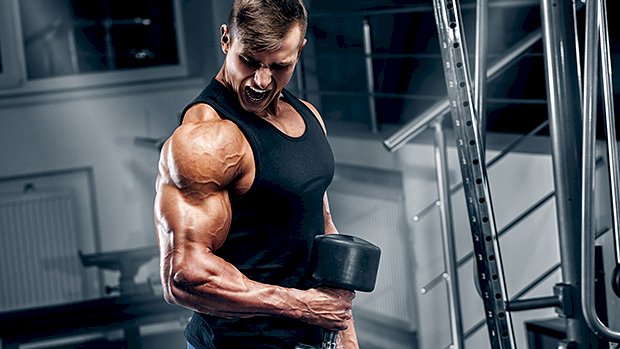
 The best way to encourage your muscles to get bigger and stronger is through application of kaizen, which is Japanese for “continuous improvement.” You apply this principle by trying to increase the weight or number of reps at every opportunity, no matter how small the increase might be. While this principle definitely works, your progress will likely stall at a point. To bust through the plateau, you’ll need to change the stimulus in some way. That usually means switching the exercise, the angle, the resistance profile, or the technique. With that in mind, here are ten plateau–busting biceps exercises for when the basics stop working. 1 – Kneeling Landmine Reverse Curl Don’t knock this setup until you’ve tried it. It can be a useful way to train your biceps in their weakest position, along with being a real plateau buster. From a tall-kneeling position, grip the bar from a point directly in front of your junk, down the midline of your body. Keep your elbow tucked and wrist neutral as you curl. Your fist should travel slightly outside the line of your shoulder, allowing you to feel an intense biceps and forearm contraction at the top. Try to crush your forearm against your biceps. If a full length Olympic bar is too heavy, start with a 5-foot Olympic bar or shorter EZ-curl bar. The palms-down (pronated) grip emphasizes the brachialis and coracobrachialis portion of the upper arm. The fat grip of the bar benefits the movement too, requiring your forearms to do a lot more work. 2 – Hammer Curl 6/6/12s You’ll be doing a mechanical drop-set, transitioning from a seated hammer curl to a standing hammer curl, and then finishing with a higher-rep pump. There’s not much to dislike about this one. A1. Seated Hammer Curl, 6-8 reps (no rest) A2. Standing Hammer Curl, 6-8 reps (same weight, no rest) A3. Band Hammer Curl, 12-20 reps These also work well with an underhand grip. 3 – Rack Landmine Reverse Curl This one’s like the kneeling landmine reverse curl, but you set yourself up in a rack using the pins. I first remember seeing this being performed by John Meadows and it’s since become a personal favorite. When you compare it to the landmine setup described earlier, this version has a slightly different feel to it, though the benefits are the same. Try both and play around with angles and body position until you find the version that aligns your shoulders, elbows, and wrists the best. And yes, this does technically count as using the squat rack to curl, albeit you’re actually outside of it so you get a pass! 4 – One-Arm Supported Hercules Curl A Hercules curl typically has you set up between cables set to a high position and performing a curl that somewhat resembles a front double biceps pose. It’s a good one for training the long-head of the biceps in their shortened position. Enter the one-arm supported version where we use a bench for additional stability and support for the elbow and shoulder. The angle of the cable is key. The cable load is greatest when the angle of the cable is roughly 90 degrees to the forearm (due to leverage factors), so play with the cable height and bench angle to help you get the best feel. 5 – Back–Facing Preacher Hammer Curl Sit backwards on the preacher bench and keep your upper arms fixed against the pad. This eliminates cheating and keeps your humerus directly perpendicular to the floor, allowing you to really isolate the tension. You can also do this movement by sitting backwards in a lat pulldown machine, where you can adjust the height of the knee pads to fit the height of your upper arms. The surprising thing is how comfortable these two setups are! 6 – Dumbbell Curl Triple-Threat Triple-threat protocols add volume to your workouts, increase training variety, and give you insane pumps. Here’s one that Christian Thibaudeau has shared before. Each position has a purpose and applies load to the biceps at a different point. This is typically done with dumbbells, but works great with an EZ-bar too. Try 5–7 reps in each position: A1. Leaning Back Biceps Curl:The point of maximal loading (PML) is in the bottom portion of the curl. Same weight, no rest. A2. Standing Upright Biceps Curl:The PML is around the middle of the curl. Same weight, no rest. A3. Leaning Forward Biceps curl:The PML is closer to the top of the curl. Put them all together and you’ve got one killer biceps movement. 7 – Kettlebell Pistol Hammer Curl While some common biceps exercises fall short in maintaining tension throughout the movement, kettlebell curls are an exception. They also help to emphasize an elongated eccentric contraction, which causes lots of micro–trauma that’s essential for muscle growth. As a result of the high tension, kettlebells also produce an occlusion–type effect, whereupon the restricted blood flow acts as another kind of hypertrophy stimulus. This move specifically targets the brachialis and brachioradialis in the top portion of the movement.
Origin: 10 Game-Changer Biceps Exercises
Tag: Biceps
Tip: The 6-12-25 Protocol for Biceps
 Back in 2005, Charles Poliquin popularized something called “lactic acid training” with his German Body Composition programs. The basic idea was to train in a way that produced lactate, which in turn increased growth hormone to boost fat loss and protect muscle mass. The more advanced rep scheme involved doing 6, 12, and 25 reps with short rest periods between exercises. Yeah, it burned. Lactate is commonly associated with that local burning sensation in the muscles, but “lactate burn” is a misnomer. In reality, lactate actually consumes those H+ ions associated with the burn. All that aside, we can use some of the same set and rep scheme in German Body Composition to attack a weak or underdeveloped muscle group. Try this for lagging biceps: A. Neutral-Grip Pull-Up x 6 B. T-Bar Row (Pronated Grip) x 12 C. Dumbbell Hammer Curl x 25 Important: Take no rest periods between movements! Your “rest” is just the amount of time it takes to move between exercises. After the hammer curls, rest two to three minutes and repeat this giant set three to four more times. Can I Do It With Other Body Parts? Yep, just follow these guidelines for exercise selection: 1st Exercise:Multi-Joint Movement, 6 reps 2nd Exercise:Multi-Joint Movement, 12 reps 3rd Exercise:Single-Joint Movement, 25
Origin: Tip: The 6-12-25 Protocol for Biceps
Tip: Bulletproof Your Biceps
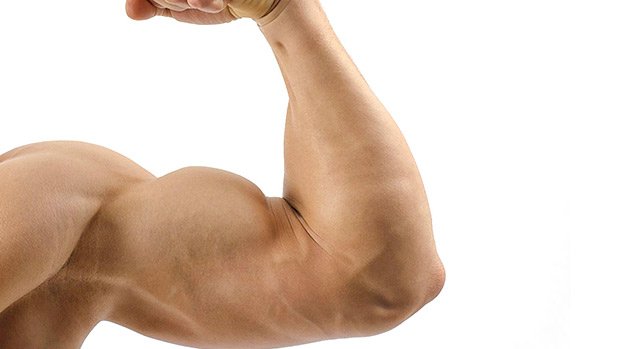 Biceps tears are common in powerlifting. Using an alternate grip when deadlifting? That underhand arm is at risk. Tears are even more common in strongman. Tire flips and stone lifting are the usual culprits. Happens in bodybuilding too. And if you’re a fan of ring dips or muscle-ups, then you too are at risk. Tears happen when the biceps are loaded and then suddenly lengthened. In a deadlift, they generally happen if the arm isn’t 100-percent straight at the start but then straightens during the pull. In strongman, tears occur when a stone or tire slips. As the object drops, the athlete tries to stop it, rapidly loading the biceps as they lengthen. To some extent, it’s a problem you can’t always prevent, but you can definitely lower your risk. Lessons From the Biceps Femoris Soccer players have hamstring tear problems. A huge amount of money and time has gone into trying to prevent them. What people have found is that the risk factor involves the way the hamstring is loaded (and overloaded) as it lengthens – the same mechanism of injury as biceps tears in strength sports! Research has also found that strengthening the hamstrings as they lengthen helps reduce the injury risk. The most famously researched exercise has been the Nordic curl. How can we use this for our biceps? We use a Nordic curl for biceps, otherwise known as the biceps glide. This exercise loads the biceps as they lengthen. The Biceps Glide Loading and conditioning the biceps this way will, over time, reduce the risk of tearing when mixed-grip deadlifting, stone or tire lifting, and in life in general. Notes When you first do this exercise, you’re fatiguing the biceps through the risky range of movement and loading pattern. Initially, you might slightly increase risk. So go gently at first, progress carefully, and for 72 hours stay away from other movements that may also put your biceps at risk. As you improve at this exercise, you could use them as a warm-up to activate the biceps before a high-risk movement. This needs to be done lightly and for low volume without fatiguing the biceps. Once you’re proficient with glides, you can load them up heavier to condition the biceps, but in sessions 72 hours away from full-body, high-risk movements like deadlifts and strongman events. The movement itself will always have a risk. It has to in order to have a positive conditioning effect. It’s very low and controlled risk relative to the movements where biceps tend to pop, but you should still treat it with respect. Ease into it and be progressive.
Origin: Tip: Bulletproof Your Biceps
Tip: The Surefire Way to Build Biceps
 To build your biceps, like any muscle, you’ll need to work them through their full contractile range. This means doing a variety of exercises that’ll overload them in all positions: shortened, lengthened, and mid-range. Incline dumbbell bicep curls are what most people use for the lengthened position, which makes sense at first. Only problem is, they don’t overload the lengthened position. At the bottom, the biceps are stretched but there’s no lever arm. As you curl, the lever extends further away from the body increasing the amount of mechanical work being done by the biceps. So, while you may fully lengthen the biceps into a loaded stretch, you haven’t overloaded this portion of the range. The mid-range is where most of the work is being done. The Solution: Low-Cable Curls The line of pull from the low cable means that the biceps are working hard out of the starting (lengthened) position. The resistance profile of the lift also does a good job of mimicking that of the muscle throughout the entire range. At the bottom, the lengthened position is challenged. As you curl up into the mid-range (your strongest position), the lever lengthens slightly, then at the top (weaker position) the lever drops off a little. This makes the exercise extremely effective throughout the entire range because it places optimal levels of tension at each point on the strength curve. Nothing Is Perfect The one drawback of this exercise (compared to the incline dumbbell curl) is a lack of stability. Sometimes when people first try the low-cable curl, they struggle to keep their shoulders stable. This causes them to start swinging their shoulders or shrugging up, which creates momentum and takes tension off the biceps. Try to “lock the shoulders down” to focus all of your attention on the biceps. With incline dumbbell curls, you have a bench to drive into and provide artificial stability throughout the shoulders. This makes it easier to focus on only working the biceps. So I often teach people the incline dumbbell curl first to build a habit of putting the biceps in a lengthened position while also programming some scapular stability work. Then they progress to the low-cable curls for enhanced biceps growth once they can control the
Origin: Tip: The Surefire Way to Build Biceps
Tip: How to Fix All Your Biceps Problems
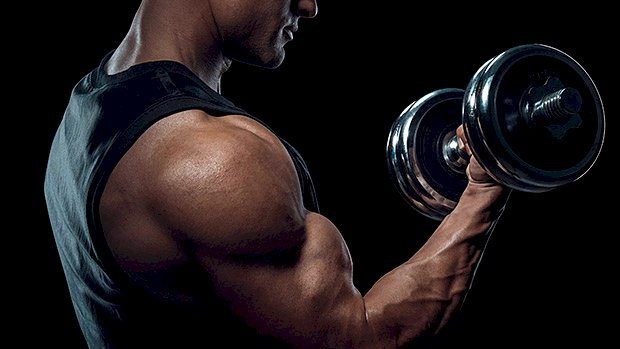 Most guys struggle to build their biceps. This is usually because… They have crappy form. They lack stability. They’re ignoring one of the functions of the biceps. Swinging the weights, leaning back, doing half-reps, and letting the shoulders take over are all common issues. Training like this might boost your ego, but it won’t build your biceps. How To Fix Those Problems The best solution is to create a stable base by strengthening your lower and mid-traps, rear delts, and rotator cuffs so that you’re placing tension on the biceps and making them work to overcome the weight. Want a more immediate fix? Artificially create a position of stability during your curls. Take a look: You can see that I’m getting support from the leg pads of a lat pulldown machine. This will allow you to drive your triceps back into the pad and create a very stable platform to train the biceps. It also makes it harder to cheat your reps. Another problem solved. This all adds up to more tension going where you want it – the biceps. More tension equals more growth. Why the Offset Grip? You already know the biceps bend the elbow. But they also supinate the wrist. Taking an offset grip will cause the weight to shift to one side. Place the thumb-side of your hand up against the end plate of the dumbbell. This means if the dumbbell is pulling you into pronation, your supinators (including the biceps) have to work hard to keep the dumbbell level. You end up working both elbow flexion and supination. This increases the activation of the biceps during each rep. By making these small tweaks, every rep will stimulate the biceps more than the regular, sloppy curls you see in gyms all over the world. Work to develop strength in this exercise and your biceps will grow way more than they were when you were “curling” the 60s. Oh, and if you ever progress to using the 60s for reps on offset supported curls, your arms will be
Origin: Tip: How to Fix All Your Biceps Problems
Tip: Elbows Inflamed? Build Biceps Anyway
 There’s nothing worse for a lifter than dealing with joint inflammation like elbow tendonitis. When the orthopedist tells you the only way to remedy that pain when flexing or extending your arm is rest and recovery, it conjures up images of church lady arms that swing to and fro during heavy clapping. It can take six months or more for tendonitis to go away. Are you really going to stop training your arms for that long? Probably not. The good news is that you don’t have to. You have one more card to play before downsizing your T-shirts to fit your shrinking arms. That card is blood flow restriction (BFR). BFR Brad Schoenfeld covered blood flow restriction (BFR) here and its benefits have been well documented in the research community. Just recently, a meta-analysis was published (Lixandro, 2018) pitting traditional heavy-load training against low-load BFR training to see which was more efficient at growing muscle and strength. Using almost 50 studies, it was determined that low-load BFR was just as effective in terms of hypertrophy as traditional heavy strength training. Sure, strength suffers a great deal in the absence of lifting heavy shit, but at least the sleeves will still hug the arms nice and tight. Here’s How to Do It Place the restriction (wraps or cuffs) directly between the medial deltoid and bicep. Wrap your arms with a perceived tightness of 7/10. This will provide enough pressure to occlude the cephalic vein, but ensure you’re still allowing arterial flow. Check for a distal radial pulse (at the wrist) after you’re wrapped to make sure it’s not too tight. Don’t do the exercise if you can’t find your pulse. Wrap Up and Lift Pain-Free BFR mimics the intensity of lifting heavy without actually lifting anything heavy. The light loads (20-30% of 1 RM) used for standard BFR training will typically allow a lifter to get away with doing movements they otherwise couldn’t do with an inflamed elbow. Additionally, the pooling of blood during a series of BFR curls or extensions creates a cushion of sorts for the elbow that minimizes pain even further. Programming Use BFR up to 2-3 times per week for best results. Try it wherever arm work is programmed in your current protocol and see if you can do it without pain. You probably can. The most heavily researched set/rep scheme is 30-15-15-15. It’s considered the gold standard by practitioners. It looks like this: Set 1:30 reps Set 2:15 reps Set 3:15 reps Set 4:15 reps Take only 30 seconds rest between each set. Unwrap after set 4.
Origin: Tip: Elbows Inflamed? Build Biceps Anyway
Tip: Slow Cook Your Biceps for Growth
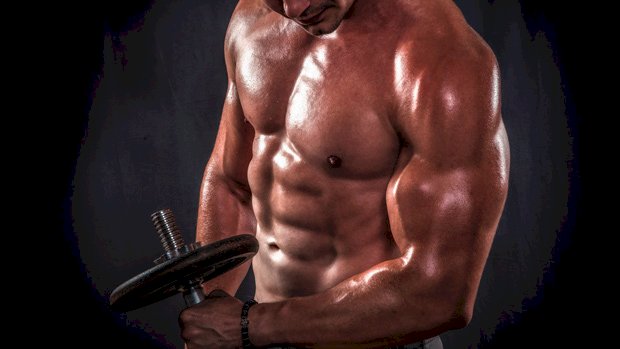 Biceps Rotisseries Let’s “slow cook” your biceps, as well as the brachioradialis, via a lot of rotation and change in hand position. The Protocol Dumbbell Reverse Curl:6-8 reps with an estimated 12-rep max weight Dumbbell Hammer Curl:6-8 reps (same weight) Dumbbell Curl:6-8 reps (same weight) Dumbbell Cheat Curl:6-8 reps (same weight) 90-Degree Alternating Pronation/Supination:6-8 reps (after last cheat rep) 90-Degree Isometric Hold:Hold for as long as possible (after last supination and pronation) You’ll use the same weight throughout and there’s no rest between the variations. Rest 90-120 seconds and repeat. You’ll likely have to drop down a set of dumbbells to do a second series. (You’ll only need two “sets” of this at the end of your workout.) Leave your ego at the door for this one. This protocol is straight-up metabolic stress, skin-splitting pump work! If you need to use 15-20 pound dumbbells, then so be it. Now isn’t the time to try and impress the Gym Shark girl next to you with huge weights. Weight Selection is Key on the First Exercise You want to have several reps in reserve. If you go too heavy on the reverse curl and get too close to failure, you won’t last and won’t hit the rep targets on the movements that follow. Trust me, by the third or fourth movement, it’ll get plenty hard. Note on the Cheat Curl You want to hip hinge just a little and “pop” up powerfully. Pause the contraction and then do a very slow and focused
Origin: Tip: Slow Cook Your Biceps for Growth
Tip: Nail Both Heads of the Biceps With This
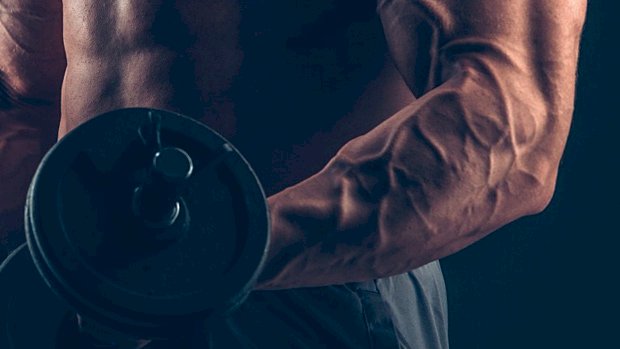 Rise Ups This is a very effective mechanical advantage drop set. You’ll start face down but spin around on the subsequent set, finally ending up standing, hitting both the long and short heads of the biceps hard in the process. Dumbbell Spider Curl:8-12 reps (to failure) Incline Dumbbell Curl:Max reps (same weight, same incline) Strict Standing Dumbbell Curl:Max reps (same weight) Standing Cheat Dumbbell Curl:Max reps (same weight) 90-Degree Isometric Hold:Max time (after last cheat rep) Do the first variation using a weight you can lift for 8-12 reps. Then go for maximum reps on the exercise variations that follow. Do this as a finisher for one or two sets after your heavier biceps
Origin: Tip: Nail Both Heads of the Biceps With This
Pump and Grunt – New Biceps Finishers
 When it comes to biceps training, we all love our 21’s, our drop sets, running the rack, and various other schemes that add metabolic stress or act as time-efficient finishers. They can get stale, though, so let’s breathe a little life into your workouts with these intelligent and basic (yet not boring) biceps protocols. 1 – Biceps Rotisseries Let’s “slow cook” your biceps, as well as the brachioradialis, via a lot of rotation and change in hand position. The protocol: Dumbbell Reverse Curl:6-8 reps with an estimated 12-rep max weight Dumbbell Hammer Curl:6-8 reps (same weight) Dumbbell Curl:6-8 reps (same weight) Dumbbell Cheat Curl:6-8 reps (same weight) 90-Degree Alternating Pronation/Supination:6-8 reps (after last cheat rep) 90-Degree Isometric Hold:Hold for as long as possible (after last supination and pronation) You’ll use the same weight throughout and there’s no rest between the variations. Rest 90-120 seconds and repeat. You’ll likely have to drop down a set of ‘bells to do a second series. You’ll need to leave your ego at the door. This protocol is straight-up metabolic stress, skin-splitting pump work! If you need to use 15-20 pound dumbbells, then so be it. Now isn’t the time to try and impress the Gym Shark girl next to you with huge weights. The weight selection on that first exercise is key. You want to have several reps in reserve. If you go too heavy on the reverse curl and get too close to failure, you won’t last and won’t hit the rep targets on the movements that follow. Trust me, by the third or fourth movement, it’ll get plenty hard. A quick note on the cheat curl – you want to hip hinge just a little and “pop” up powerfully. Pause the contraction and then do a very slow and focused negative. 2 – EZ Does Its This is a straightforward mechanical advantage drop set. We start with the theoretical weakest exercise and then manipulate leverage and strength curve to pour on more volume and extend the set. The protocol: Bent Over EZ-Bar Spider(ish) Curl:8-12 reps (to failure) Strict EZ-Bar Curl with Shoulder Flexion:Max reps (same weight) Strict EZ-Bar Curl:Max reps (same weight) Cheat EZ-Bar Curl:Max reps (same weight) Do the first variation using weight you can lift for 8-12 reps. From there out, go for maximum reps, always using the same weight. Rest 90-120 seconds and repeat. You’ll likely need to reduce the weight a bit to do a second round. Again, this is metabolic stress work – you won’t need a lot of load and you should only do 2 sets, tops. Apply the same guidelines on the cheat curl as laid out above: a little hip hinge and pop up forcefully. Pause the contraction and use a very controlled negative. Here’s an alternative version: This one uses an EZ-bar cable attachment and a low pulley. 3 – Rise Ups This is another straightforward and effective mechanical advantage drop set. With this one, you’ll start face down but spin around on the subsequent set, finally ending up standing, hitting both the long and short heads of the biceps hard in the process: Dumbbell Spider Curl:8-12 reps (to failure) Incline Dumbbell Curl:Max reps (same weight, same incline) Strict Standing Dumbbell Curl:Max reps (same weight) Standing Cheat Dumbbell Curl:Max reps (same weight) 90-Degree Isometric Hold:Max time (after last cheat rep) Do the first variation using a weight you can lift for 8-12 reps. Then go for maximum reps on the exercise variations that follow. The same guidelines apply here in terms of rest periods, sets, and load reduction. How and Where to Use These Regardless of your training split, use these biceps variations mid to late workout – after your heavier, straight-set progressive overload work. There are no hard and fast rules here. Remember, this is metabolic stress and muscle damage work. These aren’t protocols where you’re chasing weight or personal records. It’s all about tension, volume, and mind-muscle connection. Go after mechanical tension, maximizing load, and progression earlier in the workout using other exercises. These are not entrees; they’re side dishes. In Defense of Finishers You can certainly thrive by hammering basic stuff over and over for years, but isn’t training supposed to be fun? And who doesn’t like to pump up their arms? The protocols presented here are a way to make your training “flexibly structured,” quench your bro thirst, and implement some smart variety. There’s nothing wrong with leaving the gym with a pump and a smile and chomping at the bit to come back for
Origin: Pump and Grunt – New Biceps Finishers
Tip: Do Fixation-Insertion Super Sets for Biceps
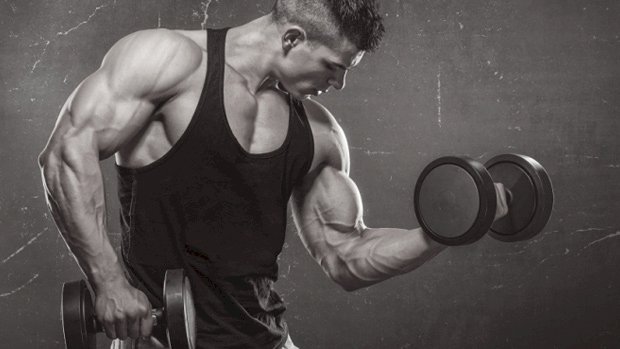 In kinesiology, the origin of a muscle is what is fixated and the insertion is what moves. If you can superset movements that combine these two opposite functions, you stimulate muscle fibers at both ends and you get super compensation. Here’s a nasty super set for biceps: Do 4-6 reps of close-grip chin ups. Rest 8-10 seconds. Then do 8-10 reps of incline dumbbell curls. See photo below. Do five sets, resting approximately 2 minutes between sets. Here’s What’s Happening When you’re doing the chin-up, the origin is at the elbow and the insertion is at the shoulder. Then, when you do the incline dumbbell curls, it’s the opposite: the origin is at the shoulder and the insertion is at the elbow. Mechanically, you’re doing two extremes, and inducing fiber damage beyond
Origin: Tip: Do Fixation-Insertion Super Sets for Biceps
 All about sport xlsport.club