
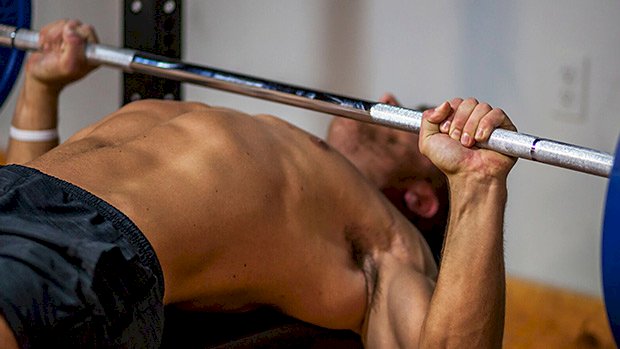
 You can’t fire cannons from a canoe and you can’t bench press big weights from unstable shoulders. The external rotators of the shoulders are important for shoulder health. But they also play a role in stabilizing the arms during bench presses and can contribute to a stronger bench. Some guys know all this and do their best ostrich impression. They stick their head in the sand, neglect training external rotation, and play ignorant when their shoulders hurt and their bench stalls. Other guys are more proactive. They do dedicated external rotation work and… still end up with a stalled bench press! Why? They forget one-third of the muscles involved and use exercises which ignore how these muscles actually function during a bench press. The rotator cuff muscles play an important role in shoulder stability. These muscles work like “active” ligaments to maintain proper alignment of the shoulder and reduce excess movement. Two of the four muscles work to externally rotate the upper arm. These are the teres minor and infraspinatus. These both get worked with your classic external rotation, rehab-style exercises. But there’s one other muscle that can contribute to externally rotating your humerus. The Forgotten Muscle By strengthening the posterior (rear) deltoid, you can increase your stability on pressing exercises AND build more impressive-looking shoulders. To make your rear-delt work maximally efficient, combine it with the function of the external rotators during a bench press: isometrically contract to hold the upper arm in position. Don’t go back and forth, externally rotating the shoulder as you do with the pink dumbbells in your typical rehab drills. One Exercise to Do It All Use the supinated-grip rear delt flye: This exercise places you into external rotation and requires you to work to maintain this position while the shoulder moves through flexion and extension. This mimics the requirements of teres minor and infraspinatus during a bench press. Even better, you’re simultaneously training the rear delt and taking it to a fully shortened position. The arm path you take also lines up the fibers of the rear delt optimally to produce force, meaning you get a greater training effect. Hold at the top, where the muscle is maximally shortened and the lever arm is longest. This will place high levels of tension through the muscle and develop the strength required for you to stabilize big weights when benching. Since you’re looking to develop stability to boost your bench press, using higher reps to train strength-endurance is a good choice with this lift. I suggest sets of 12-20 reps with a 2-second peak contraction on every rep. This will develop great isometric strength in the rotator cuff and pack size onto your rear delts. The rear delts have a high proportion of slow-twitch fibers and respond really well to higher reps and long time under tension
Origin: Tip: The Missing Exercise for a Stronger Bench
Tag: Bench
Tip: Should You Bench With Your Feet Up?
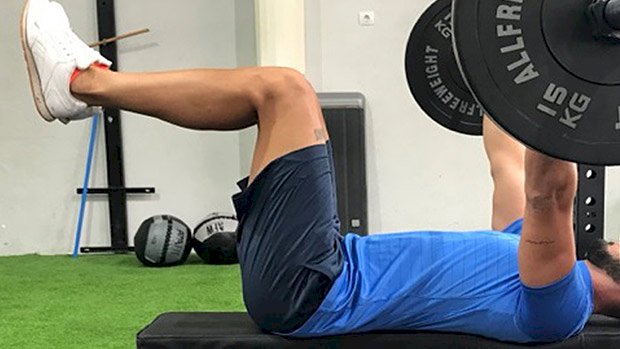 Charles Poliquin used to have a term for guys who bench-pressed with their legs off the floor and their knees bent at a 45-degree angle. He called them “future orthopedic patients.” He thought that benching that way was plain stupid and totally useless, unless maybe Ludmilla, the one-eyed Russian former Olympic shotputter who works in custodial services at the gym was mopping up around the bench press and you had to lift up your legs because you were afraid of getting a meaty backhand across the face for mucking up her clean floor. I’ve always thought it was a stupid way to bench, too, and I can’t help but shoot condescending stares at any moron I see doing it. That’s why it was particularly painful to read this new study. It seems, cough, hem, haw, that benching with your feet off the floor actually increases the involvement of the pecs, delts, triceps, and even the muscles in the forearms. But then I thought about it a bit and decided that their findings, while legitimate, weren’t applicable to anyone who wants to add muscle or get stronger. What They Did Spanish scientists recruited 20 young men and carefully established their 1 RMs (the most weight they could lift for one rep). They then wired them up with enough electrodes to make them look like the dudes in a Marvel Comics origin story, just before something went horribly wrong and turned them into super heroes or super villains that spat lighting bolts out of their wazoo. After thoroughly warming up, the subjects performed 8 reps of bench press with 60% of their 1 RM with either their feet on the ground or their feet elevated. They did a set of 8 reps using a 2:2 tempo (both lowering and raising the bar to a count of 2). After an appropriate rest period, the participants repeated the lifts, doing the opposite (feet up or feet down) of their first test. What They Found Doing bench presses with the legs up significantly increased the recruitment of the pectoralis major (clavicular portion, sternal portion, and costal portion), anterior deltoid, triceps brachii (medial head), forearms (flexor digitorum), rectus abdominis, external oblique, and rectus femoris muscles. This prompted the authors of the study to write, in Yoda-speak, the following: “To perform the bench press exercise with flexed hips could be recommended for training in sports where the upper limbs and hip flexor muscles are required.” How to Use This Info While I don’t doubt the findings of this study, I’m still not going to do or recommend the “legs up” bench press. I’ve got several reasons. For one, the slow tempo they used in the study doesn’t reflect how people normally bench and I’m pretty sure that lifting explosively, or at least quickly, would show a different recruitment pattern. Secondly, their study showed that there’s more activation of the rectus femoris in the legs-up bench than there is in the conventional bench. The trouble with that is, the bench, when it’s done with any amount of significant weight, is actually a whole-body lift with all kinds of involvement from the legs. Clearly, these guys were using a weight that was so light that it didn’t require any drive from their legs. If they had used a heavier weight, it would surely have shown a higher level of recruitment of the rectus femoris than just lifting up your legs so Ludmilla can mop under your feet. Third, other studies have shown the opposite – that the conventional bench recruits more muscle than the legs-up version. (Of course, those studies used a BOSU ball underneath the lumbar spine to introduce instability, and the weight of the lifter plus the weight on the bar just might have smushed the ball down so it was, in effect, close to being a flat or semi-flat surface.) Lastly, recruitment of motor units isn’t the end-all and be-all of hypertrophy or strength. What matters more is the mechanical loading the muscle fibers are subjected to. Look at it this way, if you were to put on a chicken costume, climb atop your house and jump off, you’d recruit a whole lot of pectoralis-muscle fibers as you frantically sought to achieve flight, but all the flapping in the world wouldn’t lead to additional strength or size. What you need is adequate load, but if you attempted legs-up benches with much more than the 60% of 1 RM used in the Spanish study, you’d eventually run into the same problem you do with any type of instability training – having to balance the bar lengthens the amount of time between the eccentric and concentric part of a movement, resulting in a much-impaired stretch-shortening cycle, which impedes strength gains. Also, the limiting factor in any kind of instability training becomes the strength of the stabilizer muscles involved in the lift. In other words, muscle fiber recruitment of the chest, delts, and triceps ultimately would suffer because the amount of weight you’d need to coax the muscle to grow would likely be more than you could balance and keep from ending up an orthopedic
Origin: Tip: Should You Bench With Your Feet Up?
Tip: Bench Like a Beast Without Shoulder Pain
 Shoulder discomfort when bench pressing is common among experienced bodybuilders and strength athletes. Most just fight through the pain because they’re afraid they’ll lose size and strength if they give it up. While benching isn’t the only way to grow your chest and triceps, it’s certainly a core upper-body exercise. Fortunately, there are ways you can bench press that help alleviate stress from the shoulder joint. Before we get into those, let’s quickly review why your shoulders might be aching: Benching is an internal rotator-dominant exercise. Many lifters are already very internally rotated since they sit for work at a computer and have weak upper-back muscles. Coupling those issues with the bench press further adds to the shoulder stress. Inefficient warm-up and poor mobility. You have to warm up if you’re going to bench, especially if you don’t want your shoulders to suffer from it. Before you even touch the bar, do some mobility drills to help open up your range of motion, and maybe perform some activation exercises with light bands for the shoulders, triceps, and upper back. 3 Shoulder-Friendly Bench Exercises You can tweak the bench press to greatly reduce the stress on the shoulders and keep the tension on the muscles you’re trying to train the first place. If you’re consistent with your warm-up and mobility drills, but still feel some unwanted tension in the shoulders when you bench, try these variations: 1 – Dumbbell Press with External Rotation This puts less stress on the shoulders as opposed to excessive internal rotation. At the top of the motion, your hands will be facing in toward each other with your shoulders externally rotated. You can turn the palms forward at the bottom or keep them neutral during the entire range of motion. 2 – Slight Decline Bench Slap a plate or two under one end of the bench. This will put you on a slight decline angle, allowing you to use the pecs more effectively while taking any unwanted stress off the shoulders. 3 – Floor Press When people are experiencing shoulder pain during the bench press, it’s usually because their mobility is limited and they’re trying to perform the press through a greater range of motion than their shoulders are ready for by bringing the dumbbells down too far. You can eliminate this completely by doing floor presses either with dumbbells or a bar. Pressing from the floor reduces the range of motion your shoulders have to go through and maintains tension on the
Origin: Tip: Bench Like a Beast Without Shoulder Pain
Tip: How to Diagnose Your Bench Press Problem
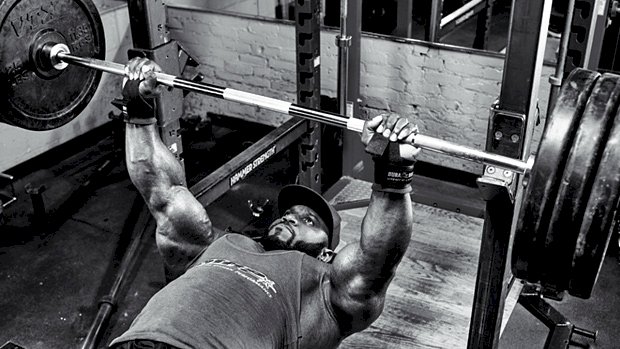 This table lists the most probable issue causing each sticking point on the bench press. Now, there could be something more complex going on, or a technical issue that’s more unique to you. But most of the time, I’ve found that strengthening the sticking point area will solve the problem. So take a look at this table, determine where your sticking point is, take note of the causes, and use the appropriate assistance exercises to strengthen that area. Bench Press Sticking Point Causes Assistance Exercises Breaking off from chest 1. Lats weak or not properly engaged 2. External shoulder rotators 3. Upper traps more dominant than lower traps and rear delts 1. Straight-arms pulldown, Pendlay row, seal row 2. Cuban press, seated dumbbell snatch, external shoulder rotations 3. Trap-3 raise, rear delt machine, Powell raise, victory raise Lower third Pecs Wide-grip bench press, Spotto press, decline bench press, floor press, dumbbell bench press, bench press with Duffalo bar Mid third 1. Anterior delts 2. Rear delts and rhomboids (Shoulder lifts up from bench) 1. Incline bench press, slight incline bench press, lying front raise 2. Bench press with resistance band around wrists, rear delt machine, face pulls Upper third (lockout) Triceps, especially long head Close-grip pin press, lockout bench press, close-grip floor press, close-grip decline bench, overhead triceps extensions If you’re unfamiliar with some of these exercises, use this list: Seal Row A seal row is a chest-supported row (using dumbbells or a bar) using a bench. Elevate the bench on blocks or plates. If you don’t have that setup, a regular chest-supported row will do. Cuban Press Trap-3 Raise Powell Raise Victory Raise Spotto Press Bench Press With Resistance Band Around Wrists Bench Press With Duffalo Bar Once you fix a muscle weakness, it’ll take some time to transfer those strength gains to the bench press. Your body will need to change the intermuscular coordination pattern. Don’t panic if your strength gains in pressing lag a few weeks behind your strength gains in the assistance
Origin: Tip: How to Diagnose Your Bench Press Problem
 All about sport xlsport.club