
 Here’s a useful way to set up a heavy band, providing both comfort and stability. Simply place a plate over the center of your band and stand on it. Compare doing this to just standing on a band and you’ll instantly feel the difference. The band will also stay closer to shoulder width throughout any exercise. Resistance bands have many uses. One is the ability to accelerate through increasing resistance. This can prime your nervous system, activate high-threshold motor units, and potentiate your whole body for a better workout. Banded single-leg RDLs are an excellent way to prepare for a heavy lower-body workout, especially if you do a few explosive reps, allowing the band to accelerate you back down. This will overload the stretch-reflex mechanism and prime your muscles for a good workout. Because single-leg RDLs done this way provide an element of stability (versus your standard single-leg deadlift) these can also be used as a teaching tool to improve single-leg stability and strength. 2. Banded Split Squat This is an excellent way to warm up your quads and get a bit of blood in there before your heavy lifts. Because of the angle of the band, there’s even greater quadriceps emphasis. As an alternative to the leg extensions and sissy squats, these can make for an excellent assistance exercise for your lower-body workouts. If you’re at home or in your Vegas penthouse suite wondering how you could do these without an Olympic-size plate, all you need is something flat and strong to place over the band. Or you could just step on the band. 3. Banded Pull-Through Cable pull-throughs are on par with 45-degree back extensions and reverse hypers for developing posterior chain strength in a manner that limits load through your spine. Loop a band around a post somewhere and boom… you’ve got yourself an effective pull-through setup. Because of the ascending resistance of the band, doing pull-throughs in this way tends to bias glute activation at the top, although you’ll get a nice stretch and a little load through your hamstrings at the bottom too. Excellent as a warm-up drill, to teach hip hinge technique, or to burn out your glutes. 4. Lateral Kneeling Hip Thrust Open up your tight adductors and wake up your sleepy glutes with these. Here you’re combining a band kneeling hip thrust with a great hip-opening drill. Throw these into your warm-ups for healthy hips and knees. They’ll also work as a high-rep booty-pumper – just don’t make eye contact. 5. Band ISO Bird-Dog A resistance band is one of the best ways to progress and load a bird-dog. So if bird-dogs are a frequent part of your training anyway, here’s how you can make them harder. You’ll be challenging the collapse of your extended arm and leg. This will help fire up everything from your hamstring to your opposing-side shoulder, and everything else in between. Bird-dogs are part of Professor Stuart McGill’s “big three” core exercises. It’s good to add them into your warm-ups, at the end of workouts, or supersetted with other exercises for long-term back health. Add a heavy band like this for a bigger
Origin: Tip: 5 Heavy Band Exercises for Legs & Glutes
Tag: Band
Tip: Forget the IT Band
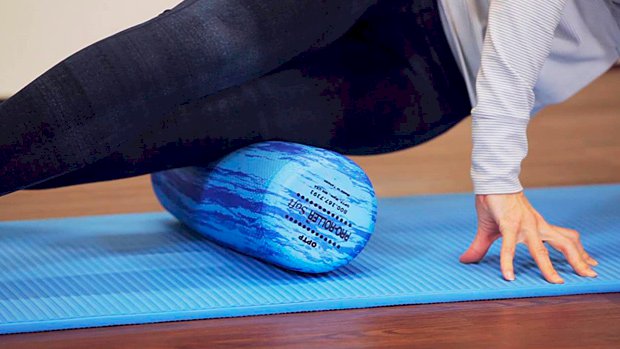 Foam Rolling the IT Band Rehab pros are divided on the topic of foam rolling the IT band. Some say you can’t deform dense fascial layers like the IT-tract (they’re correct), but they’d be blind if they didn’t recognize that a ton of people do get positive responses to rolling this piece of fascia. What Really Happens Here’s what’s really going on when you do it: By positioning the foam roller on the outside of your thigh on where you think the IT band is located, you’re actually targeting the underlying vastus lateralis (lateral quadriceps) and biceps femoris (lateral hamstrings) musculature. Most people have no idea how to target, let alone locate, a functionally shortened area of musculature or symptomatic trigger point. Just because it hurts and is located on the side of your leg doesn’t mean you’re “treating” the IT band. So if you’re a fan of foam rolling this area, then whether you realize it or not, you’re probably not on the IT band. You’d probably get long-term benefits by rolling a different area. Instead of trying to squash the IT band, target the quads and hamstrings directly. The Fix: Foam Roll the Quads and Hams Forget the IT band. Target the vastus lateralis and biceps femoris directly. All you have to do is slightly change the position of your body over the foam roller. You’ll get maximum benefit from SMR work in the lateral leg without continuing to be a slave to the IT band
Origin: Tip: Forget the IT Band
 All about sport xlsport.club