
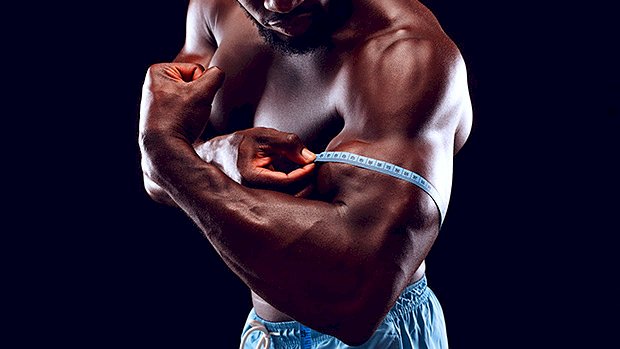
 Blood flow restriction (BFR) training is a specialized technique that can help you build sleeve-popping arms. It involves wrapping a restrictive implement such as bands or cuffs around the limbs while lifting. This type of training comes with a warning though: Mind-blowing and sometimes painful pumps may be experienced. Here’s what you should know before diving in. Blood Flow Restriction: The Basics Research on hypertrophy shows a load of 65% or more is required to build significant muscle size. But research on BFR shows loads as low as 20-30% create the same muscle-building effect. That would mean you’d theoretically build as much muscle with 65 pounds as you normally would with 200. The advantages of requiring less weight are obvious when it comes to rehab, as well as building muscle without undue stress on other body structures – the type of stress that causes elbow pain after a few weeks of heavy triceps training, for example. Trying to grow your arms can sometimes feel like you’re beating a dead horse. Week after week you hammer them hard with progressive overload, only to stop because your elbows and wrists have had enough. If this sounds like you, then BFR could be a way to manage your training load, reaching a point where your stubborn arms finally start to grow. What’s Happening? Occlusion training allows arterial blood flow to a region, your arms in this case, while restricting venous return. Basically, you’re allowing blood to flow into the muscle, but partially restricting its return out. To do this safely and effectively, using a purpose-made occlusion cuff is always best. This occlusion results in an increase in Type II muscle fiber recruitment and an increase in localized growth hormone and IGF-1 levels (by up to 300%). In return, you’ll see an increase in muscle protein synthesis by 45-55%, leading to greater muscular growth. The benefits of occlusion training are largely seen distal to the occlusion device. For example, placing it high on your arm will provide benefits to the rest of the arm below the cuff. (There’s some evidence to suggest that there are also benefits proximal to the cuff, though.) Selecting the Right BFR Device Today you can find a number of implements made just for BFR training. These are generally better than knee or wrist wraps. Some lifters even use medical tourniquets, but a proper occlusion cuff is best. Researchers use specialty inflatable cuffs that measure the pressure. You can buy these online. Cuff pressure is individual, depending on vasculature, tolerance level, or if you’re using it over or under a shirt. Just remember, greater pressure from the cuff does not directly correlate to how hardcore you think you are. Just keep it snug, not as tight as it’ll go. For the upper arms, you’re seeking around 100-220mmHg using an occlusion cuff, or a 7 out of 10 in intensity relative to your maximum tolerable level. Place the cuff at the top of your upper arms. It’s good if you’ve got a little pump prior to doing this. Find the right pressure and then begin your BFR training. You can leave the cuff on for up to 10-30 minutes, although if there’s any sensation of numbness, tingling, or major discomfort, take it off immediately. The BFR Arm Workout You can do this workout up to twice a week. You may feel you can do more or add in some extra exercises, but don’t. The aim of this workout is to stimulate, rather than annihilate, your arms into growth. To get your arms bigger you need to get them stronger too. That’s why the workout will start with some heavy lifts (producing a lot of mechanical tension) before your actual BFR exercises. The protocol often cited in research as having the greatest effects on hypertrophy is 30/15/15/15. This is exactly what you’ll be using. That means you’ll squeeze a near-maximal 30 reps out of your first set. Thirty seconds later you’ll aim for just 15 reps with the same weight, then do two more 15-rep sets. This will still be a struggle since your arms will have ballooned up! A. Weighted Dips or Decline Narrow Grip Bench Press:4 x 5-7 with a 4-second eccentric (negative) tempo. Rest 2 minutes between sets. B. Seated or Scott Hammer Curl:4 x 5-7 with a 4-second eccentric tempo. Rest 2 minutes between sets C. Overhead Triceps Extension with BFR:4 x 30/15/15/15. Rest only 30 seconds between sets. (See video above.) D. Cable-Behind Biceps Curl with BFR:4 x 30/15/15/15. Rest 30 seconds between sets. (See video
Origin: Tip: BFR for Big Arms
Tag: Arms?
Tip: Big Arms, No Weights
 Most gyms now come equipped with suspension straps, but rings also work for this killer superset. Suspension Strap Skull Crusher and Curl A1 Suspension Strap Inverted Skull Crusher – 4 sets of 10-12 A2 Suspension Strap Curl – 4 sets of 10-12 Take no rest between the skull crusher and the curl, then rest approximately 90-120 seconds between supersets. Choose an angle of moderate difficulty until you’ve gained proficiency and can increase the challenge. For the triceps portion:Maintain a stable shoulder angle as you control the descent into end-range elbow flexion, mirroring a skull crusher, and then reverse into elbow lockout and repeat. For the suspension strap curls:Maintain neutral body position with arms extended 90 degrees from your torso. The elbows will try to drop as the more powerful lats instinctively try to turn the movement into more of a row. Defend against this by maintaining strict position of the humeri by elevating your elbows. This keeps tension on your biceps, thus delivering an intense stress and
Origin: Tip: Big Arms, No Weights
Tip: The Bodyweight Superset for Big Arms
 When most people want to build their arms, they head straight to the EZ-curl bar and the rope pulldown machine. That’s a mistake. For most lifters, chin-ups and dips should form the foundation of their arm training. Here’s a superset that’ll get the job done. Chin-Up and Dip Superset A1 Chin-Up – 4 sets to near failure A2 Dip – 4 sets to near failure No rest between A1 and A2. Rest approximately 2-3 minutes between supersets. This means that you’ll do a set of chin-ups, then immediately do a set of dips without rest. That’s one round and you’ll do three more, resting a couple of minutes between supersets. Perform these exercises to near but not absolute failure. Consistent absolute failure on all sets adds disproportionate fatigue to the training effect. For the chin-ups: Choose a partial or fully underhand grip to emphasize biceps recruitment. Fully extend your elbows at the bottom with control and then reverse direction. Your scapula should move with you and not remain locked in place. Use full available range of motion at the top and bottom under control to avoid needless injury risk. Squeeze at the top and then repeat. For the dips: Use caution as they can put your shoulder in a compromised position and aren’t suitable for those with injured shoulders or poor joint mobility. Ensure the ball of the joint doesn’t glide forward from the socket in the bottom of your dip, which would result in the ball pushing repeatedly against your biceps and rotator cuff tendons. Descend to a depth you can control and then extend elbows to lockout. Some trainers emphasize remaining upright for more triceps focus, but more forward torso lean may allow more shoulder comfort and will still smash triceps while engaging more chest. Remember, classic-era bodybuilders used bodyweight compounds as the foundation of arm training. Though prominent bodybuilders of the ’60s and ’70s lacked the sheer mass (and abdominal distention) of modern pros, Arnold and his contemporaries never lacked for world-class
Origin: Tip: The Bodyweight Superset for Big Arms
Tip: Can Anyone Build 19-Inch Arms?
 Reality Check Here’s a question we received recently: “How often do you have to train each week to get 19-inch arms?” Let me offer some hard-earned perspective. I’ve been lifting for a long time. I was always cursed with crappy arms. The late Charles Poliquin used to call me some German term that translated to “Asparagus Tarzan.” Whether he meant I was a half-naked savage raised in the jungle by a tribe of asparagus or that I had arms like spears of asparagus, I’m not sure, but I think it was the latter. Anyhow, I’ve tried every program, every training style, every trick known to bodybuilding, but my arms are still my worst body part. Part of it’s because my arms are long. Want that box of cereal on the high shelf? No problemo. But filling in that long vista of space between my shoulders and elbows with muscle? Sigh. The only thing that ever worked, remotely, was a piece of advice from again, Charles Poliquin. In his experience, he said that you had to gain roughly 15 pounds of bodyweight for every extra inch you added to your arms. True enough, when I went from my usual fighting weight of 215 to 220 pounds to 235 pounds, my “biceps” (more accurately, my arms) grew about an inch. Still, by his reasoning, I would have had to gain another 15 to 25 pounds to get even close to 19 inches. Wasn’t gonna’ happen. Wasn’t the look I wanted, anyhow. And when I went back to my fighting weight, I wasn’t able to sustain the added size for long, which probably means that some of the added arm size was blubber. What I’m trying to say is that the size of your arms is largely genetically determined. I fully realize that right now there are a bunch of genetically gifted guys reading this that are hollering all kinds of synonyms for bullshit, but these guys know nothing about being a hardgainer. They might suggest that someone like me needs to train more, and if that didn’t work, I need to train less. They might say to lift heavier, lift lighter, do drop sets, work them once a week, work them twice a week, eat more, sacrifice a heifer to the biceps god, and so on. Eff ’em. I’ve tried it all. Most of these guys, however, could fold laundry and still grow giant arms. What I’m saying is that if you’re regular folk and want big(ger) biceps, follow the regular rules of bodybuilding: Train the whole body. Get good at the big lifts. Consistently eat more calories than baseline. Do lots of pull-ups and close-bench bench presses. After all that, if it’s in your genetic cards, you’ll get your 19-inch biceps. If not, focus on less stubborn body parts. But if having huge guns means that much to you, there are always steroids, in which case the old “gain 15 pounds rule” goes out the
Origin: Tip: Can Anyone Build 19-Inch Arms?
 All about sport xlsport.club