
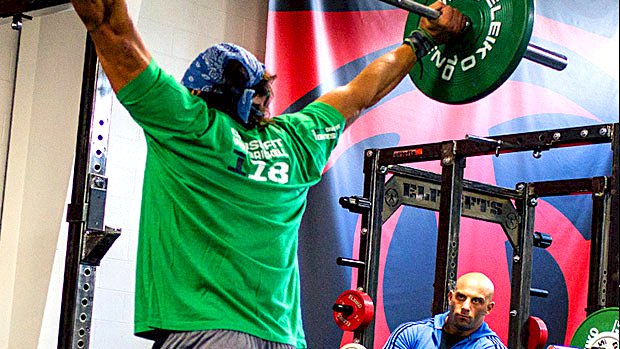
 Here’s what you need to know… Build a strong back. CrossFitters work their lower backs every day in one way or another. Adopting this kind of strategy will carry over to Olympic lifts, deadlifts, and squats. Respect the reps. CrossFitters do a lot of high rep work, and it leads to both strength and muscle gains. Dominate the weight. CrossFitters newer to weight training often don’t have any mental blocks when it comes to hitting PRs and making fast progress. Lesson Learned I used to think CrossFit was a fad and assumed they all used bad form, that they couldn’t get strong or build muscle doing those workouts. I was wrong. Working with a lot of CrossFit athletes changed my mind. While I personally wouldn’t train using only WODs, I did learn a lot of things from coaching CrossFit athletes. I work with a diverse clientele: average Joes, athletes, bodybuilders, and CrossFitters, and I must say that next to the powerlifters, the CrossFitters were the strongest overall. Oddly enough, for a group that has a reputation for using bad form, they have probably the best form among the people I’ve trained. Serious CrossFitters are perfectionists and really work at their craft. Sure, they might have a slight technical breakdown during WODs, but most of the time their technique is solid. Here are the three things I learned by training them: 1 – Strengthen Your Lower Back This is the secret to fast strength gains on the Olympic lifts, deadlifts, and squats. CrossFit athletes – even most recreational CrossFitters – have super strong lower backs. And as a result, they make fast progress on Olympic lifts when properly coached. Heck, many that I coached took only a few months to hit weights that took me a few years to attain while training on the Olympic lifts full time. CrossFit athletes aren’t doing tons of fulltime Olympic lifting workouts, certainly not at the frequency that would justify the super fast improvements I’ve seen. The following are pretty much part of every single WOD. They’re doing hundreds, if not thousands, of reps per week involving the lower back to some extent: Deadlifting anything from super high reps (up to 100 reps in a workout) to super heavy weights Kettlebell swings with all sorts of weights and rep ranges High-rep Olympic lifting (not something I’d personally do or recommend) Not only do they do all this work for the lower back, but they tend to loosen up their form a bit during WODs. This makes them round the lower back slightly. I’m not saying that you should start doing tons of rounded-back lifting, but deadlifting with a rounded back puts more stress on your erector spinae and – if you don’t blow a disk – it will make your lower back stronger. Even Klokov does a ton of rounded-back pulling. When it comes to the Olympic lifts, a strong lower back allows you to stay in a position to make the best use of your strength when the weight gets heavy. One CrossFitter I coached started out doing deadlifts. He didn’t have much experience and had the worst fishing-rod deadlift form ever. I made fun of him at the time because he told me he was going to bring his 405-pound deadlift up to 535 in four months. I even wrote him an email saying why he was being unrealistic and how he was disrespecting powerlifters who work their tail off for every 10 pounds they added. Well, he actually did it, but with the most horrible form possible. Fast forward a year and that guy now has one of the best lifting forms I’ve seen and it’s because he has a super strong lower back. He’s now snatching, cleaning, deadlifting, and squatting superb weights for his size. I “theoretically” understood the value of a strong lower back, but never focused on it that much. I felt that I got all the lower back stimulation I needed from doing the Olympic lifts and squats. In retrospect I now know I always had a weak lower back and it probably held me back. Apply It The lower back responds better to a high volume of work. If you want to build it to a level that will give you the strength to shock people, you need to work it for a high number of reps at a very high frequency. The good news is that the lower back muscles seem to have the highest trainability of all the muscles. This means they get bigger and stronger very rapidly if you focus hard on training them. With the lower back the big secret is just training it. Try ending every session with a lower back exercise. Depending on how fresh I am or how strong I feel, I’ll pick the movement that will work the best on that day. If I feel tired, then doing heavy triples on the Romanian deadlift might not be a good idea. I’m now devoting a good amount of time on making my lower back stronger using various rep ranges, using from 3 to 10 reps on the Romanian deadlift and other pulls; 10-12 on loaded back extensions, the back extension machine, glute-ham raises, and reverse hypers; and up to 30 on kettlebell swings. Don’t dismiss something as simple as a back extension machine.
Origin: A CrossFit Apology
 All about sport xlsport.club