
 Progress After 40 for Advanced Lifters How much muscle can a natural, advanced lifter build in his 40s? Well, I’d love to tell you that an advanced lifter in his 40s can keep building tons of muscle… in part because I’m over 40 too. But it’d be a lie. It’s not even an age thing (although that plays a role), but a matter of training experience and adaptation. To me, “advanced lifter” means at least 15 years of hard training. That means you’ve gained quite a few pounds of muscle already. The human body has a limited capacity to build and keep muscle naturally. This is largely dependent on our genetics. The ACTN3 genotype, myostatin levels, body structure, and many more factors come into play. We don’t fully understand all the factors yet, but the fact is that the average human male can add 30-40 pounds of muscle above what his normal adult weight would be over the course of his training career. Of course, using anabolics will bypass many of the limiting factors that prevent a natural from growing to Mr. Olympia size. I’m also talking about pure muscle weight. With those 30-40 pounds you’d likely add some extra pounds in the form of glycogen, water, and collagen. Not to mention that you could add some fat and still look great. You might add 50-60 pounds of scale weight over your career, but only 30-40 pounds of that weight would be muscle. The closer you are to reaching those 30-40 pounds, the slower and harder your gains will be. So let’s take a 40-year old man who’s at a normal adult weight who would be around 175 pounds without lifting. And let’s say, after 15 years of training, he’s now 210 pounds with a similar or better body fat percentage. By lifting for all those years, he added around 30-35 pounds of muscle to his frame. Realistically, he can now hope to add 5-10 pounds of muscle at most. If a second 40-year-old man gained only 10 pounds over the course of his training career (because he hasn’t been training hard and smart consistently), he has the potential to gain more muscle than the first guy if he trains the right way. Why is the more dedicated and experienced lifter going to have a harder time building a lot of new muscle? First because of adaptation. His body is well adapted to lifting. It’s very hard at that point for training to represent a stress. If the training is no longer a stress, the body won’t change because extra muscle isn’t needed to do the work. If you want to increase the training stress you need to: Lift more weight or… Do more volume or… Push your sets harder But there’s the catch-22. All three of these things can jack up cortisol and might stop progression. Furthermore, you can’t always push them up. There will be a point where it’s hard to add 5 pounds per 6-8 weeks on a lift. And if you already train to failure or close to it, there isn’t much room to increase there either. And adding volume – especially in older lifters – is one of the best ways to halt progress. It’s also not very practical for the real world. A normal human being with a job and family can’t spend 2-3 hours in the gym every day. An advanced lifter needs an extremely high training stress to keep progressing, but doing just that might actually do more harm than good. Also, as you get older your physiology changes, and not for the best when it comes to building muscle: Testosterone levels tend to decrease. Growth hormone and IGF-1 can decrease. Stem cells decrease due to a lower IGF-1 level. Stem cells are required to repair muscle damage. Fewer stem cells means that you don’t repair and build muscle as easily. Your body likely has more chronic systemic inflammation. This can significantly decrease your capacity to build muscle (among other things) in part because it reduces insulin sensitivity. You lose nerve cells and have atrophy in others. This will decrease strength. And if strength goes down, it can be harder to maintain, much less add, more muscle tissue. The muscle tissue is adapted to a certain level of loading. If your nerves no longer allow you to produce as much force, the lower level of muscle tension produced when training might not be enough to fully stimulate growth. Finally, as you’re getting older, life tends to take over. If you have a full-time job and a family, you have a lot more stress. That can also impact your capacity to progress. Now The Good News Don’t stop trying to improve because it’s possible to surprise yourself and achieve more than you thought. I got into my best shape at 41 and I’m still able to improve a bit. Here are a few guidelines that tend to help older lifters keep making progress: 1. Don’t always train hard. I know this sounds counterintuitive, but periods of maintenance training can help re-sensitize your body to training. Call it “strategic deconditioning” if you want. For 3-5 weeks, do the minimum necessary to avoid losing muscle. If you’re a dedicated lifter, that’s going to be much less than you think. Do less volume, don’t push your sets
Origin: Tip: Realistic Gains After 40
Tag: After
Tip: Take This to Stay Lean After Dieting
 Being lean, really lean, is usually a transient state as all severely restrictive diets eventually come to an end. On one hand, the end of a diet is good. You get to laugh deliriously as ice cream dribbles down your chin. Plus, it gets easier to put on muscle. But the bad side is that your V-taper starts to soften, blur, and spread out until it’s kind of a U-taper, which really isn’t a taper at all. Recent research, though, suggests that taking curcumin after a calorie-restriction diet is over might limit the amount of fat you regain, even if for some reason you stop training, too. What They Did This was a rat study and before you say anything, rat studies are just fine, thank you. Their physiology is similar to ours and you can carefully monitor their every waking and sleeping moment because they live in cages with wheels and are housed in scientific institutions. You can’t do that stuff with humans. They’d object. And they’d probably turn their noses up at the exercise wheel and insist on one of those stupid, over-priced Peloton bikes where some virtual coach who’s likely impotent from riding so much browbeats you to pedal faster. Anyhow, scientists took rats and split them into two groups. One group was on a calorie restriction diet and had 24-hour access to one of those rat-iconic running wheels. The other group didn’t have a wheel and they got to eat as much as they wanted. After 3 weeks, the trained rats were divided into three groups. The first group was terminated immediately and the second and third groups had their running wheels locked and were reintroduced to ad libitum (as much as they want) feeding for a week. Additionally, one of these groups received a daily gavage (force feeding) of curcumin (200 mg/kg) while the other group received placebo. What They Found When the rats no longer got to exercise and were given as much as they wanted to eat, body mass naturally increased, accompanied by a 9 to 14-fold increase in epdidymal, perirneal, and inguinal adipose tissue. In other words, they got tubby in all the places one doesn’t want to get tubby in, but all of these increases were attenuated in the curcumin group. Furthermore, the curcumin-fed rats had a much more favorable insulin curve and much lower C-reactive protein (a measure of inflammation) than the non-curucmin group. The researchers concluded that, “…results indicate the curcumin has a protective effect against weight regain and impaired metabolic control following a successful period of weight loss through diet and exercise, perhaps via inhibition of glucocorticoid action and inflammation.” How to Use This Info Most people, upon cessation of a diet, probably don’t abruptly revert back to previous bad eating habits. Instead, they’d gradually relax their previously Spartan diet and slowly start to put the pounds back on until they woke up one morning and found that they’re not just pudgy again, but have a renewed sense of self-loathing. Even so, there’s ample reason to think that curcumin would work equally well in preventing post-diet fat gain in humans. Of course, the human evidence on this particular aspect of curcumin is largely unexplored, but empirically speaking at least, curcumin does seem to keep the pounds at bay. One eyebrow-raising aspect of the rat study was the amount of curcumin administered. The dosage was 200 mg/kg, which translates to 18,000 mg. for a 200-pound person. That’s about thirty-six 500-mg. capsules per day. An amount that large would cause your tears, sweat, urine, and feces to be colored a kind of initially pleasing but ultimately frightening Day-Glo orange. Don’t freak out, though. There’s an easy solution. Plain old unadulterated curcumin is notoriously hard to absorb for rats and humans alike, so the researchers had to overdose the rats to ensure they got a therapeutic dosage. If the researchers had instead added piperine (a black pepper derivative) to the curcumin, they could have increased absorption by up to 2,000 percent, thus negating the need for such humungous doses. In fact, you’d only have to take a couple of Biotest® curcumin/piperine capsules a day, which is quite a bit more manageable than 36 a
Origin: Tip: Take This to Stay Lean After Dieting
Tip: Do These Stretches After Squats
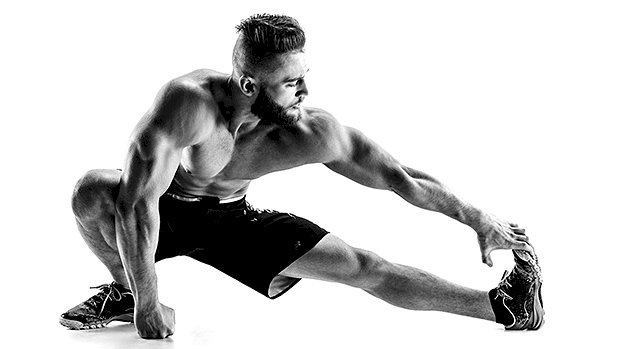 Save your stretching for post-workout. This is when you want to hold stretches for a longer period of time while your muscles are still warm and receptive. These will help get rid of the kinks in your glutes and help prevent those kinks from cropping up again. Glutes and Hips This is called the standing pigeon stretch. Place one leg across a box at a 90 degree angle. Press your opposite hip forward and rotate the hip that’s on the box backward. Hips and Hip Flexors Do the lizard lunge with external rotation. Place one foot in front of you so that your knee is behind your shin. Extend your opposite leg behind you. Roll to the outside of your foot and press your knee away from your body. Hips and Thoracic Spine Do the squat hold with a reach back. Keeping your heels flat, squat down as deep as you can comfortably hold. While keeping you heels flat, reach one arm up as you try to touch your bicep to your ear. Ankles and Calves Place a resistance band around your ankle and loop the other end around a fixture. Keep your heel flat as you push your knee forward so that it goes past your toes. The band will pull your shin backwards, creating a stretch in your
Origin: Tip: Do These Stretches After Squats
 All about sport xlsport.club