
 Wait, What’s Rest-Pause Training? Rest-pause is an intensity extending method that’s long been praised for its strength and hypertrophy benefits. It’s where you perform an exercise to technical failure. After your initial set, you pause briefly. This “rest period” is typically 15-30 seconds. Then you’ll do another set until failure before taking another brief break. You do this until you’ve completed a targeted number of total reps. The total reps you choose depends on a variety of factors, but generally speaking, it should be double the amount of reps you were able to perform during the first initial set. So for example, if I were able to bench a weight for 8 reps in the first set, I’d aim to accumulate 8 more reps in the following sets to hit the targeted total of 16. Here’s what that might look like: Set 1:8 reps to failure (8 total reps completed) 15 seconds rest Set 2:4 reps to failure (12 total reps completed) 15 seconds rest Set 3:2 reps to failure (14 total reps completed) 15 seconds rest Set 4:1 rep to failure (15 total reps completed) 15 seconds rest Set 5:1 rep to failure (16 total reps completed) Does It Work? Yes, it can work for both muscle and strength gains because you’re able to maintain high motor unit recruitment. It also allows you to use the same high loads for all sets, unlike something like drop sets where you reduce the load with each subsequent set. Anyone who’s tried rest-pause knows it works… to a degree. The research confirms its efficacy, too, but a lot of coaches have probably exaggerated how well it works, especially as it relates to strength and size. Are the benefits of rest-pause more from the rep scheme itself, or is it just a matter of basic lifting principles like intensity, volume, and effort? I’d argue it’s more of the latter, especially when you compare it to boring old traditional lifting where you do a set, take a full rest period, and then do another set. Rest-Pause and Hypertrophy A 6-week study comparing strength, hypertrophy, and muscular endurance between rest-pause training and traditional training found all measures were equal after the study, except lower body endurance and lower body hypertrophy, both of which were higher in the rest-pause group (1). If taken at face value, this study shows you can get equal strength but induce more muscle growth and more endurance benefits by switching from traditional sets to rest-pause sets. However, if you look a little closer, you’ll realize you probably can’t have your cake and eat it too. Both groups (which included both men and women) trained 4 times a week with 2 days designated as upper-body push days and 2 days devoted to training back, biceps, and legs. The rest-pause group lifted with 80% of 1-rep max to failure with a rest-pause protocol that included 20-second rest periods between sets until lifters reached 18 total reps. The traditional group did each exercise for 3 sets of 6 using 80% of 1-rep max. They rested 2 to 3 minutes between sets. This study should get a lot of credit as its design was better than most studies. It used trained individuals, controlled for the same 1-rep max, and made sure both groups did 18 total reps, but unfortunately there were some issues that would obviously favor the rest-pause group: 1 – Intensity was matched, but effort wasn’t. Both groups used their respective 80% of 1-rep max, but the rest-pause group trained to failure while the traditional group not only didn’t train to failure but couldn’t have, given their protocol. The traditional group did 3 sets of 6 at the same load of 80% of 1-rep max. In general, someone using 80% of 1-rep max load should be able to crank out at least 7-8 reps when taken to failure (6), but they were only instructed to do 6 reps per set. Furthermore, if you consider the following personal differences, the participants might have easily done an even greater number or reps: Individual differences:Research consistently shows that different people can crank out a different number of reps even with the same 1-rep max (2). Adaptation differences:The more endurance you have, the more reps you can complete before failure at a given 1-rep max percentage, even when using as high as an 80% load (3). Gender differences:Women can perform more reps given the same 1-rep max (4). Any guy who’s trained with a girl can easily testify to this. Some women are just insane volume queens. Considering all this, there are plenty of reasons to think the traditional lifting group stopped short of, or pretty far from, failure. The study had another problem, too. 2 – Progressive overload wasn’t matched. The rest-pause group used progressive overload, but not the traditional group. Since the rest-pause group was instructed to train to failure until reaching 18 total reps, progressive overload was naturally built into their program. Hypothetically speaking, as they got stronger, their weekly progression for a given exercise could’ve looked something like
Origin: The Truth About Rest-Pause Training
Tag: About
Tip: The Truth About the Bad Girl Machine
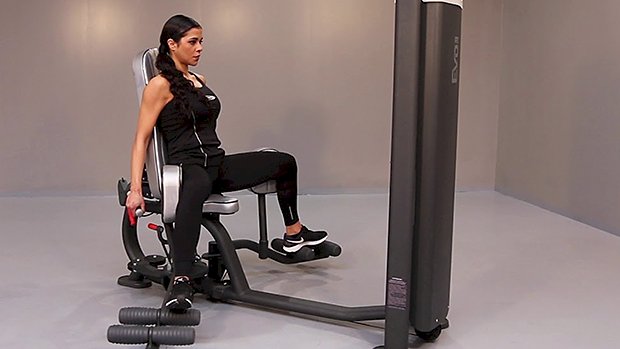 The Good Girl/Bad Girl Machine These two machines get a bad rap because for a long time women were told to get on them to “shape and tone” their thighs via the bullshit known as spot reduction. In fact, I often have to wait for some little old lady to be done with these before I can hop on. And yeah, I got a few stares along the way. Even from granny. It’s crazy how many people hate these machines because they’re not regarded as “hardcore.” They saved me from a recurring injury when I was competing in powerlifting. I suffered from a bout of adductor strains during those years that drove me nuts, but once I got really freaking strong on the adductor machine my squat climbed from 635 to 660 pounds. I’m not saying there was “carryover” to my squat from doing the good-girl machine. But once I stopped having adductor strains, I was able to smash out some very productive squat cycles that allowed those gains to happen. I credit the adductor machine for that. But I didn’t approach it like Suzanne Summers ThighMaster time. I really pushed the progressive overload and worked to get brutally strong on them, eventually working up to using the whole stack for lengthy sets. With the bad-girl machine, aka the abductor machine, I used it prior to squatting as a way to get my hips and glutes warmed up. I stayed lighter for this movement and worked in the 15-20 rep range. When I initiated a squat workout this way, my squats felt way better and were more “in the groove” right out of the gate. If you find yourself struggling to hit depth early in your squat session because the loading isn’t heavy enough to force you down into position, or that your hips and knees are ornery in the warm-up process, throw these in before squats to potentially alleviate that problem. Three to four sets of 15-20 reps will do the
Origin: Tip: The Truth About the Bad Girl Machine
Why You’re Wrong About Machine Training
 I Used to be Anti-Machine Like many people who came to lifting heavy objects via the sports of weightlifting and powerlifting, I viewed machines with contempt. I believed people who used them lacked the intestinal fortitude to learn how to use free weights (which are “obviously” superior). Thankfully, I’ve managed to evolve to a less ideological viewpoint, opting for one that’s more evidence-based instead. I ask myself a simple question: “What’s the best way to get big and strong?” Answering this question allows me to be much more open and objective to considering any and all rational methods that take me from point A to point B. I care about the result, not how you get the result. And that’s what allowed me to view machine training in an altogether different light. An Evidence-Based Discussion Current scientific thinking suggests that muscles get bigger and stronger when they’re exposed to unaccustomed levels of tension. The magnitude of that tension is most important for strength goals, and the volume of that tension – the number of times your muscles experience tension per unit of time – matters most for hypertrophy (size) development. Both machine and free weight exercises expose your muscles to tension, but with slightly different pros and cons. So abandon your ideological thinking and think of both options simply as tools that have varying degrees of utility, depending on context and circumstances. And remember, you’re not restricted to one or the other. Machines and Free Weights: The Key Differences By definition, a machine-based exercise is a movement where you’re required to exert force against a resistance without needing to do much in the way of controlling that force, at least compared to similar free-weight exercises. Let’s examine two very similar exercises – the Smith machine squat and the barbell squat. They both stimulate the same muscles, but in slightly different ways. Let’s examine the pros and cons… Advantages of the Smith Machine Squat More technique options. Because the bar slides up and down a fixed rail, you can do a number of things you can’t do with a barbell, like placing your feet in front of (instead of directly under) the bar. This strategy allows you to assume a more upright position than you could achieve with a barbell squat, which means greater quadriceps recruitment. You can use more weight because you don’t need to balance or stabilize. This results in more muscular tension, which in turn equates to more pronounced strength and hypertrophy adaptations. The Smith machine is much more forgiving of relatively minor errors such as positioning yourself slightly off-center under the bar. Disadvantages of the Smith Machine Squat It doesn’t require you to control bar path. While this is the most often-cited criticism of machine training, I’ve never once – in my many years of studying motor unit recruitment – come across the notion that control was a necessary or even a desirable precondition for strength or muscle development. Again, muscle fibers adapt and grow when they’re forced to generate high levels of tension. Not only do Smith and barbell squats both afford the ability to provide this tension, in many cases, the Smith squat is a better way to provide this tension. If you only squat on a Smith machine, you’ll never learn how to do a proper barbell squat. While undeniably true, I wonder how consequential this really is, assuming that you don’t plan to compete in powerlifting. It’s much like pointing out that if you only play the piano, you’ll never learn to properly play the organ. If the goal is organ mastery, this is a problem. But if the goal is to cultivate more generalized musical skills, it’s not. The strength acquired by using free weight exercises has greater positive transfer to many “real world” skills. While we’re now at least getting into a more plausible defense of free weights, the concept of transfer is often poorly understood and applied, largely because movement structure is only one component of transfer. Now, don’t get me wrong, movement structure certainly matters. For example, it’s intuitively obvious that the strength gained from squatting will positively transfer better to a vertical jump than the strength you’d acquire doing leg extensions, mostly because the structure of a squat is much more similar to a jump than the structure of a leg extension. However, if you’re comparing the positive transfer potentials of Smith and barbell squats, there’s really not a whole lot of difference between the two, unless you place your feet considerably in front of the bar when Smith squatting. But even here, the differences are relatively minor. But does needing to control your muscular efforts during a barbell squat transfer over? While there might be something to this, unless you find the vertical jump to be a complex maneuver (in terms of balance and/or overall body control), I’m far from convinced that barbell squatting would offer a
Origin: Why You’re Wrong About Machine Training
4 Horrible Truths About Pro Bodybuilding
 Here’s what you need to know… Chasing a pro card turns you into an asshole. If you have a girlfriend or spouse, you’ll probably end up cheating on her. Contest prep makes you hurt everybody you love. The drugs, brutal dieting, hard training, and contest prep will make you hate the world and the world hate you. Trying to become a pro will likely leave you broke. Even if you do win a show or two, the prize money won’t come close to covering your expenses. Becoming a pro will likely wreck your health and cause you to die young. The amount of muscle mass you need to acquire, the drugs, and the yo-yo dieting will ruin your health. There are good things about pro bodybuilding, too. You’ll meet great people, learn a lot about your body and mind, and have the potential to become a more determined, passionate, intense, human being. Drinking Crankcase Oil By most definitions, I’ve been a success in my chosen field. I’ve built a career in bodybuilding over the course of 20 years. I’ve won Israel’s national bodybuilding title 5 times. I earned my pro card and had a respectable showing in the Mr. Olympia. Perhaps more importantly, I’ve coached hundreds of athletes. But looking back on it, I can see that there are things I sacrificed that weren’t worth sacrificing. So when I walk into a commercial gym and see a motivated young kid who’ll do anything and everything to get a pro card, my instinct is to sit him down and have a conversation about his goals and dreams. I want to make damn sure he understands what he’s getting himself into. He needs to realize his chances of actually becoming a professional bodybuilder are stacked against him and the path is often ugly and soul draining. The late Steve Michalik once said he’d drink crankcase oil to get further in the sport, and that was for the Mr. America contest, an amateur competition. I would ask this motivated young kid if he’s willing to “drink crankcase oil” to get where he wants to go, because that would be the easy part of the journey. I’d then make sure he understood the following points: 1 – Bodybuilding is a very selfish and mentally destructive sport. To do well, you need to become a self-centered asshole. It’s the nature of this sport and it’s not a matter of “if” it will affect you, but by how much. Some individuals are more affected than others, but the use of certain “supplements” for an extended period of time will cause profound psychological effects, including changes in personality. You’ll experience increased aggression and anger. It may be over something as inconsequential as someone talking too loud or looking at you the wrong way. The most trivial incident might become goddamn HUGE AND ANNOYING. You’ll have no patience, a short temper, and will feel sluggish during most of your day. Simple things will become huge chores. Increased libido will plague you. If you have a girlfriend or spouse, you’ll probably end up cheating on her. If you have any underlying, previously dormant mental issue like OCD or an eating disorder, these “supplements” will make it rear its ugly head and increase exponentially in power. Depression, anxiety, and shortness of breath will all become part of your daily life. And rest assured, if you’re planning on becoming a pro bodybuilder, you’re going to need and use a lot of these volatile drugs (there, I said it). It’s just another thing that needs to be done in order to compete at the highest levels (the same as every other professional sport, for that matter). But when you combine all this with an obsession with your body fat and how much you weigh, with looking at yourself in the mirror multiple times a day, and, in general, living a life where every action from eating, to breathing, to sleeping is about improving your outside appearance, selfishness and self-centeredness are inevitable. It’ll affect your personality, and at the end of the day when you leave the gym and the competition is over, these changes don’t disappear and you’ll still need to deal with life outside of bodybuilding. 2 – You will hurt the people you love and you may end up alone. To this day, after more than twenty years in the industry, I still haven’t met a bodybuilder who’s prepared for a show without seriously affecting his or her marriage. When you diet, you become cranky, tired, and moody. You hate the world. When you diet, the first person you lash out at is typically your spouse – the person who generally provides you with the most support. Ironic, isn’t it? I’ve seen couples break up, separate, and even get divorced after lousy show preps. The higher the level, the more drugs involved, the more severe the drama. And don’t think you’ll treat your friends or family any better, either. The drugs, combined with the brutal diet, the hard training, the cardio, and the final pre-contest week with its dehydration and carb load/depletion will take any bad situation and exponentially increase it. Anyone who thinks this won’t happen to them is
Origin: 4 Horrible Truths About Pro Bodybuilding
 All about sport xlsport.club