
 To build a strong, athletic body you can’t skip out on core training. It may be the one thing that’s holding back your progress. But to train the core for performance, you need to address its main functions. The 3 Main Functions of the Core: Transfer force between the feet and hands Transfer force where you want the force to go Transfer force without energy leaks When you’ve trained the core the way it’s meant to be trained, you’ll run faster, jump longer and higher, throw further, strike harder, and simply be a strong, resilient beast in your sport. A strong core will also keep your spine and body healthier. It’s vital for both performance and health. The Top Exercises You can perform thousands of different ab and core exercises. But I’m a strong proponent of keeping the spine rigid while the hips, legs, and arms move. This doesn’t mean that I’m against spinal flexion, sit-up variations, etc. I simply see more direct carryover to performance from training the ability to let the hips, shoulders and arms do the movement while the spine stays mostly rigid. 1 – The Athletic Plank The regular plank is a fine exercise to teach core stability and the ability to generate full body tension. (If you’re going to do them, look up the RKC version.) Once you’ve mastered the regular plank, it’s time to introduce a more reactive version. During functional movements and sports, the core has to respond, not simply work in and from a passive position. This exercise will teach you to respond and react by creating stability and stiffness. To do it, start by moving the hips up and down slowly. Then “jump” up so the feet lift from the floor. When you land, you instantly want to stick the landing in a regular tight plank position. When you’ve got this down, jump and land in a rotated position, switching sides from rep to rep. To be explosive you have to be able to go from ON to OFF and back to ON again. The faster you can go from active to relaxed, and from relaxed to tight, the better it is for your athletic ability. Master this and your performance will increase. 2 – The Bulletproof Side Plank This is the plank’s forgotten sidekick. That’s not good because too much focus on the front side of the body (by doing only regular planks) will lead to a big gap in your core strength. Without directly loading the sides, you’ll leave a hole in your performance. You’ve probably never done REAL side planks. I can say this because I’ve watched hundred of athletes do them and they all compensate, rotate, and/or flex their hips. Why? Because their core muscles are weak in this area. Most people struggle with the bulletproof side plank in the beginning because it forces you to use the right muscles. It’s simply hard to cheat this exercise! With the bulletproof side plank, your heels, butt, and shoulders must be touching the wall. Your elbow can be placed a bit out from the wall for stability. The head will preferably touch, but if you have neck issues it can remain wherever it’s most comfortable. The first step is to be able to hold the position for at least 30 seconds. When this is mastered, add lateral movement as shown in the video. This is a great way to train the lateral core and hip strength and stability. 3 – Dumbbell Core Rotation Once you’ve mastered the moves above, you’re ready for rotations. Rotation – and the ability to be its master – is the foundation for athletic performance and a healthy body. Most injuries and compensations happen because force is “leaking out” in movements. This leaking is often a result of training mainly in the sagittal and frontal plane. For example, if you only train squats, deadlifts, lunges and side lunges, you set yourself up for failure. These are all good, but without a strong focus on rotation you self-sabotage your performance. Training rotation will automatically train and teach anti-rotation as well, especially if you’re turning up the volume (the speed of execution). To do the exercise, stand upright with a dumbbell in each hand, placed in a neutral hammer, curl-like position. From here, start to swing the dumbbells from side to side in a circular motion. The point is to accelerate, decelerate, and re-accelerate with the whole body and core engaged. The great thing about it? It instantly teaches the importance of where the rotation force is coming from – the feet. A common cause of many problems is a lack of proper “rooting” of the feet. This exercise will reveal it. You can either do this exercise with a “core” focus, which means you’ll mainly focus on the abs/low back area, or you can integrate more hips in the movement. In the former version, the feet are locked on the ground at all times. In the latter version, you allow your heels to come off the ground, creating movement throughout the balls of your feet. Obviously your whole body is working in both versions, but you can direct the focus where you need it. Start with feet locked in. 4 – The Athletic Landmine
Origin: 5 Violent Core Exercises
Author: ondriving
Tip: How Limb Length Affects Training
 Can Limb Length Play a Role in Exercise Selection? Yes! Exercise selection is the most important training variable. Imagine if you’re a patient at the doctor’s office and the conversation went like this… Doctor:I’m going to prescribe you 200mg twice a day. Patient:200mg of what, Doc? Doctor:What do you prefer? Which medication do you feel like taking? It doesn’t make sense, right? Well it’s the same with training. Think of sets, reps, and training methods as the dosage and exercises as the medicine. While everybody will improve their body and performance by gradually becoming stronger on the big basics, simply doing those and nothing else will emphasize certain muscles over others, and might not end up giving you the result you’re looking for. Some people will get great pec development from the bench press while others will only grow their triceps and delts. Some will build tremendous quads from back squatting and others will build bigger glutes. Limb length relative to torso length helps determine which muscles receive the most stimulation. Here’s a general overview: Body Type 1 – Long Limbs/Short Torso Tend to progress more easily on pulling movements than on pressing ones Have an easier time getting stronger on the hip hinge/deadlift than on the squat Upper Body Pressing Pecs are the easiest to develop Delts are second Triceps are the hardest to develop Upper Body Pulling Lats are the easiest to develop Rhomboids, rear delts are second Biceps are third Upper traps are the hardest to develop Lower Body Training Glutes are the easiest to develop Hamstrings are second Quads are third Calves are the hardest to develop Body Type 2 – Short Limbs/Long Torso Tend to progress more easily on pressing movements than on pulling ones Have an easier time getting stronger on the squat than on hinging/deadlifting Upper Body Pressing Triceps are the easiest to develop Delts are second Pecs are the hardest to develop Upper Body Pulling Upper traps are the easiest to develop Biceps are second Rhomboid, rear delts are third Lats are the hardest to develop Lower Body Training Quads are the easiest to develop Calves are second Hamstrings are third Glutes are the hardest to develop All of this is true most of the time, but there will be some exceptions. (Arnold, for example, is long limbed and had huge biceps.) That info allows you to better select the assistance work you’re doing in a program by telling you which muscles will need added direct work. For example, I have short legs, so I don’t need any direct assistance work for the quads. They grow just fine by doing squats exclusively and I prefer to invest my training time on exercises that are actually needed to fix a weakness. However, I do need direct glute and hamstring work. You don’t need as much (if any) direct work for the muscles that are the easiest to develop, but you’ll need a lot more for those that are the hardest. Knowing this also helps us better select the big lift variations for our workouts. If I have long legs, the front squat will be better than the back squat for overall development. Why? Because with the back squat I’ll get mostly glutes and some hamstrings while with the front squat I’d stimulate the quads. A heels-elevated back squats would also do the trick. While there’s nothing wrong with good, smart programs you find on the internet, you should still give yourself some leeway in exercise selection: you can respect the spirit of a program while choosing better
Origin: Tip: How Limb Length Affects Training
Stubborn Delts: The High Tension Solution
 Building big, healthy shoulders goes beyond just overhead pressing a city bus. Sure, that’ll get the job done if you’re capable of it, but there’s a better way. We’ll get into some of the exercises you probably aren’t doing, but there’s something we have to talk about first… Maximizing Tension There’s a handful of reasons you might find it difficult to develop a stubborn body part. Lack of mind-muscle connection, poor execution, poor movement selection for your structure, and poor overall programming are a few. The old bodybuilding adage, “train a muscle at different angles,” was basically a way of saying that you need to take advantage of the length-tension relationship within different movements. Different exercises will provide different resistance curves to the muscles being trained, so they’ll train those muscles at different lengths within the movement. Maximizing development is about creating as much tension as possible in those different lengths. The key is to find exercises that best suit your structure and best train the muscles in various positions: lengthened, mid, and shortened. But it’s also important to use movements that stress the targeted musculature appropriate within those lengths. Here are four exercises that’ll satisfy this approach: 1 – Banded Dumbbell Press The dumbbell overhead press is a proven delt strength and size builder. But both strength and physique-focused lifters could be doing it more effectively. The most common way people do the press is seated (which is fine), then they lock the elbows back by using external rotation, and press from the shoulders to the overhead position with the dumbbells arching together over that range of motion. There are a few problems here. To start, you can’t get away from the fact that this exercise predominantly hits the anterior delts. This means you should be making sure to get the anterior delt loaded maximally in its most lengthened state. Doing this will keep you from going into excessive external rotation and instead let the elbows come forward a bit, allowing you to work in your natural scapular plane. While pressing, you want to avoid that common arching motion because it actually takes the delts out of their active range of motion very quickly. It’s the traps that adduct the arms in that overhead arching motion. This arching motion also shortens the lever arm in the movement, making it easier as you reach lockout. And that’s cool and all if you aren’t trying to stress the actual delt muscles. But if you are, it means you’re not spending as much time in the area where the movement is actually difficult. The better way to perform these is to press directly upwards with the dumbbells staying in line with the elbows. It’s no different than if you stacked the elbows and wrists in a vertical line with one another like if you were doing a barbell press. Lastly, to make these more productive, add a band to flatten out that descending resistance curve. By adding in the band we’re eliminating that dead area in the range of motion at the top and creating a longer torque curve. Now you’re maximally loading the anterior deltoid in the bottom, you’re staying in a longer active range of motion, and you’re eliminating that dead range of motion near the top where there’s very little tension. 2 – Rear Delt Row with Supination I’ve done my fair share of bent-over lateral raises (rear delt raises), but the truth is that they fall short as a rear delt movement. With a bent-over lateral raise, the rear delts never actually get fully shortened. A key component in maximizing an exercise is to get the target muscle fully lengthened and then fully shortened within a movement. But some exercises don’t do that as well as others. A better option is the rear delt row with supination. With this exercise, you’ll be rowing (as you might expect) to bring the elbow behind the body as far as possible, which will shorten the rear delt. But you’ll add a twist, literally, by supinating as you perform the row. Why the twist? Because it’ll bring about a certain amount of external rotation in the shoulder, which is one of the components of the rear delt. Supination at the forearm is actively linked with external rotation of the shoulder, just like pronation is linked with internal rotation. This isn’t an exercise you’ll go super heavy on, but you won’t need to so long as you’re using the appropriate resistance with it for the mechanics, and making sure to get the rear delt fully shortened. 3 – Incline Lateral Raise It’s nearly impossible to cheat with these, unlike the standing lateral raise. Not that cheating is bad, and I actually do add cheaty lateral raises into my programming from time to time. But for most guys having trouble getting a strong mind-muscle connection, the incline version is a better choice. This exercise will also naturally put the resistance in line with the middle fibers of the delt. When you use a standing lateral raise it’s
Origin: Stubborn Delts: The High Tension Solution
Tip: How to Get Better Results with Chin-Ups
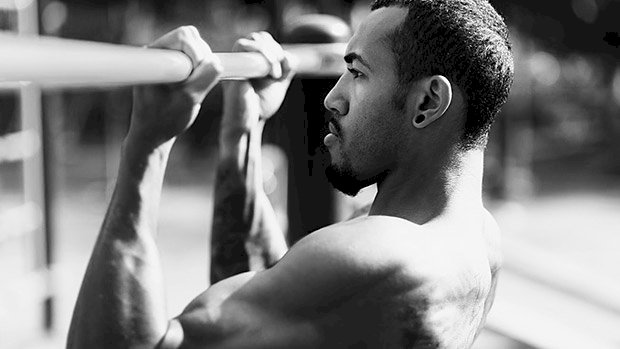 Chin-ups are a classic lat and biceps builder. Rings will amplify your benefits. Here’s Why The supinated grip draws your elbows in. This position is more joint friendly for your shoulders and hammers your lats as shoulder extensors. You get some serious mechanical tension on your biceps. Rings keeps you honest. If you start jerking and kipping, you’ll be swinging around the gym like Tarzan. Free moving handles reduce joint stress. This allows you to do more weight and more volume. Tips Take an underhand, supinated grip. Keep your chest up, shoulders down, and lean back a bit. Focus on driving your elbows down as you lift. Focus on squeezing your biceps as you come to the top. Extend your elbows as you come down, but don’t go limp. Good Alternatives Use the rotating handles that come with some high-end racks, or use the D-handles found at most gyms. All you need is a small chain and carabineer you can pick up from a hardware store. If you have to use a fixed bar, alternate every 1-2 months between supinated and neutral (palms facing each other) grips to reduce the risk of joint
Origin: Tip: How to Get Better Results with Chin-Ups
Tip: Could This Be the Next Super Supplement?
 We know through written historical accounts that ancient people and not-so-ancient peoples often used plants and herbs to treat sickness. Through years of trial and error, they were able to figure out which plants had healing powers. What they’d probably stumbled on were plants that had high concentrations of certain natural phenolic compounds, which are more commonly referred to as polyphenols. Institutionalized medicine didn’t pay much attention to them, though, because the things these healers used just didn’t work well enough to inspire interest or confidence. No amount of vile-tasting herbal teas was going to fix diabetes, lower body fat, or prevent heart disease. But science has since been able to identify, extract, and concentrate these plant chemicals and use them in a way that would do all those ancient folk-medicine practitioners proud. Common examples of these polyphenols include resveratrol, green tea extract, quercetin, caffeic acid, anthocyanins like cyanidin 3-glucoside, and the current darling of the polyphenol world, curcumin. But a new player is ready to make its entrance and it might eventually rival curcumin in its accomplishments. It’s called fisetin, and its list of reported and purported benefits is pretty long. What Dose Fisetin Do? Like many polyphenols, fisetin seems to be a utility player, playing nutritional shortstop just as well as it plays nutritional right field. One problem, though – even though over 800 studies have been conducted on fisetin, only one of them involved humans. Most of what we know is based on experiments with mice and rats. Still, if some of the following benefits extend to humans, as they often do with polyphenols in general, then we might really have something: Reduces body fat:Mice gained 75% less weight when they were introduced to a high-calorie diet and given fisetin. The thinking is that fisetin may increase levels of the fat-burning hormone adipokinectin. Helps regulate blood sugar:Diabetic rats and mice fed fisetin experienced insulin and blood sugar levels compatible with healthy mice. Furthermore, it prevented sugar from bonding with proteins, a process known as glycation that contributes to a host of bad stuff like nerve damage, kidney disease, cataracts, and aging of tissues in general. Prevents the growth of various cancers:Like curcumin, fisetin seems to downright hate cancer, holding special grudges against colon, brain, lung, breast, ovarian, pancreatic, and brain cancers. It also seems to protect against prostate cancer by blocking the receptors for DHT. Improves memory and learning:Fisetin improved the memory retention and learning abilities of old rats. Protects your skin:Fisetin slowed the breakdown of collagen in cells exposed to ultraviolet light. Relieves depression and anxiety:Fisetin seems to increase levels of serotonin and noradrenaline, thereby improving mood. Helps ameliorate neurodegenerative diseases:Animal models of Alzheimer’s, Huntington’s, multiple sclerosis, or amyotrophic lateral sclerosis showed marked improvement in such aspects as memory, balance, coordination, and life span when fisetin was introduced. Lowers blood pressure:Fisetin dilates blood vessels, thereby allowing blood to flow through the pipes easier. Helps you handle booze better:Mice that partied too hard were able to process alcohol better. Combats Irritable bowel disease (IBS):When mice with the human equivalent of IBS were given fisetin, inflammation went way down. Fights aging in general:Fisetin seems to be a powerful “senolytic” in that it helps the aging body rid itself of senescent cells (cells that stopped dividing) that normally lead to inflammation and reduced lifespan if left to foster. How Does Fisetin Work? Like most polyphenols, fisetin is a powerful antioxidant, which explains or partly explains many of its effects. Secondly, it blocks an inflammatory switch known as NF-kB. Block this protein complex and you help thwart the evil plans of cancers, allergies, and autoimmune diseases. Fisetin also influences mTOR, a kinase that acts as kind of a cellular switch. Having higher levels of mTOR after a workout is a good thing as it helps you grow muscle, but having perpetually high mTOR levels is associated with a variety of diseases. Fisetin could be used to modulate mTOR levels to your advantage. Is Fisetin Safe? Fisetin, like most polyphenols, seems to only have better angels perched on its shoulders in that it doesn’t seem to have any negative side effects, even at high doses (at least in animal studies). Still, pregnant women and children should heed the usual warnings since we don’t yet know enough about the substance. The good news is that the Mayo Clinic is currently investigating fisetin in three separate studies involving diabetes, kidney disease, and frailty, so we should have more info on its safety and efficacy soon. What Foods Contain Fisetin? Of all foods analyzed for fisetin levels, strawberries contained the most, but
Origin: Tip: Could This Be the Next Super Supplement?
Tip: Box Step-Offs for Big Legs
 Stepping off a box shouldn’t just be reserved for your local step aerobics class. With a few minor upgrades, box step-offs can be an effective way to add some frontal plane (side-to-side) loading to your leg day. Not only can they add another direction to your training, but they transfer over well to athletics and they’re a damned effective muscle-builder too. Lots of Ways to Do Them Box step-offs are somewhere in between a lateral lunge and a squat, while the addition of a box takes you further into deficit. The height of the box and degree of deficit are up to you. For those that don’t want much extra range of motion, stepping off a 45-pound plate might be enough. Conversely, for those that want a deep deficit, setting a box and some risers up to knee height would have its advantages. A single dumbbell in the offside hand works great, but most seem to prefer the feel of a kettlebell. This variation is a good starting point for many and allows some respectable loading for even the strongest lifter. It’s not uncommon for someone to get to the point where they can use a third of their bodyweight in one hand. Other effective ways to load step-offs are in a goblet position, front rack position, or with a landmine bar. The landmine can provide an element of stability to the exercise, as it’s one of the most comfortable variations (if you get the setup right). It can be held in the offside hand or in both. A cable seems to work okay too. For complete beginners, a medicine ball or even body weight are just fine to start off with. Just make sure you respect the movement with these rules: 1. A Deficit is for a Deficit Far too many times you see those using a raised platform stop before actually getting into the deficit. The point of a deficit is to increase range of motion. Unless you’re doing a goblet squat, EZ-bar front squat, or are a beginner stepping of a 45-pound plate, the implement you’re using needs to drop below the top of whatever you’re standing on, thus taking you into a deficit! If it doesn’t, then there’s not really much use for the extra height. 2. Put on the Brake As you step sideways off the box, there’s a “braking effect” happening. The offside leg must step off and absorb the impact forces through the abductors, quadriceps, and glutes. This braking effect is a form of eccentric overload, and eccentric overload is good for building muscle. 3. Lean With a Purpose Depending on how you hold the weight, distribution of load and body position change. You can have a more upright torso by using a goblet position or front rack, or slightly more forward-leaning torso with a weight hanging in front. You can even emphasize a forward lean and get even greater hip dominance. Just focus on pushing your butt back more as if you were showing it off to the person behind you. To target the offside leg, hold the weight on that same side of the body. We’re not talking a massive change here, but when the weight is held in one hand, load is shifted away from the nearside leg towards the offside, meaning that as you’re stepping off, the brakes need to work a little harder. That means more eccentric overload on the abductors, glutes, and quads on the offside leg. There tends to be a bigger forward lean in one-handed variations too. Programming Step-Offs Whichever way you perform box step-offs, it’s the combined lateral braking motion and increased hip and knee range of motion that makes this exercise so effective. The decision you need to make is whether you want to load the braking side more (emphasizing the eccentric overload), or if your focus is loading more through increased stretch and range of motion on the nearside leg. Both can be great triggers of muscle growth as well as have carry-over advantages to sport. Pick your weight, sets and reps based on these goals, although generally 2-4 sets of 8-15 reps each side work
Origin: Tip: Box Step-Offs for Big Legs
Tip: Elbows Inflamed? Build Biceps Anyway
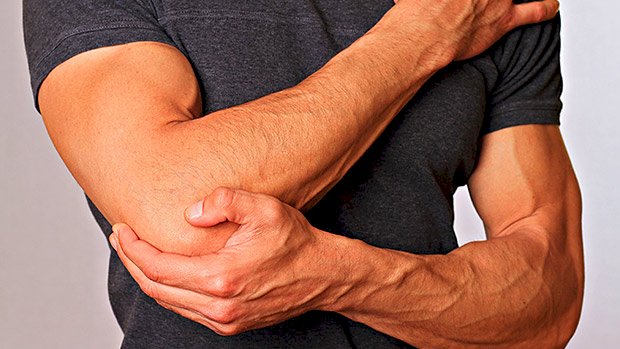 There’s nothing worse for a lifter than dealing with joint inflammation like elbow tendonitis. When the orthopedist tells you the only way to remedy that pain when flexing or extending your arm is rest and recovery, it conjures up images of church lady arms that swing to and fro during heavy clapping. It can take six months or more for tendonitis to go away. Are you really going to stop training your arms for that long? Probably not. The good news is that you don’t have to. You have one more card to play before downsizing your T-shirts to fit your shrinking arms. That card is blood flow restriction (BFR). BFR Brad Schoenfeld covered blood flow restriction (BFR) here and its benefits have been well documented in the research community. Just recently, a meta-analysis was published (Lixandro, 2018) pitting traditional heavy-load training against low-load BFR training to see which was more efficient at growing muscle and strength. Using almost 50 studies, it was determined that low-load BFR was just as effective in terms of hypertrophy as traditional heavy strength training. Sure, strength suffers a great deal in the absence of lifting heavy shit, but at least the sleeves will still hug the arms nice and tight. Here’s How to Do It Place the restriction (wraps or cuffs) directly between the medial deltoid and bicep. Wrap your arms with a perceived tightness of 7/10. This will provide enough pressure to occlude the cephalic vein, but ensure you’re still allowing arterial flow. Check for a distal radial pulse (at the wrist) after you’re wrapped to make sure it’s not too tight. Don’t do the exercise if you can’t find your pulse. Wrap Up and Lift Pain-Free BFR mimics the intensity of lifting heavy without actually lifting anything heavy. The light loads (20-30% of 1 RM) used for standard BFR training will typically allow a lifter to get away with doing movements they otherwise couldn’t do with an inflamed elbow. Additionally, the pooling of blood during a series of BFR curls or extensions creates a cushion of sorts for the elbow that minimizes pain even further. Programming Use BFR up to 2-3 times per week for best results. Try it wherever arm work is programmed in your current protocol and see if you can do it without pain. You probably can. The most heavily researched set/rep scheme is 30-15-15-15. It’s considered the gold standard by practitioners. It looks like this: Set 1:30 reps Set 2:15 reps Set 3:15 reps Set 4:15 reps Take only 30 seconds rest between each set. Unwrap after set 4.
Origin: Tip: Elbows Inflamed? Build Biceps Anyway
16 Unstable Exercises That Actually Work
 From Rehab Clinic to Your Gym If you mention “unstable” and “training” in the same sentence, there’s a good chance some knowledgeable meathead will stuff you into a locker. And for the most part, doing so is warranted. BOSU balls, wobble boards, and other unstable shenanigans belong in a physical therapy office, not a gym – and therein lies the problem. The unstable surface training (UST) craze began in clinical rehab settings after showing some promise in treating particular ankle issues. As is often the case, though, something that was useful within a single context took off and weaseled its way into the mainstream. Hipsters doubling as personal trainers began putting their clients on balance boards and Swiss balls while they juggled kettlebells and talked trash about egg yolks. The problem is, UST doesn’t hold any water outside of the physical therapy realm. As a matter of fact, multiple studies chastise its use for injury prevention as a whole, limiting its efficacy to individuals with a history of ankle sprains. Other studies have found that people who train on unstable surfaces are more likely to experience significant injuries. Does that mean that UST is more likely to contribute to injuries? You can be the judge. If there’s one thing that the research undoubtedly proves, though, it’s that training on a STABLE surface is the clear king for getting bigger, stronger, and more athletic. But not all unstable training is created equal. Some unstable training methods and exercises can provide unique benefits that, when implemented properly, can stimulate newfound gains in strength, hypertrophy, and performance. To reap the unique benefits that certain forms of instability can provide, give the following methods and exercises a go. 1 – Use Unstable Exercises as Primers in a Warm-Up To get bigger and stronger, your training should be centered around exercises that can be sufficiently loaded and progressed over time. For the most part, exercises that fail to meet these two criteria serve little to no purpose for gains in strength and size. But there are a number of unstable exercises that can be valuable when used as “primers” prior to your regular training. Why? When performing certain exercises with slight instability, each rep reinforces proper movement mechanics, improves intra- and inter-muscular coordination, forces joint stabilization, and grooves stability. By checking these boxes, your muscles and nervous system get to a place where they’re better equipped to handle heavy loads with pristine technique. Here’s a few examples of how to get primed to lift using unstable surfaces: Chaos Push-Up One of the recurring themes of intelligent unstable training is a constant demand for core stability and control, and the chaos push-up is no exception. On top of pushing the anterior core to the max, it targets the entire musculature of the upper body while strengthening the scapula and shoulder stabilizers. Since the oscillations are significant, chaos push-ups require a slow tempo and perfect mechanics, which translates to increased shoulder stability and better pressing mechanics. Half-Kneeling Bottoms Up Kettlebell Press Who said unstable training has to involve fancy equipment? By nature, holding a kettlebell in a bottoms-up position is inherently unstable. This will improve your pressing mechanics, help you build healthier shoulders, and get a slight pump. And as an added bonus, the half-kneeling position requires full-body tension in order to resist extension, rotation, and lateral flexion at the spine. The only bad news is, you’re going to have to check your ego and use lighter weights. Because of the movement’s unstable nature, a high demand is placed on maintaining stability in the shoulders, forearms, and hips. Single-Leg Stability Ball Hamstring Curl Relax, tough guy. The stability ball isn’t completely worthless. The benefits of these curls are two-fold: First, they train knee flexion (working leg) and hip extension (elevated leg) simultaneously, unlike most hamstring exercises that focus on one or the other. Second, the unilateral aspect of the movement requires balance, stability, and control. Plus, you’ll elicit a brutal hamstring pump that will prime your knees and low back for optimal function prior to squatting. Rear-Foot Elevated Split Squat With this variation, you’ll place your back foot on a band. Why the band? Well, when doing rear-foot elevated split squats, most lifters allow their back leg to take on a large part of the work. While that isn’t necessarily bad when the goal is overall load, using a band to elevate the back foot forces the front leg to work in isolation. At the same time, the band necessitates tri-planar balance and hip stability, similar to a pistol squat or one-leg squat to bench/box. Unlike those two movements, though, the rear-foot elevated split squat actively engages the hip flexors and forces a deep stretch. The result: healthy hips,
Origin: 16 Unstable Exercises That Actually Work
Tip: Build Your Back With DUDS
 Try this lat-dominant drop set on back day after you’re done with your heavier, progressive-overload work. Pulling For The Pump Don’t let the “DUDS” acronym fool you: they’re far from a dud finisher. Pick literally any lat pulldown or pullover variation and do this: Do an all-out set to failure (5 to 8 reps). Cut the weight in half and double the number of reps (10 to 16). Immediately cut the weight in half again and double the number of reps (20-32). If you need to take mini 10-second breaks to finish, go ahead. I’d suggest doing it on a well-designed pullover machine. Think of it as metabolic-stress type work, which should come at the end of a workout and only be done for ONE set. Don’t abuse it! Maybe sprinkle it in every other
Origin: Tip: Build Your Back With DUDS
Question of Nutrition 10
 Meal Frequency Confusion Q: Some diet experts say that having six small meals a day is outdated. Many recommend three (or fewer) meals instead. But what if I feel uncomfortably stuffed when trying to cram all my calories into three meals? Is there any harm in continuing to eat smaller, more frequent meals if I’m not gaining fat from it? A: I understand your frustration. This industry seems to constantly be stuck in a never-ending cycle of black and white advice. One minute something is in vogue and the next it’s not. I will tell you definitely and without hesitation that eating small frequent meals is NOT outdated and is a fantastic strategy for many people. Part of the reason you’re getting the message to avoid small frequent meals is a newfound appreciation for less-frequent eating. We now have plenty of substantial research telling us that there are many different eating regimes that work and have benefits. A quick perusal of the last several years of research will reveal that one meal a day (OMAD) style of eating can work great for some. Different time restricted feeding schedules such as the 16/8 approach – which involves fasting for 16 hours a day by avoiding breakfast – can deliver great results. A more recent study showed skipping dinner may be superior to skipping breakfast. Varied fasting regimes, like the 5-2 plan, where you eat normal during the weekdays and then consume little to no food on the weekends, can be beneficial. All of these studies have created excitement. New information typically generates a novelty bias for a bit. It’s common to overemphasize the new and underappreciate the old, but it doesn’t make a whole lot of sense since new things haven’t been tested by time. Usually, the tried and true is better than the fresh and new. I address all of this to hopefully help allay your concerns and clear some confusion. The current consensus in the nutrition research is still that calories matter most. Sure, we now know hormonal influence are working with calories to impact things like hunger, mood, cravings, and energy, but in the end we must attend to the calorie levels of the individual diets we choose. There are two things required for sustained fat loss: A calorie deficit Metabolic hormonal balance The calories drive the weight loss and the hormones push that weight loss towards fat loss and sustainability. You need both. Quality and quantity are equally important. It’s impossible to separate the two. The question of eating frequency comes down to the individual. We’re all different. We’re unique in our genetics, psychology, and personal preferences. We should honor that. What all that research above says is, there’s more than one way to skin the calorie and hormone cat. Ultimately, it’s about finding what works for you. Try telling the bodybuilding world from 1960 to 2000 that small frequent meals weren’t ideal. You’d be laughed at and mocked. The small frequent meal approach works fantastically well, but it’s not the only way. Some people do better with different eating frequencies. My advice? Keep doing exactly what you’re doing so long as that regime keeps these things in check: sleep, hunger, mood, energy, cravings (SHMEC), and so long as you’re attaining or maintaining your desired body composition. Why would you change? One final hint here. The metabolism is an adaptive system. You want to keep it flexible and healthy. You can do that by keeping it guessing and changing up your eating frequency at times. So, you may benefit even more if, from time to time, you experiment with less frequent eating. It’s the same for those less frequent eaters. They’re far better off deviating occasionally to a more frequent eating pattern. In the end, you should always return to what works best for you. Remember, research is a tool for averages not individuals. The research can get you in the ballpark, but you’ll need to tweak and adjust to get it just right for you. Clomid for Boosting Test? Q: Steroid-using bodybuilders use the drug clomid, an anti-estrogen, to help restore testicular function after a cycle, but I’ve heard of doctors prescribing it as a form of TRT – to boost natural T levels. Does that work? A: It absolutely works and works incredibly well. There are more than a couple studies showing its benefit. I now consider it my first line therapy for low testosterone after trying to correct with diet and exercise. I used to suggest HCG for this, but clomid is cheaper and more effective – it raises T and has a nice effect on the estrogen to testosterone ratio, where HCG may worsen that ratio in some. It also has a very good safety record with virtually no negative side effects reported in studies and no negative impact on PSA and hematocrit levels. Clomid is cheaper than either HCG or testosterone. The typical dose is 12.5 to 50mg per day. I usually start my patients at 25mg per day and then retest all blood values after 6 weeks, adjusting dosing as needed. One caveat:
Origin: Question of Nutrition 10
 All about sport xlsport.club