
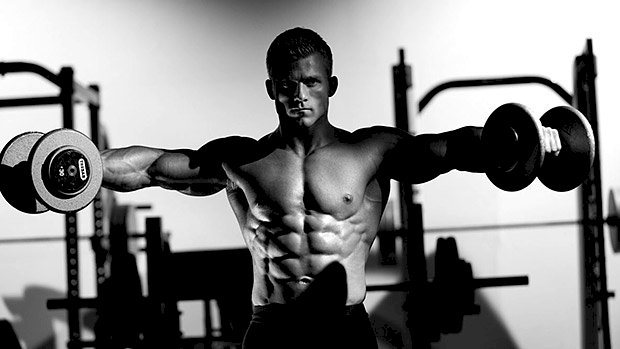
 It’s nearly impossible to cheat with these, unlike the standing lateral raise. For lifters having trouble getting a strong mind-muscle connection, the incline version is a better choice. Incline Lateral Raise This exercise will also naturally put the resistance in line with the middle fibers of the delt. When you use a standing lateral raise it’s common (and fairly natural) to work more in the scapular plane, which is slightly safer for the shoulder joint. But it also tends to make it more of an anterior deltoid movement, which we’re trying to avoid since that’s already been covered. Since the resistance is more in line with the middle delt, and you can’t cheat, you’ll naturally bring the dumbbells directly up to your side. This is what makes it a great option for smoking the middle delts. Lastly, if you want to keep tension on the shoulders as much as possible throughout the range of motion, then eliminate the bottom quarter of the movement. The delt itself isn’t very active in the bottom part of the range of motion. It’s the supraspinatus that initiates the abduction of the arm from this position, and then the delt takes over after that. Once you lift the dumbbells to the top on the first rep, lower only about three-fourths of the way down before doing the next rep. Sets & Reps Try these with drop sets or cluster sets. Do 4-6 sets total in the cluster with 10 seconds between each set, going to total muscular failure on the last
Origin: Tip: The No-Cheat Lateral Raise
Author: ondriving
Your Guide To Heavy-Light Training
 Look Great, Perform Even Better People that look and perform like muscular athletes usually do two things in the gym: They train to improve performance by driving up strength, speed, and conditioning. They use specific hypertrophy work to attack weak points and, ultimately, build a balanced physique. But the problem among most people is that they treat aesthetics (looking good) and athleticism (performing well) as mutually exclusive training goals. Fortunately, they don’t have to be – especially when you use and adjust the training methods of the late Olympic sprint coach, Charlie Francis. While Francis wasn’t programming workouts to help his athletes look better naked or bust a deadlift PR, his high-low principle is what kept them progressing without burning out. We can use the same idea to increase both performance and hypertrophy. Here’s an overview of what that looks like before I get into the details. Heavy-Light Training Overview It’s also called an “intensive-extensive” or a “high-low” training split. It bases workouts on the neurological demand of training. It places the highest-demand work on nonconsecutive days. The “heavy” or intensive days are when you do exercises that are more demanding on the central nervous system. For lifting, this can mean that the work is greater in complexity, has greater explosive demands, or requires max strength. The “light” or extensive training days are based on a higher volume and less weight. To keep the workout challenging without such extreme neural demands, this will mean creating more metabolic stress within your muscles. Four Benefits Of Heavy-Light Training 1. You get stronger and look better at the same time. This programming allows you to train muscles and movement patterns more frequently. For many lifters, this results in improved technique and, as a result, faster gains in strength compared to training a muscle or movement pattern once per week. You also get the bonus of consistency. Organizing workouts in a way that keeps you from digging yourself into a recovery hole will allow you to keep training and keep challenging your body without burning out. You can’t change your body composition or gain strength without consistent effort and that’s what this type of training guarantees. 2. You feel good and stay fresh from workout to workout. The reason this type of program works is because of its varying neurological demands, which keep systemic stress in check. You’ll be able to squat, deadlift, etc. more often, but you must vary the loading and volume to prevent excess fatigue. To understand it better you’ll need to know a couple things about the nervous system. Let’s cover that… Your nervous system has two parts: The central nervous system (CNS), composed of the brain and the spinal cord. The peripheral nervous system (PNS), all the remaining nerves and ganglia outside of the brain and spinal cord. Motor units consist of one motor neuron and all the muscle fibers it stimulates. When a signal is sent from the nervous system, it activates the motor unit. Then all the muscle fibers innervated by the motor unit are stimulated and contract. Each motor unit consists of a bundle of muscle fibers and a motor neuron. Small fibers are in small bundles and in control of smaller, finite movements. Large muscle fibers are in bigger bundles to generate maximum power and strength. So when you unrack a weight at 95% of your 1RM, your nervous system goes into overdrive, sending massive signals to your body to increase muscular recruitment. Motor neurons, and virtually every other nerve in your body, are constantly receiving information from other nerves. As a result, it becomes supercharged, recruiting more muscle fibers to execute the near-max squat, along with improving muscle fiber recruitment on subsequent exercises, making them more effective. That means lifting heavy all the time is best, right? Nope. If you lifted heavy every workout, your nervous system, joints, and tissues would start screaming at you before too long. That’s where this programming shines. It limits the overall stress you’re placing on your body by adjusting the demands on your CNS by varying load, speed, and intent of exercises. 3. You improve your technique. With heavy-light training you do each movement pattern more often than most training splits. When it comes to maximizing your performance, the more often you do a movement correctly, the more proficient you’ll become. Once a movement becomes more naturally and technically precise, your strength numbers can improve, driving up work capacity, which will lead to improvements in your physique. Remember when you first started deadlifting and you had to learn the mechanics of the movement? While you were deadlifting you’d think things like, “Don’t round your back and pull the slack out of the bar.” But with lots of repetition using good technique, you get the movement down pat. Reaching this state of “unconscious competence” in
Origin: Your Guide To Heavy-Light Training
Tip: The Full-Body Lunge
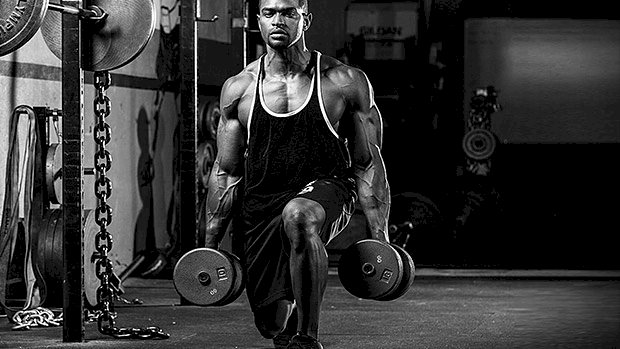 Doing exercises using the Zercher position has been trending lately and for good reason. When you place a barbell in the crook of your elbows and perform traditional compound movements, some cool shit happens. Using this variation for a squat, lunge, or carry is an incredibly effective way to hammer the upper back, traps, biceps, and abs. Getting comfortable with big barbells in the Zercher position will not only build the “yoke,” it develops a bulletproof midsection that can stand up to large loads for standard lifts. The problem with Zercher position exercises is that most lifters are limited by how much they can hold, at least until the upper body muscles catch up to the strength of the lower body. Either the torso or biceps will fail first. This leaves the legs without a great stimulus for strength or hypertrophy. Enter the Zercher Dumbbell Lunge Drop Set A great way around this issue is to use a mechanical drop set of sorts. A typical mechanical drop set involves modifying an exercise after the failure point to make it easier and allow for additional reps. In this case, after you reach failure at the torso/biceps in the Zercher position, you drop the bar, switch dumbbells, and finish off the legs with traditional dumbbell lunges. This allows you to reap all the benefits of using a Zercher position and smash the legs in the same set. How to Do It Do 2 sets of Zercher lunges in your preferred rep range, but leave 1-2 reps in the tank on each set. Place dumbbells that add up to 75% of the total load used for the Zercher lunge close to where you ended the first 2 sets. On the third and final set, take the Zercher lunge to failure, ditch the barbell, grab the dumbbells, and do lunges until form breaks
Origin: Tip: The Full-Body Lunge
Tip: Build Big Shoulders With Bodyweight
 The handstand walk is a long-term skill to acquire, but it’s definitely worth learning. The progressions are quite attainable and provide a unique pump that’ll make your triceps and shoulders burn like nothing else. An added bonus is the open shoulder position, which helps with thoracic mobility. Plus, having your weight on your hands builds a crazy amount of shoulder stability that you just don’t get with barbells. Mastering the Handstand Walk All you need is something to elevate your feet. This could be a box, bench, sofa, bed, chair, etc. Then you have five different exercises: Holding the handstand position, aiming for a vertical torso Shoulder taps Walking from side to side Feet elevated push-ups Pike push-ups Which exercises you use will be based on your individual level and skillset. I recommend practicing each exercise individually until you’re confident. Set markers to hit for each exercise such as: 30 second holds 20 shoulder taps unbroken A 360-degree walk around (both directions) 10 elevated push-ups 5 pike push-ups If you can do these easily then you can start having fun. For example, try using a set of 20-30 shoulder taps as a drop set after heavy presses! The Descending Ladder Workout One of my favorite rep schemes for these movements is a five-round descending ladder: Round 1 10 shoulder taps Walk halfway around the box 5 pike push-ups or elevated push-ups Walk back to where you started (if you initially walked to the right, walk left to go back) Round 2 8 shoulder taps Walk halfway 4 pike push-ups or elevated push-ups Walk back Round 3 6 shoulder taps Walk halfway 3 pike push-ups or elevated push-ups Walk back Round 4 4 shoulder taps Walk halfway 2 pike push-ups or elevated push-ups Walk back Round 5 2 shoulder taps Walk halfway 1 pike push-up or elevated push-up Walk back Aim to break up your sets as little as possible. If you can do all five rounds unbroken – without coming down between the sets – you win! The prize is shoulder gains and a massive
Origin: Tip: Build Big Shoulders With Bodyweight
Tip: The Cure For Stubborn Medial Delts
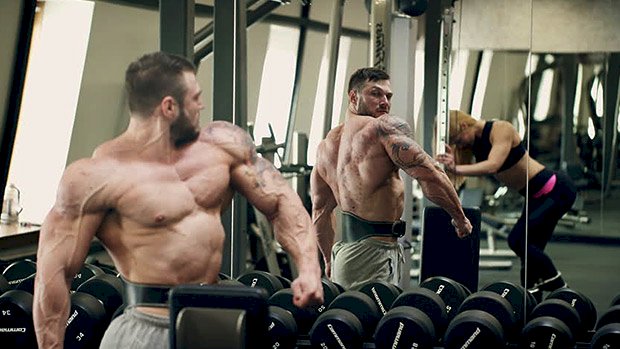 How To Tell If Yours Need To Growth The medial (side) delts can be stubborn. Stand in front of a mirror and square up to it. Are your shoulders rounded on the sides, almost like a ball cut in half? Or are they shaped more like a 90-degree angle? If they’re more like the latter, that’s a sign you could stand to add a little muscle there. Sadly, for most, it’s a tough area to develop. Throwing in a few token sets of lateral raises a couple times a week won’t cut it. If you want them to respond, you need to get a little creative and be willing to put up with a lot of discomfort. Why? Because the medial delts respond well to extended time under tension and skin-splitting metabolic stress work. You know, the type of stuff that causes burning, searing pain. Metabolic stress – along with mechanical tension and muscle damage – is one of the key drivers of hypertrophy. It’s the key driver that a lot of people forget to use. So, if your shoulders are flat and you covet a cannonball look, try one of the protocols below. Do a different one each shoulder workout, twice a week, for the next 8 weeks. Protocol 1: Progressive Isometrics (Machine Lateral Raise) Progressive isometrics can turn any exercise with a hard contraction in the shortened position into a nightmare (in a good way). With this protocol, pick a lateral raise variation. I prefer cables or a machine over dumbbells. Choose a weight which would make you fail at rep 15. Do one rep and hold it for a one second count at the top. Do two reps then hold it for a two second count at the top. Do three reps then hold it for a three second count at the top, etc. Notice that you’re only holding on the last rep. So you’ll do 10 total reps with a 10 second hold on the final rep. This should be grueling. But it’s not over! At the completion of the set, rest two minutes, reduce the weight by about 10%, and do it again. Protocol 2: Single-Arm Delt Destruction This is probably the nastiest thing I’ve come up with for targeting and thoroughly exhausting the medial delts. Here’s what to do… Behind-the-Back Single-Arm Cable Lateral Raise: Do 12-15 reps to failure Single-Arm Cable Lateral Raise: Do as many reps as possible using the same weight. Same goes for the next three exercises. Single-Arm Cross-Body Upright Row with External Rotation Single-Arm Cheat Cable Lateral Raise Singe-Arm Partial Cable Lateral Raise Don’t rest between exercises, just change positions. Repeat on the other side, rest for a minute, and then repeat for a second set on each arm. Expect about a 20% reduction in reps the second time through. Protocol 3: Dumbbell Drop Set for Delts Grab two sets of dumbbells – one heavy and one half that weight. Now do this: Dumbbell Clean to Ahrens Press with Accentuated Negative Lateral Raise: 6-8 reps to failure Cheat Dumbbell Upright Row: Do as many reps as possible using the same weight (Now move to the light dumbbells.) Dumbbell Lateral Raise: Do as many strict reps as possible Poliquin Dumbbell Lateral Raise: Do as many reps as possible using the same weight. Same goes for the next three exercises. Modified Bent-Arm Dumbbell Lateral Raise Cheat Dumbbell Lateral Raise Cheat Dumbbell Upright Row Rest two minutes Go down five pounds from your heavy set of dumbbells. Repeat. The priority is the first exercise because it sets the tone for the entire protocol. With the Ahrens press, press out at an angle, NOT straight up. Take a closer look. Once you reach full extension, you’ll want to get a 3-4 second negative (lowering) on the lateral raise. Take this exercise to failure until you can’t control the negative any longer. Where To Put These In Your Workouts There are a lot of ways to add them to your training depending on what your program looks like. But an easy way to start adding them in now is to do them twice weekly, and rotate through using a different one each session. Try that for 8 weeks. One day a week, do one of these protocols mid-to-late workout AFTER your heavier, progressive overload work. On the second training day, START your workout with one of these to really dial in the focus on the medial delts before you’re too trashed from your other upper body
Origin: Tip: The Cure For Stubborn Medial Delts
Tip: 4 Unique Exercises for a Stronger Grip
 The strength of your grip is crucial to your athletic and training performance. Whether it’s locking out a PR deadlift, choking out your partner in jiu jitsu practice, or giving a firm handshake upon first meeting someone, a strong grip is the ultimate sign of a strong dude. As an added bonus, training your grip also increases recruitment of the muscles of your rotator cuff, so you get an added benefit of healthier shoulders as well as a vice-like grip. Carries and deadlifts are the obvious (and best) choices for developing a crushing grip, big traps, and girthy forearms. But these heavily loaded exercises are quite taxing on the CNS, so while they should be staples in your program, you can only do them a few times per week with any substantial load. Using a battle rope for these common exercises below will give you a big return on your training investment by: Increasing the frequency with which you can train your grip. Improving your joint positions due to irradiation – when you grip harder, you reflexively contract your rotator cuff, glutes, and abs harder. Better joint positions lead to better muscle recruitment, which means more force development and less wear and tear. There’s nothing wrong with doing these exercises with their traditional tools, but if you want to get bigger forearms, a stronger grip, and healthier shoulders, they’re worth subbing in. 1. Battle Rope Curl Set a battle rope up over a chin-up bar or power rack. Using a neutral grip, keep your upper arms perpendicular to your torso and curl your thumbs to your hairline. Keep your abs braced while contracting your glutes and quads to eliminate cheating. Use these in place of your last biceps exercise of the day or at the end of a pull-focused day for 2-3 sets of 10-12 reps. 2. Battle Rope Triceps Extension This will smoke your abs, triceps, and forearms. Set yourself up with a battle rope over a rack or chin-up bar. Keeping your upper arms perpendicular to your body, bend at the elbows until they pass by your face, but not so far as to lose tension on the triceps, before extending them back out. Brace hard so there’s no lower back extension at any time. The lower the angle, the more of your weight you’ll have to handle. Start conservatively and work your way down closer to parallel to increase the difficulty. Perform 2-3 sets of 10-12 at the end of an upper body or arm day. 3. Battle Rope Face Pull Face pulls are key no matter who you are, but especially if you have shoulder impingement issues. These will give you more activation in your rotator cuff and increase the subacromion space, which will better position the glenohumeral joint, yielding better muscle activation in the rear delts and upper back. Set up as if you were going to do an inverted row, heels in the ground and upper arms perpendicular to your torso. With your elbows wide, drive them back while pulling your thumbs towards your ears. Do 2-4 sets of 10-12 before, between, or after heavy press sets, or at the end of a pull-focused day. 4. Inverted Row Instead of traditional inverted rows using suspension straps, try this variation instead. Drive your elbows back and pull your shoulder blades down into your back pockets, without extending through your lower back. Around 2-4 sets of 10-12 reps is a perfect finishing touch on any pulling-focused training
Origin: Tip: 4 Unique Exercises for a Stronger Grip
How to be a Social Media Fitness Star
 The online world is like a digital proxy of the real world. With their anonymity secured behind a keyboard, people have the luxury of creating and promoting an idealized version of themselves – and not always with the best motives. On the internet, even the most timid among us suddenly grow a pair big enough to impress Conor McGregor. Paradoxically, spending too much time on social media platforms like Instagram, Facebook, and Twitter can transform otherwise well-adjusted people into neurotic shells of their former selves. The fitness genre is particularly emblematic of these perils. We’re all proud of our fitness accomplishments (and should be), but many of us are overly-invested with our gym heroics. These pitfalls have real consequences, so here’s a comprehensive guide to fun and rewarding online fitness behavior. Like all tools, the internet can help or hurt your personal cause – it just requires the proper application. Let’s dig in. When and How to Give People Advice Ah, we’re all full of invaluable advice, aren’t we? Especially when our anonymity hides the fact that the person we’re giving advice to is often more accomplished than we are. Giving lifting or nutrition advice to strangers is much more likely to be an unproductive experience than a positive one, for both giver and receiver. Here are a few tips on shifting the odds of success in your favor: Identify your motive. Are you really trying to help that dude who somehow, despite his limited knowledge, is far stronger and more jacked than you are? Or are you initiating a debate for the purpose of proving your superior knowledge and perhaps making yourself feel superior? If it’s for the former, consider contacting that person privately. Start the exchange with a sincere compliment of some sort, and then ask if he/she might be open to a suggestion. If the answer is yes, establish a bit of rapport by explaining that you found this particular tip helpful yourself, so you just wanted to spread the love, so to speak. This will make the recipient much more open to your advice. If instead you’re just engaging in a pissing contest, well, just don’t. It’ll piss them off and it’ll piss you off – it’s just lose-lose. If you’ve got pent-up frustrations in life that lead you to trolling fitness enthusiasts for stress-relief purposes, I’d suggest that you attend to your bad job, sad marriage, or whatever it might be that you’re dealing with offline. In the words of a certain polarizing professor and psychologist: “Before you fix the world, try fixing yourself.” Don’t spam. Another common motive for trying to “help” other lifters online is the attempt to sell coaching services. I’ll have more to say on this later, but for now let’s just say that people really hate spammers, so don’t be that guy. How to Receive Advice From Others Inevitably, whenever you choose to post a physique pic or a lifting video, you’ll get feedback ranging from supportive and positive praise to vile, heartless criticism. Your response to such feedback should be hinged on the intent of the replier. Your response to positive or helpful comments is easy – simply thank them for their kind words. If, however, someone is obviously trolling you, there are a handful of potentially productive actions you might consider: Direct your attention inward. Even if a troll’s reply to you is nasty and designed to piss you off, it still might have merit. So step back for a second and see if maybe he has a point. If so, sincerely thank him for the advice and move on. Ignore the offending post or reply. Trolls thrive off of attention, so don’t give them any. Block the troll. Yes, that’s a thing. Just block them and you’ll never see that person or his posts again. Ever. Problem solved! Leave a pithy reply. I don’t usually recommend this tack, but I know many of you can’t help yourselves, so if you must reply, do it well. A few of my favorites include: “Ordinarily I’d be happy to explain this to you, but right now I don’t have the time or the crayons.” “It’s pretty hilarious watching you try to fit your entire vocabulary into one sentence.” “Thanks for sharing. We’re all refreshed and challenged by your unique point of view.” Again, while I usually recommend against feeding the trolls, if you do choose to do so, at least do your best to be entertaining for the sake of anyone who happens to come across the thread. How to Avoid Being Offended There’s never a reason to be offended. I’ve never been offended, not even once. Here’s why: If someone comments that I’m old and have shitty calves, it doesn’t exactly make my day, but guess what? He’s right! Yes, he’s an asshole, but it won’t offend me. Conversely, if someone else tells me that I have no qualifications to express my opinion about fitness-related matters, he’s also being an asshole, but in this case he’s simply wrong, so again, I’m not offended. Another point of friction is when people are confronted with compelling evidence against a position,
Origin: How to be a Social Media Fitness Star
Tip: Go Slow, Hold, and Explode
 Eccentric isometrics (EIs) are a movement where the eccentric or negative portion of the lift is lowered in a controlled manner, and then held in that position for a pre-determined time before completing the actual lifting phase of the exercise. Rep Ranges and Tempos Given that EI’s use tempos that aren’t “normal,” it’s best to perform movements in the 1-6 rep range. The eccentric portion should last between 3-6 seconds, with the isometric being held for anywhere between 2-7 seconds. Any less and you’ll negate the benefits from pausing in the lengthened position. Any longer will add to fatigue, again negating the intended outcomes. When it comes to intensity, start conservative and adjust as needed until you’re moving the weight at the pre-determined tempo for the pre-determined number of reps. Generally speaking, finish the set with another two reps in the tank. This is how it would look if you were doing a typical set of EI’s using elevated push-ups with, say, a 55X1 tempo: Elevated Push-Up with Eccentric Isometrics 5:The duration (in seconds) of the lowering portion of the lift. 5:The duration of the isometric hold. X:This means to do the lifting part of the rep as explosively fast as good form allows. 1:The duration of rest at the “top” or “rest” portion of the lift. The Benefits of Eccentric Isometrics Post activation potentiation:EI’s prime the CNS for strength training, thus allowing a greater training effect. Increased proprioception:EI’s tidy up body mechanics and body positioning while improving motor control and neural firing patterns, all of which allow for a greater training effect. Fixes left-right imbalances:Doing EI’s in a unilateral manner does wonders for shoring up strength in a deficient limb. Facilitates immense force absorption capabilities:If you’re a fighter, EI’s teach your body to move efficiently while using the most biomechanically accurate positions. This will allow your body to absorb high-impact force as efficiently as possible. Practical Application To obtain the most bang-for-the-buck, do exercises that involve a significant stretch and muscle lengthening. For instance, any squat variation (like a Bulgarian split squat) works well, as do hinge variations (such as an RDL), pull variations (such as a single-arm lat pulldown), and press variations (dumbbell overhead press, etc). Bulgarian Split Squat – Eccentric Isometric Protocol Feel free to allow creativity to flow. Experiment and see what’s effective. Bilateral and unilaterally based movements are equally effective, but unilateral movements (like single-leg Romanian deadlifts) tend to work well for those who have poor biomechanics when doing bilateral movements. Landmine Squat – Eccentric Isometric Protocol Key Points EI’s improve your power, strength, stability, and movement efficiency. Performing controlled eccentrics and pausing at your biomechanical end-range yields fantastic benefits ranging from performance to longevity. EI’s correct your movement patterns and mobility issues. EI’s teach proper force absorption and efficiency for combat sports. EI’s can be used year-round for a host of bilateral and unilateral exercises. Ideally, the eccentric portion of the movement should last between 3-6 seconds and the isometric part of the movement should last between 2-7 seconds. Whether you’re a wrestler, MMA fighter, a blue belt or just someone that likes to work out, adding EI’s into your plan will turn you into a battle-ready
Origin: Tip: Go Slow, Hold, and Explode
15 Exercises for a Powerful Upper Body
 The Need for Speed Speed work is most often used by those wanting to build power and explosiveness. When it comes to upper-body power training with bands (dynamic effort) a lot of non-powerlifters copy what they see powerlifters doing – attaching Superbands to each side of a bar and doing fast bench presses. That’s fine. However, you don’t need to just use a barbell to do power training with bands. In fact, it makes more sense to do multi-angled speed work for both pushing and pulling actions. Here are a variety of banded power training exercises for non-powerlifters: 1 – Speed Press These are JC Bands, but you can do these exercises by anchoring regular bands or bands with handles to a stable piece of equipment. This allows you to keep the bands longer, which creates a smoother, less drastic resistance change as they lengthen. Using a split-stance provides a better base of support so you’ll be able to generate maximum force. Press until just before your elbows fully extend, and allow your elbows to travel just beyond your torso on each rep. Sets and reps: 3-5 x 8-12 seconds of as many reps as possible (AMRAP) Use a band tension and stand at a distance that allows you to move at a pace of at least 3 reps per second. 2 – Alternate-Arm Speed Press Press until just before your elbow fully extends, and allow your elbow on your back arm to travel just beyond your torso. Be athletic by using a little rotation at your torso and even your lower body. Make sure they work together in a smooth and coordinated manner. Sets and reps: 3-4 x 6-8 seconds AMRAP, per stance Move at a pace of at least 3 reps per second. 3 – Speed One-Arm Press If you’re pressing with your right arm, stand in a split-stance with your left leg in front. Be athletic by using a little rotation, shifting weight at your torso and lower body to work together in a coordinated manner. Sets and reps: 3-4 x 8-12 seconds AMRAP, each side Perform at least 2 reps per second. 4 – Speed Incline Press Keep the bands in contact with the top of your arms. You want the pressing action of your arms to be in line with the angle of the bands, which should be set at roughly 45-degrees. Switch lead legs on each set, but it doesn’t matter if you end up doing one more set on one stance versus the other. (That goes for most of these exercises.) The lower body is doing less than when doing the alternate-arm versions because there’s no rotational element involved. Sets and reps: 3-4 x 8-12 seconds AMRAP Move at a pace of at least 3 reps per second. 5 – Speed Incline Alternate-Arm Press Press each arm at the same angle as the band. Press until just before your elbow fully extends, and allow the elbow of your back arm to travel just past your torso. Sets and reps: 3-4 x 6-8 seconds AMRAP, per stance Do at least 3 reps per second. 6 – Angled Barbell Speed One-Arm Press In my Ultimate Guide to Landmine Presses, I talked about using a band to perform presses. You can also use the band for dynamic effort reps by performing angled barbell presses as fast as you can. Sets and reps: 3-4 x 8-12 seconds AMRAP, each side Use a band for tension and stand at a distance that allows you to move at a pace of at least 2 reps per second. 7 – Angled Barbell Speed Leaning One-Arm Press This variation is more like an incline pressing action, whereas this leaning torso version is more like an overhead press. For both versions, make sure the band is anchored on your same-side foot directly underneath your pressing arm. Same sets and reps as above. 8 – Speed One-Arm Overhead Press You can use a Superband for this but here I’m using an NT Loop because I designed it to be a far more comfortable and stable band to place around your limbs, waist, or hips. Sets and reps: 3-4 x 8-12 seconds AMRAP, each side Move at a pace of at least 2 reps per second. 9 – Speed Row Make sure not to alligator-arm this. Using a split-stance provides a better base of support. Pull until your elbows travel just beyond your torso, and extend your arms just before your elbows fully extend on each rep. Switch lead legs on each set. Sets and reps: 3-5 x 8-12 seconds, AMRAP Do at least 3 reps per second. 10 – Speed Alternate-Arm Row Pull until your elbows travel just beyond your torso, and extend your arms just before your elbows fully extend on each rep. Use a little rotation at your torso and even your lower body so they work together in a smooth manner. Sets and reps: 3-4 x 6-8 seconds AMRAP, per stance Do at least 3 reps per second. 11 – Speed One-Arm Row If you’re pulling with your left arm, stand in a split-stance with your right leg in front. Sets and reps: 3-4 x 8-12 seconds AMRAP, each side Do at least 2 reps per second. 12 – Speed Overhead Pull Anchor the bands at around bellybutton height and hinge forward at your hips so your torso is roughly parallel to the ground. This allows you to use a vertical pulling action like a lat pulldown. On all of
Origin: 15 Exercises for a Powerful Upper Body
Tip: 3 Meals vs. 6 Meals Per Day
 Meal Frequency Confusion! Here’s a question I recently received: “Some diet experts say that having six small meals a day is outdated. Many recommend three (or fewer) meals instead. But what if I feel uncomfortably stuffed when trying to cram all my calories into three meals? Is there any harm in continuing to eat smaller, more frequent meals if I’m not gaining fat from it?” I understand your frustration. This industry seems to constantly be stuck in a never-ending cycle of black and white advice. One minute something is in vogue and the next it’s not. I will tell you definitely and without hesitation that eating small frequent meals is NOT outdated and is a fantastic strategy for many people. Part of the reason you’re getting the message to avoid small frequent meals is a newfound appreciation for less-frequent eating. We now have plenty of substantial research telling us that there are many different eating regimes that work and have benefits. A quick perusal of the last several years of research will reveal that one meal a day (OMAD) style of eating can work great for some. Different time restricted feeding schedules such as the 16/8 approach – which involves fasting for 16 hours a day by avoiding breakfast – can deliver great results. A more recent study showed skipping dinner may be superior to skipping breakfast. Varied fasting regimes, like the 5-2 plan, where you eat normal during the weekdays and then consume little to no food on the weekends, can be beneficial. All of these studies have created excitement. New information typically generates a novelty bias for a bit. It’s common to overemphasize the new and underappreciate the old, but it doesn’t make a whole lot of sense since new things haven’t been tested by time. Usually, the tried and true is better than the fresh and new. I address all of this to hopefully help allay your concerns and clear some confusion. The current consensus in the nutrition research is still that calories matter most. Sure, we now know hormonal influence are working with calories to impact things like hunger, mood, cravings, and energy, but in the end we must attend to the calorie levels of the individual diets we choose. Calories Are King, But…. There are two things required for sustained fat loss: A calorie deficit Metabolic hormonal balance The calories drive the weight loss. The hormones push that weight loss towards fat loss and sustainability. You need both. Quality and quantity are equally important. It’s impossible to separate the two! The question of eating frequency comes down to the individual. We’re all different. We’re unique in our genetics, psychology, and personal preferences. We should honor that. What all that research above says is, there’s more than one way to skin the calorie and hormone cat. Ultimately, it’s about finding what works for you. Try telling the bodybuilding world from 1960 to 2000 that small frequent meals weren’t ideal. You’d be laughed at and mocked. The small frequent meal approach works fantastically well, but it’s not the only way. Some people do better with different eating frequencies. My advice? Keep doing exactly what you’re doing so long as that regime keeps these things in check: sleep, hunger, mood, energy, cravings (SHMEC), and so long as you’re attaining or maintaining your desired body composition. Why would you change? Your Metabolism is Adaptive Remember, the metabolism is an adaptive system. You want to keep it flexible and healthy. You can do that by keeping it guessing and changing up your eating frequency at times. So, you may benefit even more if, from time to time, you experiment with less frequent eating. It’s the same for those less frequent eaters. They’re far better off deviating occasionally to a more frequent eating pattern. In the end, you should always return to what works best for you. Remember, research is a tool for averages not individuals. The research can get you in the ballpark, but you’ll need to tweak and adjust to get it just right for
Origin: Tip: 3 Meals vs. 6 Meals Per Day
 All about sport xlsport.club