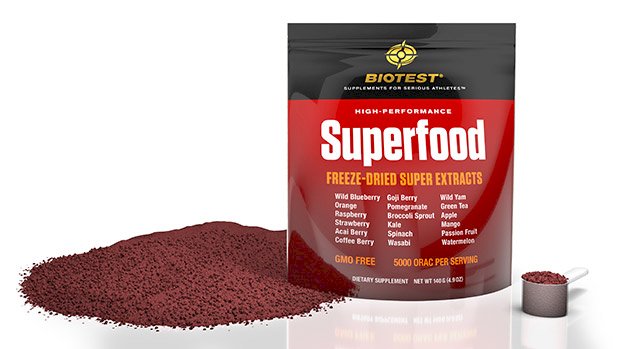
 Nutritional Virtue Signaling You know what chafes me? It’s the mutts who are always tweeting about how they don’t need supplements and that we should instead get all our nutrition from “whole foods.” They think all “processed” things are bad. I’m guessing they also wear underpants made from the natural, un-dyed wool shorn of virgin yaks and their houses are constructed of organic hemp panels glued together with woodpecker spit. They’re paragons of wholesome naturalness. Yeah right. The “whole foods only” cliché is nutritional virtue signaling at its worst, a sad attempt to prove that the people who say it are more nutritionally pious than their peers, but let me smack them across the face with a cold, line-caught herring of truth: While there’s no shortage of crappy supplements and god-awful processed foods, some supplements are great and some processed foods are actually better than whole foods. Biotest’s Superfood is a great example. Granted, it’s only minimally processed – an array of 18 strategically chosen freeze-dried fruits and vegetables – but the whole-food absolutists still paint it with a horsehair brush as a processed food. Fine. Stick with your labels, but I’m here to tell you that Superfood is one food that every human being should be taking to improve their health, longevity, and, to those for who it matters, athletic ability. What’s In Superfood? Take a look at the ingredients: Berries Wild Blueberry (1.5% anthocyanin) Orange (40% vitamin C) Raspberry (20% ellagic acid, 0.7% anthocyanins) Strawberry Acai Berry (1.5% total phenolic acids, 1% anthocyanins) Coffee Berry (50% total phenolic acids) Goji Berry Pomegranate (40% ellagic acid) Vegetables Broccoli Sprout (5000 ppm sulforaphane) Kale Spinach (700 ppm lutein) Wasabi (20% glucosinolates) Wild Yam (20% diosgenin) Green Tea (95% total polyphenols, 65% total catechins, 40% EGCG) Other Fruits Apple Mango Passion fruit Watermelon (1000 ppm lycopene) What’s So Great About Superfood? One of the reasons I’m such a big fan of Superfood is because I’m high on the science of polyphenols, which are plant-derived, bioactive compounds that can repress inflammation by inhibiting damage from free radicals and interacting with the immune system, thereby conveying such health benefits as lowered blood pressure, lessened endothelial dysfunction, reduced cholesterol, lowered risk of type 2 diabetes, lowered risk of cancer, and even improved recovery from training. You know how nearly every other article you read says you should eat, I don’t know, yams or some other vegetable or fruit for this or that benefit? Despite what most novice nutritionists think, it’s not because they contain riboflavin or some other vitamin or mineral. Don’t get me wrong, those vitamins and minerals are super important, but the real magic of vegetables and fruits are in the polyphenols they contain and Superfood is possibly the richest, most diverse, and most condensed source of polyphenols on the planet. There are two really broad classes of these polyphenols – flavonoids and nonflavonoids. The flavonoid group can further be broken down into six dietary groups: Flavones:Found in abundance in citrus fruits, celery, and parsley. Flavonols:Rich sources include broccoli, blueberries, and kale. Flavanones:These are found in citrus fruit and mint, among other places. Isoflavones:Commonly found in vegetables and fruits in general. Flavanols:Apples, grapes, teas, and cocoa are rich sources. Anthocyanidins:Found in abundance in blueberries, blackberries, and eggplant. The non-flavonoid group can also be broken down into three different classes: Stilbenes:The well-known compound resveratrol is a stilbene. It and its cousins are commonly found in red wines, apples, pears, plums, peaches, and other foods. Phenolic Acids:These are found in coffee, teas, cherries, blueberries, and a bunch of other fruits. Lignans:Rich sources include kale, broccoli, berries, and whole grains. All of these classes of polyphenols are present in Superfood. The Biological Effects of Polyphenols Polyphenols are most famous for being general antioxidants. Got a free radical spillage on aisle 3? Send in the polyphenols to mop things up. We measure how potent an antioxidant is by something called the ORAC scale, which is a standardized test used by the USDA to measure the Total Antioxidant Potency of foods and nutritional supplements. The term stands for “Oxygen Radical Absorbance Capacity,” and the measurement is expressed as ORAC units per 100 grams of a given compound. For instance, the USDA determined an “average serving of fruits and vegetables” has an ORAC rating of between 400 and 500. But all fruits and vegetables aren’t created equal. Some, like coffee berry, acai berry, and goji berry (all of which are in Superfood) are off the chart on the ORAC scale. So just what is the ORAC rating of just one serving (two scoops) of Superfood? 5,315. That means just one teaspoon of Superfood has the
Origin: This Stuff is Better Than Whole Food
This Stuff is Better Than Whole Food

Published
 All about sport xlsport.club