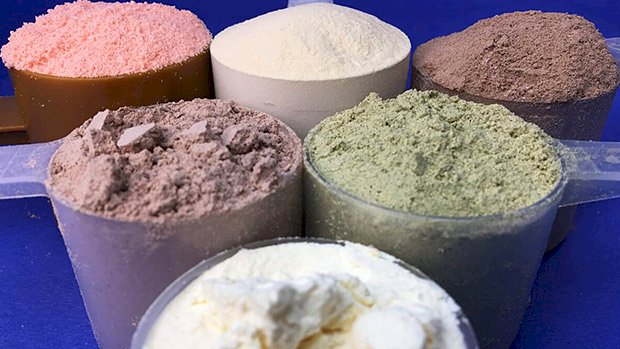
 When it comes to evaluating the quality of a protein, it all comes down to bioavailability and amino acid profile. Bioavailability simply refers to how much of a particular protein people absorb. To figure this out, scientists give test subjects carefully measured amounts of protein to ingest. The scientists then play cards until the test subjects’ poop hits the Tupperware container, at which point they measure how much nitrogen is in it. They then use the amount of nitrogen detected to calculate how much protein was in the feces and compare it to how much was ingested. The final number is referred to as the BV, or biological value. Is the BV of a Protein Worth a Shit (Literally)? The trouble is, the calculation wasn’t very good from the get go because it neglects some basic human dietary mechanics. First of all, if the protein is “fast acting,” like whey, some of it can be converted to glucose, particularly if the person is a keto madman and is chronically low on carbs (and ipso facto, glycogen). Secondly, bacteria in the gut tend to filch some of the protein. While BV is kind of outdated, protein manufacturers still use it occasionally to play the “our protein is better than yours” game. The current accepted protein evaluation standard, used by the FDA, is the PDCAAS, or Protein Digestibility Corrected Amino Acid Score, which combines biological value with a protein’s amino acid profile. Some proteins have practically everything a human needs to sustain tissue growth. We call them “complete” proteins. They have a nearly perfect blend of essential amino acids (those we can’t make ourselves) and branched chain amino acids (BCAAs), which are particularly important to muscle growth. Other proteins are missing certain amino acids or have lousy amounts of BCAAs, so much so that their amino acid profile wouldn’t support the growth of a banana slug. Unfortunately, the PDCAAS isn’t the best way to gauge a protein’s quality, either. To calculate it, the scientists again measure and calculate excreted nitrogen, but the PDCAAS, like the BV, doesn’t take into account any protein that was eaten up by the bacteria in the gut. It also requires that test subjects have an empty stomach, which exposes the test to all kinds of inaccuracies. In real life, you might quaff a protein shake, but there’d probably still be a slab of lasagna down there to slow down the protein’s absorption. Equally likely is that there might be some Wheat Chex floating around your stomach like inflatable pool toys that might bind up some of that protein because of their high-fiber content. That leaves a relatively new scale, the Digestible Indispensable Amino Acid Score, or DIAAS. It measures the nitrogen content of the ileum, or small intestine, instead of the nitrogen in the feces. This allows researchers to get a more realistic evaluation of a protein’s bioavailability because the measurement occurs before all those bacteria were able to munch up a lot of the ingested protein. It also takes into account the digestibility of each amino acid instead of the overall protein. It’s currently the best scoring system in use. Got all that? If not, it doesn’t matter so much. What’s important is to just choose the best protein source based on your needs and our current best guesses as to which support muscle and tissue growth the best. So, How do the Various Proteins Rate? Plant-derived proteins are probably the fastest growing sector in the protein business. At first glance, it makes sense they’d be doing fairly well. Anything associated with plants is instinctively thought to be healthier, but the thinking is a bit two-dimensional in that these plant-protein fans aren’t actually eating plants, but the amino acids that are left over when the water, fiber, chlorophyll, polyphenols, vitamins, and minerals – just about everything else in the plant – is extracted. My Hanes cotton underwear are probably closer in composition to an actual plant in nature than a pile of plant-derived protein. But there remains another truth, this one particularly inconvenient: the amino acid profile of plants is not the same as what you’d find in human muscle. Sure, most of the amino acids are there, but usually not in the amounts you’d need to support optimal growth of muscle. That being said, there are a couple of plant proteins that come close to being complete: pea protein and soy protein. The PDCAAS shows pea protein at an impressive 0.893, while soy proteins rates from 0.95 to 1.00, depending on how they were processed. That means that pea protein is damn close to the highly desirable 1.0 score that most animal proteins come close to, while soy protein is neck-and-neck with them. That’s a little misleading, though. The PDCAAS must grade on a curve or something so animal-derived proteins don’t get swelled heads because they actually truncate the numbers. If they didn’t do that, whey protein isolate would score 1.2 on the scale and milk protein a tad higher,
Origin: How to Evaluate Your Protein Powder
How to Evaluate Your Protein Powder

Published
 All about sport xlsport.club